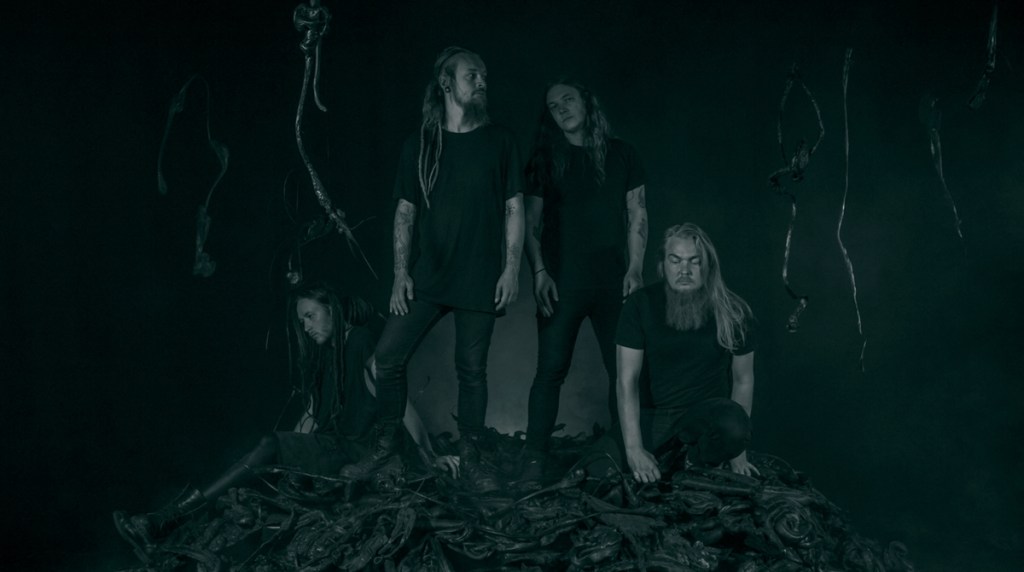
ENPHIN’s new album End Cut came out on Pelagic Records in June and it is a fine representation of the Finnish band’s cinematic, psychedelic doom. The single “Communion” flows with menacing synth washes and processional percussion giving a ritualistic cast especially in the sections where a voice echoes in distorted ripples like an announcer giving direction to an assembled crowd gathering to depart the earth to mysterious destinations in other parts of the universe. Something about music taps into the same, complex emotional and sonic realms as Orbit Service or Dead Voices On Air with that dark form of deeply atmospheric psychedelia that delves deep into the lost recesses of the psyche for inspiration. Listen to “Communion” on YouTube and follow ENPHIN at the links below.
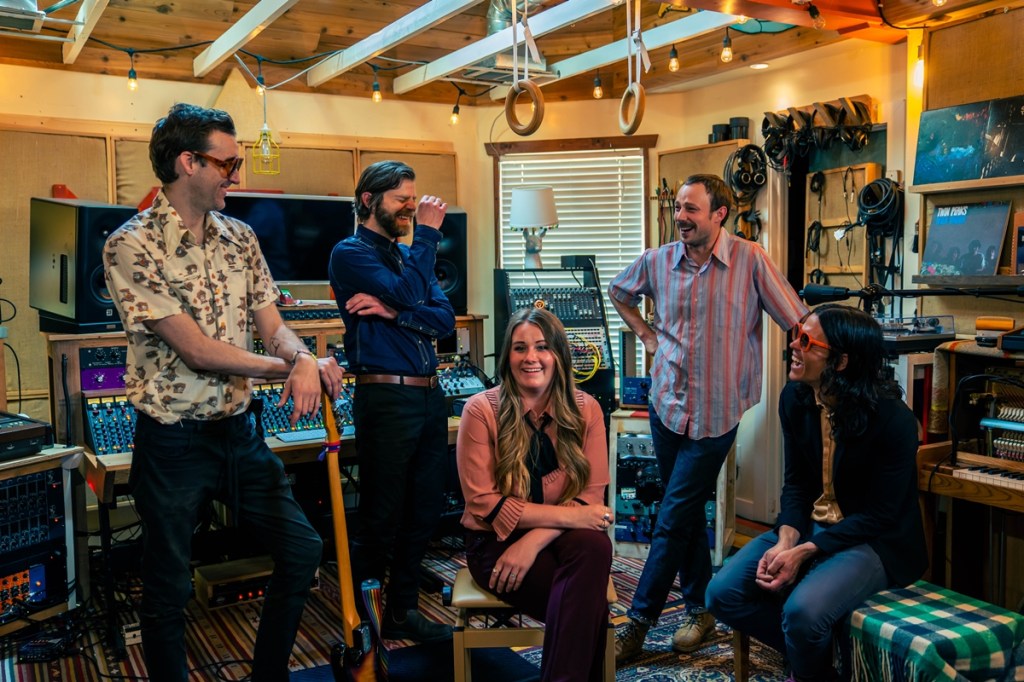
Courtney Cotter King and band, photo courtesy the artist
Courtney Cotter King’s the simple yet evocative piano figure that runs through her song “Conversation” is like a comforting and reassuring presence. That melody along with ethereal strings and soft percussion accents set a gentle and patient air around King’s soulful, vulnerable vocals sounding like she has given up on the ego drive to power through life’s challenging situations. In the lyrics it sounds like she feels like she has made some unspoken transgressions felt deeply, the kind that are difficult to discard and purge from your psyche. And guilt from these acts, however minor yet felt in the core of her being, seems to weigh her down with a kind of numbing effect as suggested in the line wanting her hand held “’til I can feel again.” Feel as in feel normal and whole and not burdened by the weight of conscience and seeking to move beyond it. Could be King is calling upon a higher power to aid in this time when it all feels so poignant and inescapable and oftentimes this is what people need to do because their rational mind and its habit of needing linear logic to think things through isn’t always enough because we depend on our own current faculties which may be inadequate to guide us through in the conventional modes of understanding we consciously possess. King articulates this process in the language of a more traditional faith but the emotional impact of the song and the core human experiences expressed transcend specificity of culture. Listen to “Conversation” on YouTube and follow King at the links provided.
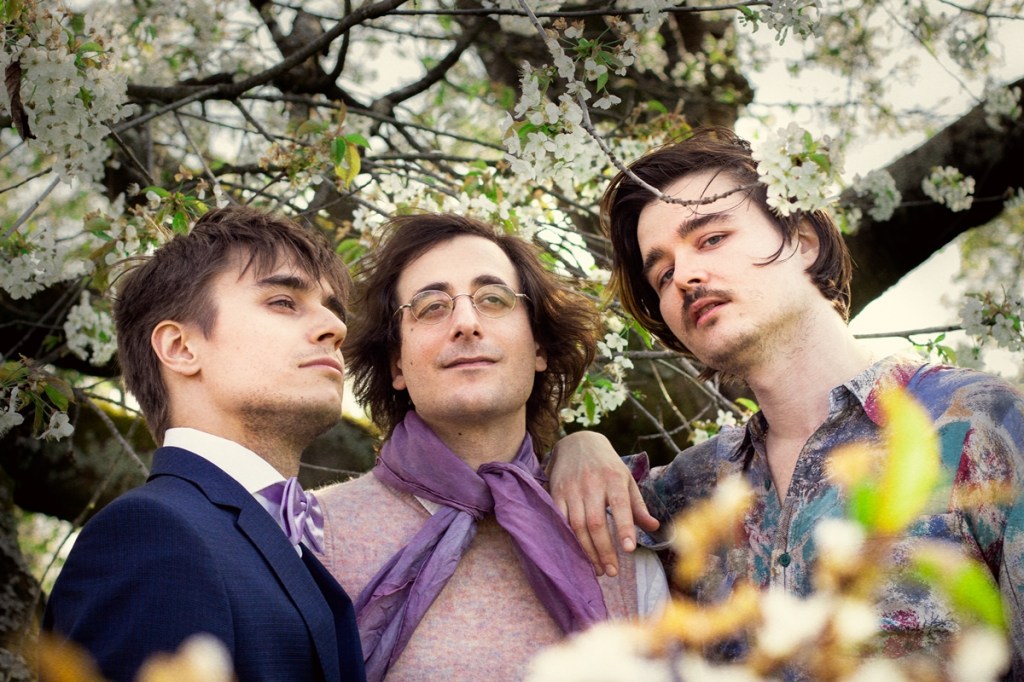
Cindy Gravity’s “48h Daydream” has a playfully surreal and eclectic aesthetic lends its psychedelic pop a decidedly different flavor from a lot of what passes for psych in the past several years. The spare guitar riff is somehow like an indie folk take on a salsa style, the bass line is subtle but also seems to provide the framework of the song as the minimal percussion is almost more textural than rhythmic and the keyboard work sounds like it came out of something Bernie Worrell might do for one of those New Wave bands with which he worked. The lyrics and the laid back vocal style are not the typical throught process for a song where someone will sing about love they have, wish they had, projected fantasy or the other usual pop and rock song tropes. There are elements of all of that but also a tacit admission of whimsy and self-awareness especially in the line “Everything lines up so well/in the little world I made up for her/She’s snooping around in my head/I may let her and just go to bed.” Maybe the song didn’t intend to shed a light on how daydreams can reinforce wishful thinking and behaviors related to such like texting someone you’re into and not hearing back within, yes, 48 hours, and thinking you did what you could to bring them into your life but there’s always consoling yourself with a daydream as an act of acceptance. The tone of the song is benevolent and self-indulgent rather than suggestive of anything nefarious and who doesn’t enjoy giving in to some harmless daydreaming know it’s just that? Listen to “48h Daydream” on YouTube and follow Berlin’s Cindy Gravity on Instagram.
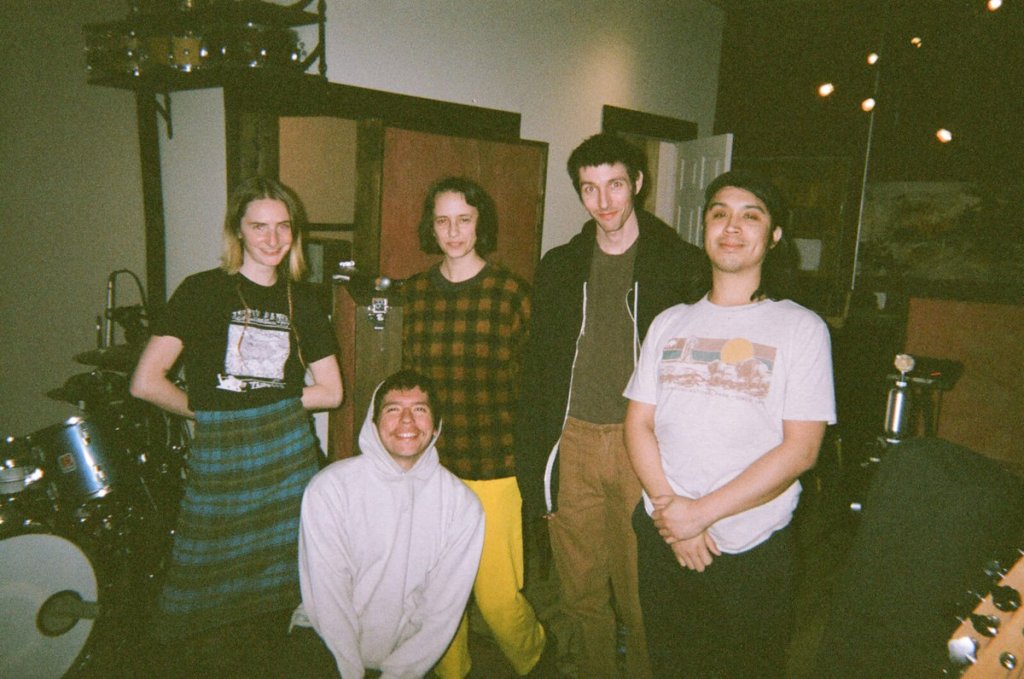
Foyer Red’s “Flipper” is a song so resonant with today it takes more than one listen to take in its full impact though one listen is enough to be drawn into its bizarro pop charm. The vocals start out sing-song-y and contemplative like something you’d expect out of a good bedroom pop song but in the background the array of sounds morphs into a mutated pastiche of vacillating dynamics and rhythms and Dada-esque use of texture, drone and jazz-like folk-inflected chord progressions. It frankly shouldn’t work except it is loosely reminiscent of “My Iron Lung” by Radiohead at times before detonating that impression gently mid-song. Elana Riordan sounds paradoxically present and disengaged from the tale of tangling with hunger and turning into a “ravenous creature left to roam the earth” and later “rusted into this warzone” alone with no bones while still growing and ready to “eat your bones.” This while swirling distorted sounds carry a somehow pleasantly disorienting unconventional melody. It’s rare for a band to combine what seems like a commentary on the burgeoning spirit of widespread nihilism that is one of the only sane reactions to the state of the world where the powers that be and authority figures are detached from the lives and interests of most people, even themselves, and you’re forced to get by as best you can and sometimes that means what Prince once sang about when the hell machine of modern late stage capitalism tries to bring you down, “Go crazy” and “punch a higher floor” by feeding that angst and frustration into unexpected and creative acts of resistance including writing a strange, colorful and creative art pop song like this. Listen to “Flipper” on YouTube and follow Foyer Red on Bandcamp.
After a fourteen year hiatus Ville Kiviniemi returns with his project The Mattoid and a new album Great Lovers. The lead single and title track arrives with an animated music video directed by Laura Rantala|. The repetitive acoustic guitar riff is the one constant that holds the song together as the piano/keyboard melody erupts, flows freely, traces the contour of rhythm and otherwise incandesces in dramatic fashion. Kiviniemi’s vocals recall those of Bill Callahan in being a little gruff yet perfect for expressing regret, confusion and vulnerability while projecting a rugged emotional strength. The song is both earthy and luminous, dreamlike yet vivid and tapping into the myths that inform our notions of what relationships are supposed to look like in the idea and contrasting that with the reality of lived experience. And central to these cognitive disconnects we have with each other is the idea posed in the song about how we can use the same types of visual organs operating according to the same scientific principles and interpret the world so differently. Which isn’t something to be taken too literally as it speaks much to perception as shaped by expectation. Beyond these heady existential examinations the song creates a mood and evokes the darkness we’re trying to illuminate the best we can with the limited and hopefully evolving tools at our disposal to connect with other people and the world around us without having to resort to pressing our own interpretations on others as an objective truth. Watch the video for “Great Lovers” on YouTube, follow The Mattoid on Spotify and order the physical release of Great Lovers on Rough Trade.
“Punish” begins as musical fever dream as depicted as analog in the music video for the song as singer Nikhil Rao of Bottled Up wakes up to a room with faceless nurses administering to him a mysterious treatment. The surreal sound is reminiscent of an odd mixture of the rhythm of Joy Division’s “Colony” and a particularly funky Talking Heads song. Or like a sanguine Parquet Courts. The song gives voice to the anxieties of a dysfunctional and even abuse relationship that began as they often do with passion and a willingness from one partner to overlook all the warning signs. The clinical setting of the video is perfect for a situation in which one is dissected and being under the enforced mercy of someone you should be able to trust but who violates that trust constantly until it’s too late. Mid-song the synth work and syncopation of the music seems like a nod to Blondie’s “Rapture” before dropping back into the song’s irresistible groove straight to the conclusion where in the music video the faceless nurses high five each other for nefarious work well done. Watch the video on YouTube and follow Bottled Up at the links below. The group’s latest album, the colorful and aptly titled Grand Bizarre released 5/27 on Misra,
If Bonnie Tyler had a current career as a writer and director of science fiction movies you’d hope she’d tap the likes of Child Seat to do music for her various films. The “Burning” single and its music video festooned with imagery of interstellar objects while Madeleine Matthews dances and sings in the foreground with wind sweeping through her feathered hair as Josiah Mazzaschi unleashes fiery and tasty guitar licks with an all but stoic calm. It’s a personal dynamic not unlike that of Sparks with Russel Mael delivering the physical melodrama in the performance while his brother Ron in his own quasi-stoic way helps to orchestrate the music that gives the vocals their context. Toward the end of the video Jeff Schroeder comes into view with a guitar solo worthy of Joe Satriani or Steve Stevens circa 1986 and seals the aesthetic. But the energy of the song doesn’t feel throwback, it feels very present and visceral. Watch the video for “Burning” on YouTube, follow Child Seat on Instagram and look out for Child Seat’s debut album out in Fall 2022.
Giant Waste of Man is plugged into the existential despair of the world today and in 2021 and 2022 spinning that into thoughtful and gentle songs about sorting through the deluge of feelings and panning for nuggets of truth in the floodstream of experiences and information that are definitely trending bleak and perilous. In the video for “Summer, after” we see a landscape in near sepia tones that depict perhaps the Los Angeles skyline in the background and immediately taking you back, if you remember the imagery or if you were there, when the Bay Area looked like Blade Runner 2049. The lonely piano figure, the ominous drones, the delicate brush of acoustic guitar riffs and hushed vocals in warm harmony make this song seemingly about all the desperate and dramatic gestures, all the bravado, all the surefire plans of rescue and renewal, the talk of returning to normal is just the conditioning of culture flexing in your heart all while you know it amounts to zero and that we are living in a time when bolder and quicker action are called for not fueled by the corrosive ideas and ideologies that have guided civilization for hundreds of years down a path of destruction and fascism. But we were never prepared for this, we were told all kinds of lies about how things are, how obeying this rule and that rule and working hard and all that nonsense about meritocracy and institutions and the rule of law preserving a just way of life—the way it has played out has hollowed out our lives and our civilization while we do pretty much nothing in the face of authoritarian rule barreling down in reaction to a weak “moderate” government serving almost entirely narrow moneyed interests and warping all collective effort in service to a profit that won’t matter if billions die in climate/ecological disaster or nuclear war. This song humanizes this backdrop of the thinking of anyone with a real awareness of what’s going on in the world and has any sense of things. When you hear the lyrics at the end of the song “Never was a man OK with a lie/When the truth was right in front of me” it just makes it simple to dispense with the chaff compromised public discourse and take life and the world on its own terms which may be one of the only paths through the rough times ahead. Musically it might be reminiscent for some of Broken Social Scene minus the dense electronic component but tonally of Low in the twenty-first century with its combination of vulnerability and emotional truth. Watch the video of “Summer, after” on YouTube and connect with Giant Waste of Man at the links below. The group’s new LP Biographer is due out August 26 on Chain Letter Collective.
Pine Barons hail from the pitch pines of southern New Jersey, an area that includes the infamous Pine Barrens where The New Jersey Devil is said to frolic in the area of The Blue Hole and the ghost of Captain Kidd among other spirits roam. So the decision to do an entire tribute album to the influential Japanese psych band Fishmans seems like an interesting and odd choice for I LOVE FISH due out July 8 including an ambitious cover of the entire 1996 album Long Season which is five tracks comprising a single song akin to Jethro Tull’s Thick as a Brick but driven by hypnotic piano and the late Shinji Sato’s idiosyncratic and compelling vocals. The lead single from the album is the introspective and moody “ナイトクルージング (Night Cruising)” and its shimmery tonal dynamic. The video features indeed a night drive but one that seems to simultaneously take place in the water and on a road with the color palette being one of distorted hues emphasized like something from a clumsy late 90s filmed to VHS production that is perfect for the song and its woozy pace swirls of rhythm and dub-like iterations of melody. At times reminiscent of something Candy Claws/Sound of Ceres might do but also a fascinating recreation of the truly unique original that one has to assume influenced indirectly if not directly the likes of Black Moth Super Rainbow and The Stargazer Lilies—gently trippy and mysterious, qualities we need more of in music these days. Watch the video for “Night Cruising” on YouTube and follow Pine Barons at the links provided.
There’s something about Bad Flamingo’s “Rolling Around In It” that sounds like something you’d hear in the opening sequence of an animated film version of a Daniel Clowes graphic novel. The eccentric elements of sound from the use of instrumentation in the guitar and bass and almost Bossa Nova rhythms in minimalist arrangements coming together in peak moments and quickly dissolving into the background to accent and frame a series of images in the lyrics that seem to follow a symbolic dream logic. Words about how a cold glass of water will turn someone into mud, the chorus of “a seven a seven a cherry a cherry a cherry a pit” suggesting the outcome on an unusual slot machine, a lighting rod that can actually be surprised it got struck. Is that really what we’re hearing? What does it all mean? That everyone and everything has unexpected vulnerabilities and outcomes and best to take a Zen approach to this built in element of chaos in a world of complex dynamic intersections? Who can say but this song that comes off like one of Suzanne Vega’s more idiosyncratic and meditative pop compositions but even weirder has an undeniable hook like much of the output of Bad Flamingo. Listen to “Rolling Around In It” on Spotify and follow Bad Flamingo at the links below.






You must be logged in to post a comment.