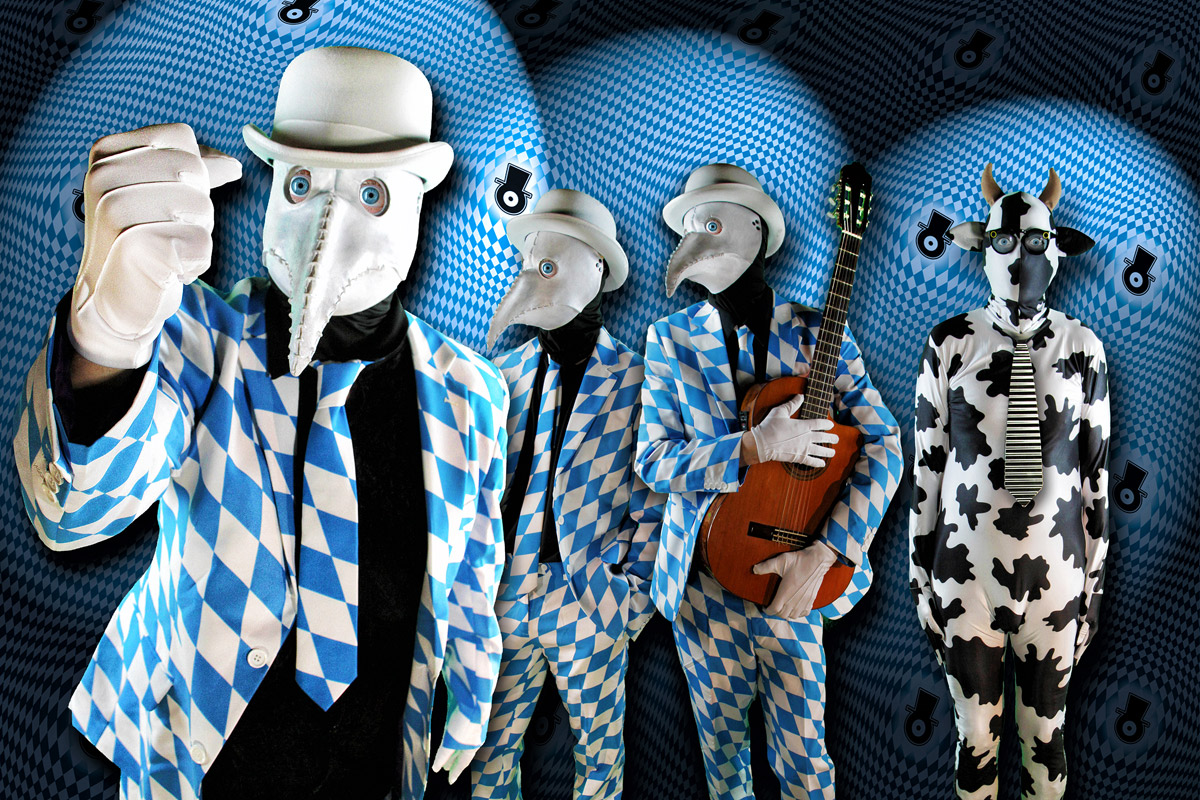
Sharone & The Wind, photo by Nic Smith Photography
On Friday, April 13, Denver based hard rock band Sharone & The Wind releases its sophomore album, Enchiridion of Nightmares. That the record is coming out on Friday the Thirteenth is fitting given the horror themes as metaphors for life’s horrors contained within. The album is all but formally structured as a kind of horror anthology, literary or cinematic. The project fronted by Sharone has come a long way from a rock band borne out of Sharone’s 2016 solo EP to the current lineup which has turned a promising early version of the band to a confident outfit with theatrical live shows that might remind some of a much smaller scale sort of thing Alice Cooper does with his own concerts.
The band’s 2017 debut album, Storm, sounded like a songwriter speaking her truth for the first time in a way that got her out of the solo, sort of singer-songwriter presentation of the music. Though, to be fair, Sharone’s 2016 solo EP and performances of those songs struck a chord with people that got to see those shows at Seventh Circle Music Collective and other places Sharone found to perform. And the incarnations of the band that existed during the writing, recording and performing of the songs from that album helped establish Sharone as a performer who not only sang but played keyboards and guitar until she was able to recruit musicians to play those instruments toward the end of that phase of the band’s life.
By early 2017, Sharone & The Wind, as it had been, was no more and the suddeness of that loss and the way in which bands often dissolve left Sharone feeling angry, sad and fearful of the future of her ability to keep doing music. But the split ended up forcing Sharone to move forward as an artist and finding a new lineup of people who believed in her vision. The result was a darker, more confident sound with Sharone’s vocal range expanding in pitch and dynamism, which manifested strikingly on the new record. It also meant live shows that more closely reflected what Sharone had been imagining for her band from early on.
“As soon as the lineup change happened I felt more creatively free and open to express myself artistically,” says Sharone. “I’ve always had these ridiculous ideas like bringing a lifesize coffin on stage and have demons dance on stage with us like we did at the Halloween show [in 2017]. I was never in a situation before to bring those ideas to life, I always felt judged. I just feel very comfortable with the current lineup and any crazy idea that comes to mind they’re all about it.”
While the band was coming together, Sharone kept writing music and the emotions haunting her paralled her interest in old horror movies and horror fiction. “Basically all the emotions people get from reading horror books or watch a horror movie or go to a haunted house,” says Sharone. “Because I was going through those feelings in my life and because I was interested in horror at the time it fit very well together [because] I was as afraid of what was going to happen in the future as I was afraid of what was going to happen to the little kid in the house in a story.
The writing and recording of the record with a new band was “like one, long therapy session” that Sharone desperately needed. It also lead to a cooperative transformation of the band to have a genuine image to present to fans to stir the imagination and for Sharone it freed her from her early inhibitions as a songwriter of promise to one comfortable in her own body and abilities.
“[Writing and recording Enchiridion of Nightmares] let me step from this very timid, vulnerable place with Storm and come to the other end of the spectrum with all these angry feelings and horror themes,” says Sharone. “Personally having done these two extremes I’m figuring out where I stand with what The Wind is and the direction I want to go from here. The last few weeks I’ve been writing new stuff that’s very open, raw and wearing no disguise of any theme, just honest.”
In March the band released a video, produced by photography, Nic Smith, for the song “Demons” in which each personal demon portrayed as taunting the various band members, “represent mental illness and how people express them.”
“I think it’s a song a lot of people can relate to in a lot of different ways because we all have internal demons with which we struggle,” says Sharone.
For the show at The Marquis the band will debut live the songs “Cursed,” “Exorcist” and “Death of a Clown” and you are invited in to share the catharsis the music brings to Sharone & The Wind.
Most people have never heard of The Residents. The band has had no commercial hits and arguably its most famous, iconic song is a cover of “Istanbul (Not Constantinople),” a 1953 novelty hit by Jimmy Kennedy and Nat Simon. Founded in 1969, from the early days, The Residents have performed in various costumes—most notably wearing giant eyeball masks with a top hat. The speculation on the identity of the members of the band have included people “knowing” Frank Zappa, Les Claypool and Gerald Casale and Mark Mothersbaugh of Devo are members of the band. There is a rumor that Homer Flynn, the band’s longtime art director, and designer of most of the album covers, is in the band as well. All of which has been denied or ignored by representatives of The Residents.
Whatever the identity of the band members or its relative obscurity, its deconstructing and reconstructing of American popular music has given the world some of its most unusual, fascinating and brillint music of the modern era. For example, The Residents have done albums dedicated to American composers like John Philip Sousa and George Gershwin. The Residents have reworked songs by Elvis and James Brown and, as on its 1978 classic Duck Stab, traditional songs like “Old MacDonald Had a Farm” as a warped and spooky song called “Farmers” which weaves in “Mary Had a Little Lamb” and “Three Blind Mice.” By following their creative instincts, The Residents, whether as interpreters of song, a long tradition in American music, or in crafting original songs, have established themselves as one of the most original and unusual bands on the basis of their recordings alone.
Live, The Residents always incorporate multimedia elements from costumes to video projections and stage sets if the tour, such as the disastrously expensive 1983 The Mole Show tour whose production cost and execution nearly did in any other touring for the band.
“They lost so much money and it was so difficult they said they would never tour again,” says Homer Flynn. “They definintely ranged it back, otherwise they wouldn’t have lived this long. That idea, though, has always been part of their planning for a show.”
The most elaborate shows Flynn says require a more stable setting with a production company coming in to help with the execution in a setting that wouldn’t really work for a touring show. But even the more scaled back presentation is striking and on the highly theatrical 2002 tour for Demons Dance Alone and even the more modest set of 2016’s Shadowland tour it was obvious that you were witnessing a band whose storytelling and persona mythmaking involves a rich creative exercise that most other bands don’t undertake.
The Residents have several high profile fans including their friend Penn Jillette, Simpsons creator Matt Groening and the aforementioned Les Claypool whose band Primus has covered Residents songs including “Sinister Exaggerator” on the 1992 Miscellaneous Debris EP. Even though such deeply imaginative music and shows rarely result in mainstream success, The Residents remain a much respected group to those who have had a chance to delve into any of their albums and seen a show. In an age when there seems little mystery left in art and music, The Residents have retained the mystique and not just because the identities of the members of the band remains a public mystery.
No one writes albums quite like 1988’s lurid yet mystical God in Three Persons or any of The Residents’ several story style albums since the 80s. In the mid-90s few adopted new technology and utilized it as fully as The Residents did for the 1994 CD-ROM edition of 1990’s Freak Show. Podcasts are a common thing of the past several years but The Residents released a noir story album as a podcast in 2006 with The River of Crime. In 2015 a documentary film about The Residents called Theory of Obscurity told the band’s story using previously inaccessible archival footage and interviews with Flynn and other partners in The Cryptic Corporations as well as many of the band’s fans, famous and otherwise.
Currently the band is in the middle of its In Between Dreams Tour making its live debut in Denver at The Bluebird Theater on Saturday, April 14. We had the chance to talk with Flynn about the band, its inspirations in some of America’s most flamboyantly theatrical performers, how The Cryptic Corporation was essentially saved by fans of the band and Flynn’s early experiences with finding music in suburban Shreveport, Louisiana, where the band started before relocating to the San Francisco Bay Area.
Queen City Sounds and Art: Did you have access to non-mainstream music or art when you were growing up?
Homer Flynn: Basically, no. I grew up in pretty straight, white, middle class suburbs. I was always a music fan and I was always seeking out new music. At that time radio was really the best exposure that you had. So I had a handful of stations that I would listen to. Back then there were certain stations you could listen to late at night. It has something to do with atmospheric conditions after a lot of other stations signed off. I would listen to stations like WNRE in New Orleans that I listened to regularly. Also WLOS in Chicago and XERF, which was Wolfman Jack, from Mexico. For me that was the only way I could get exposed to new stuff. There was a very mainstream culture at that time.
Some people take for granted that didn’t exist back then like any viable alternative kind of radio station. Although, until the early 90s, late at night some stations relaxed their control over what DJs played so you could hear a very different kind of programming than the normal faire.
Exactly. When I first came to San Francisco it was wide open. It was just as FM was starting to take off. The reality is that the corporate powers that be hadn’t figured out how to make a lot of money at it yet. So you would have a DJ that would be on for four hours playing whatever seemed cool. In a lot of ways FM at that time was kind of like how the Internet is now—more open with a lot more stuff available.
What prompted you to make the move
There were two things going on for me. One, those were George Wallace times back in the South—the original Trump. Most of the people I knew at that point had escaped or left. For me, I’d always said that I was ready to get out of the South. The main thing upon leaving is that you have to have a landing spot. I had a good landing spot in the Bay Area. If I’d had a landing spot in New York I could easily have gone there.
The Residents have deconstructed and reconstructed Western popular music for much of its career. Overtly with stuff like The King & Eye from 1989, [1984’s George and James and “Farmers,” with traditional songs. Why was that important to the band?
The Residents have always had a great love for music. All kinds of music. Even though they’ve been mainly marketed as a rock act, their taste has always been much broader than that. Things like the American Composers series allowed them to stretch out in ways that weren’t necessarily expected.
Many of The Residents’ albums from the 80s going forward seem like fascinating and imaginative works of fiction presented in a multimedia format rather than through prose.
I think that’s true. I think for The Residents they always felt like there were stories inherent in the lyrics. The lyrics would be sung by characters The Residents had in mind and those characters would have a whole story. As they matured, they started developing those stories more and more. In a lot of ways that became more full with their CD-ROM stuff in the mid-90s which offered so much in the way of presenting that storytelling.
One person that influenced them is Sun Ra. I got to see toward the end of his life and found out about him around the same time I learned about The Residents. Did you get to see Sun Ra perform?
I was a huge Sun Ra fan and the first I saw Sun Ra was at the Berkeley Jazz Festival sometime in the early 70s. This was at a small amphitheatre in Berkeley and he blew that place off the planet. Everyone else seemed like they were totally straight and going out there playing their jazz stuff and improvising or whatever. All of a sudden Sun Ra came out and it was like the whole stage levitated. I saw him several more times. I’m a huge Sun Ra fan but I can’t say I’m a huge fan of all the recordings because some of these recordings sound like, “We just did a gig, we’re all high so we’re going to go back to the hotel room and play some more and turn on a cassette recorder in the bathroom.” While a lot of that music may have been great if you were there with them it doesn’t translate well to the recordings.
Definitely. I remember seeing him on an episode of Sunday Night with David Sanborn hosting that a friend had recorded and shared trying to convince me to go to the show in Chicago and thinking, “Who is this guy? He looks like a wizard throwing glitter!”
Right, and wearing a hubcap for a belt buckle.
You have to love that. Why do you think he had such an impact on The Residents?
One of the things that had such an impact on The Residents, and I could say exactly the same thing about Liberace, not many people would compare Liberace and Sun Ra but the cool thing is that they’re both incredible showmen at a time when so many people felt like, “We’re a band and we’re going to go up on stage with just our blue jeans and t-shirt on.” And they’re indistinguishable from the audience. The Residents felt that if you’re a performer you should look like a performer. Nobody ever mistook Sun Ra for a guy that came up out of the audience and got behind the keyboards.
For the Demons Dance Alone tour in 2002 it seemed like there was a lot of production for that show and then for the Shadowlands tour was a smaller scale production. Now it’s a four member band rather than that three-member?
They’ve kind of reconstituted the current version as a classic four-piece: guitars, drums, keyboard and vocals. It’s almost like a modern retro. It’s all very electronic, as you might expect, the drummer who is an excellent drummer is playing electronic drums. He looks like he’s playing drums but they’re really MIDI triggers and can make any sound in the world.
On the Shadowlands tour in 2016 there was an object on stage like a sculpture or sphere-topped pedestal on which to project images. Has 3D mapping become part of the show?
No, I don’t think they’ve actually done any 3D mapping. They’ve done several projections the last couple of [tours]. There’s nothing particularly unusual about the projections. Probably the most interesting thing is that for the “Talking Light” show they used a small, handheld projector and they had three circular screens on stage. So the singer would kind of go to one of those circular screens to another projecting mainly short videos of stories told by the characters. Various characters told ghost stories on those three screens. What was nice about the three screens is that the light people love them because special light things could happen when there’s not a projection so it becomes another nice visual exclamation point on the stage.
The Ghost of Hope was from 2017. Are most of the albums put out through Cryptic Corporation these days?
I had a partner, a guy named Hardy Fox, that I worked with for about forty years. He and I kind of formed the Cryptic Corporation together with a couple of other guys. Hardy decided he’d had enough and wanted to retire a couple of years ago. So ultimately he wanted me to buy him out but I couldn’t afford to do that so I had to look for new partners. I found two new partners, one was MVD, Music Video Distributors. We worked them in the 80s, they sold lots of Residents VHS cassettes in the 80s, DVDs in the 90s and CDs and LPs more recently. I talked to them two or three years ago saying I was having these problems with figuring out how to do it and they said they might be interested in doing it. They said they had another partner that might be interested, which ended up being Cherry Red Records in London. Each of them bought half of Hardy’s half of The Cryptic Corporation. I still own 50%. Most of the product that is coming out at this point is being created by Cherry Red and being marketed and distributed mainly by MVD in the United States and Cherry Red in Europe. The real stroke of luck in the whole thing is that there’s a guy there named Richard Anderson who’s a project manager at Cherry Red. Turns out Richard is a huge Residents fan so it’s been a real pleasure working with him on the new material and all the back catalog that’s coming out. Richard brings a huge amount of care to the product so things are going really well at this point.
Dead Meadow at Teotihuacan, photo by Jessica Senteno
Dead Meadow is currently touring in support of its new record, The Nothing They Need. When the band began in 1998, its members had come up through the vibrant punk and hardcore scene in Washington, DC and had even played in bands in that vein but by the late 90s, playing that kind of music had lost some of its appeal and the initial trio of guitarist/singer Jason Simon, bassist Steve Kille and former drummer Mark Laughlin (Juan Londono now drums in the band) were looking to sounds that had long gone out of style but which held a newfound fascination for the musicians.
“We got excited watching old Jimi Hendrix videos all the time,” says Simon. “We lived with Corey [Shane] who played on Feathers and the three of us would sit around watching Black Sabbath videos, Led Zeppelin videos and Hendrix videos and it was like, ‘Let’s get back and do something like this.’ That’s why we picked up our instruments in the first place. When I was thirteen I wanted to play like Jimmy Page and sound like Black Sabbath. It was just trying to do something different. Actually, it’s funny a lot of those [DC post-hardcore] bands helped us out and in particular Fugazi helped us out a lot just because they were as excited as anyone to hear something different coming out of DC. Now there’s a psych rock scene but back then we were playing a punk rock show or a metal show and either way we didn’t quite fit in. We’ve seen a scene grow up since then that has fit Dead Meadow a little better.”
Dead Meadow’s 2000 self-titled debut, in fact, was released on Fugazi bassist Joe Lally’s Tolotta Records imprint as did the sophomore record, 2001’s Howls from the Hills. But in those early days, there wasn’t a new psychedelic rock scene, per se. Dead Meadow toured and found like-minded musicians who were embracing music from the 60s and 70s on the West Coast like The Brian Jonestown Massacre and The Warlocks. After signing with Matador before the release of 2003’s Shivering King And Others the group played shows with labelmates Bardo Pond. But the mixture of psychedelia and heavy music around the turn of the century was largely the purview of “stoner rock.” While Dead Meadow had similar roots in 60s psychedelic rock and Black Sabbath, it was never really a metal band.
“In the beginning we really enjoyed it because we wanted to do the punkest thing possible,” comments Simon. “Which was like, ‘Okay, cool, we’re opening for Fugazi, man? We’re going to do a ten minute guitar solo.’ And the punk kids were like ‘What is this?’ Which I thought was awesome. Some of the punk kids weren’t into it. Is this metal? It was something against the grain at the time which was something we all dug doing.”
Twenty years since Dead Meadow’s inception, the music world has caught up a bit with its fuzzy, hypnotic, heavy, bluesy, psychedelic rock songs. Yet the band’s specific aesthetic and sensibility transcends the specific wizards, demons and occult tropes of stoner rock and psychedelic doom. The song and album titles, the artwork and the textures and structures of the songs suggest a familiarity with the language of mythology and mysticism as well as that of the literature of the weird and a recreation of the feelings flowing forth from such readings.
“I like a lot of different symbolism and drawing from different roads of symbolism and making it your own,” says Simon. “I’ve always been a fan of the weird tale whether it’s Clark Ashton Smith or H.P. Lovecraft and stuff like that using all this vivid, far out imagery. Or Hindu mythology and its painting these crazy pictures the mind is almost stretching to even envision. In our move away from what was going on in the late 90s we wanted to do something more far out in that sense that expands the imagination.”
Specific references can be found sprinkled throughout Dead Meadow’s discography from Lord Dunsany in “Beyond the Fields We Know,” obvious nods to Lovecraft and perhaps an oblique hint of the occult novels of J.K. Huysmans. Blending all of that with natural imagery has given Dead Meadow both a mysterious and intimate quality.
“I like to stick things in there for the heads to pick up on,” says Simon regarding the literary allusions. “I find [nature] more inspiring. I guess that’s the symbolic nature of how the natural world relates to the inner world as well. I don’t do that intentionally, it just feels right or just cool.”
The Nothing They Need seems a step away from the evoking the imagery of weird literature while remaining songs about personal struggles, existential musings and a non-topical social commentary. The title of the album stems from a double meaning in its origins and conceptualization.
“It’s something Steve orignally said,” says Simon. “He also works in quality control in TV shows for digital content. He’s great at catching audio issues and so forth. He was talking about how there’s an insane stream of content coming out these days. Meaningless show after show. What is all this stuff? Who’s watching it? He said, ‘It’s giving people the nothing they need.’ So it’s a commentary on our times in that way. I also found it true in the opposite sense in that what people need is a step away from this crazy amount of distraction. We’re being bombarded by information all the time. Anyhthing to get your head out of it and get your piece of stillness, the grand nothing.”
“With these times and how crazy things are, I don’t think we’d try to write something overtly political but I feel like how those things can’t help but slip in,” continues Simon. “Not just how crazy it is but how to live and deal with how crazy it is and still be a creative, productive individual and feel some sense of hope.”
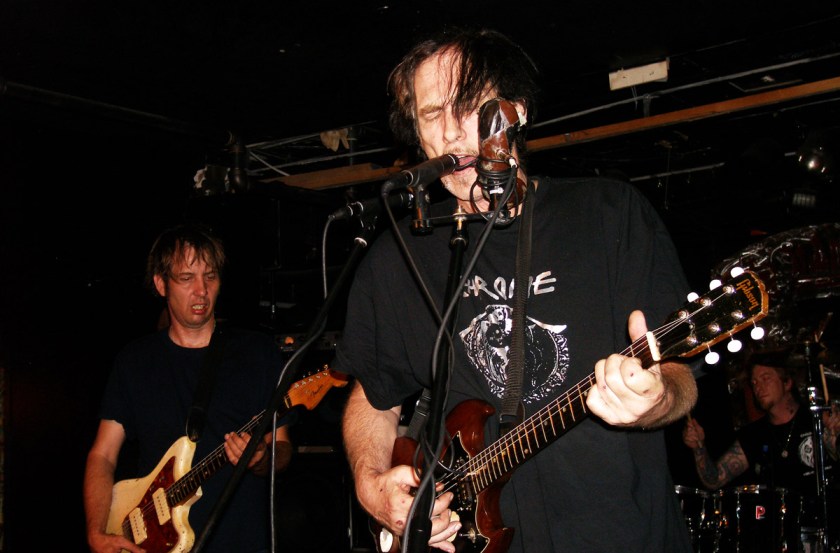
In the annals of weirdo, psychedelic, noisy rock Chrome (performing tonight, March 31 at Larimer Lounge) stands out as one of the true originals. Innovators of an art/acid damaged sound that fully blended synthesizers and rock music, Chrome is often considered one of the progenitors of industrial music. Butthole Surfers freely admit the influence, so did Stereolab. One has to assume Arab On Radar drew on Chrome’s proto-sampling, recontextualizing, deconstructionist impulses as well. When Chrome released its debut album The Visitation in 1976 it must have seemed as alien as its closest musical cousin in the early solo albums of Brian Eno. Ned Raggett Allmusic Guide described it as “Brian Eno meets Santana.” The latter probably because of the fluttery, bluesy leads that are the hallmark of part of the guitar sound on the record alongside the fuzzy, spidery melodies. The band might have continued to develop along that path if bassist Gary Spain hadn’t been playing violin in a band prior to The Visitation’s release with future Chrome guitarist Helios Creed, mentioning he was in a band called Chrome.
“I asked if I could hear it when it was done,” says Creed. “He gave me a copy and I liked the record, The Visitation, but I guess the record wasn’t selling at all and everybody quit. Then I auditioned and me and Damon [Edge] got along really well. It ended up just being me and him after a while. I played the bass on the first three records [after I was in Chrome]. When I heard that [first] record I [told them I] felt like they needed me and I was right.”
Creed had grown up in the 50s, 60s and 70s listening to, among other bands, Black Sabbath, Iron Butterfly, The Doors and Blue Cheer. “I went to go see Black Sabbath on acid and I sort of felt like I knew what I wanted to do, in a way,” says Creed. To Chrome, Creed brought another dimension to the band’s spirit of experimentation and a guitar sound that was as energetic as it was corrosive and both jagged and serpentine.
Starting with Alien Soundtracks, originally titled Ultra Soundtrack when it was a soundtrack project for what might be called an avant-garde strip show in San Francisco. But the music was considered too weird even for an endeavor like that in a city where strange art had long been embraced. From the opening track, “Chromosome Damage” to the last, “Magnetic Dwarf Reptile,” it is obvious that Chrome had absorbed obvious influences like Blue Cheer, Black Sabbath, Hendrix, Stooges and Hawkwind and allowed that to mutate and stew into something that sounded like what cyberpunk authors like William Gibson, John Shirley and Bruce Sterling were trying to capture when they took the spirit of J.G. Ballard’s visionary, dystopian science fiction and its influence on punk in brilliant new directions. Chrome albums have consistently seemed like science fiction novels and movies no one has yet written or made. “Yeah, we got sci-fi ideas and integrated it with the feel of the music,” says Creed. “Or a sterile, dehumanizing, robotic society. We had a lot of different kinds of inspirations. That movie Carrie? Alien, the first one. Blade Runner and A Clockwork Orange–the feel of those movies really inspired us.”
Although based in the Bay Area, Chrome didn’t exactly play live shows in a city where the avant-garde or any kind of strange, eccentric art seemed to find a home. The band had garnered critical acclaim abroad with Alien Soundtracks and its follow-up, 1979’s Half Machine Lip Moves but it wasn’t until 1981 that the group performed live for the first time.
“We didn’t play until Blood on the Moon came out,” says Creed. “That was our first show and we played in Italy at a music festival in Bologna. We played all new songs but they dug it. We played the whole Blood on the Moon album. There’s a live record of that show somewhere.”
The lineup with both Edge and Creed produced some of the most interesting and unusual music of the era including 1980’s more synth-infused Red Exposure, the aforementioned 1981 album Blood on the Moon and 1982’s 3rd From the Sun. With more electronic elements including drum machines, those records, dark and clearly taking cues from no one beyond the dictates of active and restless imaginations, Chrome’s sinister psychedelia was not destined to fit in with the fake positivism of the 1980s mainstream culture. Thank goodness. However, the Edge/Creed era of Chrome ended by the mid-80s and Edge moved to Paris with his wife and collaborator, Fabienne Shine. Edge released albums as Chrome into the 90s before he died of heart failure in 1995. Around that time he had reconnected with Creed with notions of doing Chrome together again.
After Chrome, Creed continued as a solo artist and collaborator with current synth and guitar player Tommy Grenas (from bands Farflung and Pressurehead) who connected Creed with former Hawkwind member Nik Turner with whom Creed and Grenas worked on a 1993 re-recording of Turner’s 1978 solo album Sphynx and the 1994 Nik Turner record Prophets of Time. Creed and Turner now have a band with Jay Tausig called Chromium Hawk Machine that put out an album called Annunaki in 2017 on Massimo Gasperini’s Black Widow Records imprint. “Massimo is into the whole Zecharia Sitchin theory about Nibiru so we made a record about it.”
Chrome circa 2008, photo by Tom Murphy
Rumor had it that Grenas was able to get a hold of Edge’s original synth rig after the musician passed. Turns out the rumors were true.
“I met Damon before I met Helios,” reveals Grenas. “When Damon passed away I had the opportunity to buy his stuff when [his sister] Sharon put it up for sale and I bought it before anyone else did. I bought Damon’s [Moog] Liberation and the [Electro-Harmonix] Micro Synth and something else. I used it on the first tour but a lot of that stuff is too fragile to take on the road.”
Grenas used some of the older gear for the Chrome records that have come out since the turn of the century. Right now the band is touring in support of 2014’s Feel It Like a Scientist and 2017’s Techromancy. While the methods and means of making sound have changed, Chrome still seems off the frequency of mundane normalcy with songs about an ominous, dystopian future society.
“It seems like we’re on the brink of going right into that with machines and robots taking over,” says Creed. “So maybe they’ll just kill us, I guess. We’re going to be obsolete. ‘You must go to this room here and wait for destruction.’ We also have songs of hope.”
In spite of the overt sound of the band and the subject matter of the lyrics, Creed’s sharp and playful sense of humor is infused into the music as well and so is his willingness to explore the dark underbelly of American culture that is often simply dismissed as folklore. Although Creed grew up in Long Beach, California and lived in the San Francisco Bay area for much of his life, he did spend some years in the American Midwest where lurid stories of local figures and events are not in short supply.
“I was living in Manhattan, Kansas, twenty miles from Stull,” says Creed. “Supposedly it’s one of the gateways to Hell. That’s the scuttlebutt. Supposedly the Pope won’t fly over it when he comes to America. Every Halloween apparently the Goth people and witchy kind of people show up there thinking they’re talking to the dark ones. But really all it is is just a burned out church. [So the story goes,] a bunch of rednecks who hated blacks, and really everyone, put people in that church and burned it down and opened a vortex to hell. You know how the old west was. Where I was living in Kansas they used to cut the heads of slaves if they didn’t like them. All this stuff never gets written about but I know the history of Kansas is very dark. It ain’t no Wizard of Oz place, I’ll tell you that much.”





 Queen City Sounds and Art
You must be logged in to post a comment.