


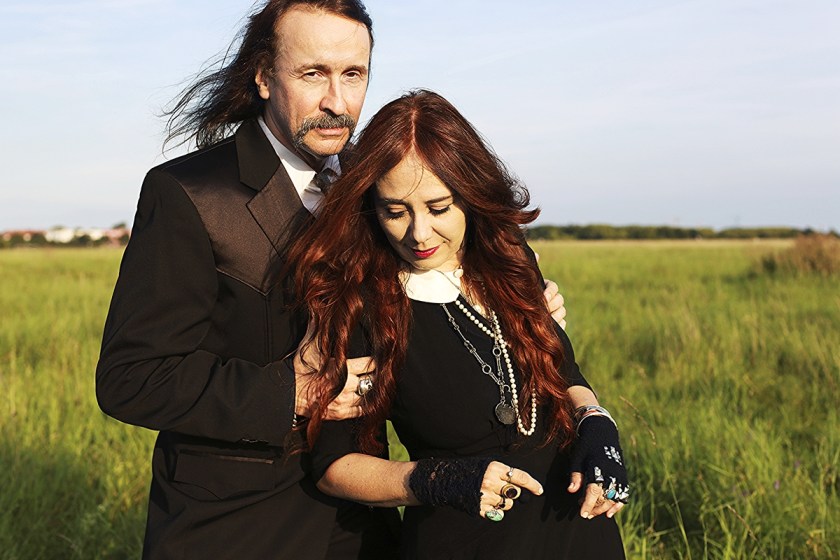
Hackedepicciotto is an avant-garde, multimedia project formed out of the collaboration between Alexander Hacke and Danielle de Picciotto. Hacke is the bassist and one of the sound designers in influential industrial band Einstürzende Neubauten and de Picciotto is an internationally renowned author and musician in her own right as well as a co-founder of the now defunct electronic music festival the Love Parade in Berlin. Their work in various projects across the past few decades has been rich, diverse and prolific. As Hackedepicciotto the duo has produced a body of work that explores the ways in which what some call late capitalism and its fallout with widespread gentrification in cities and the consequences for those who have carved a niche as creative people and those who are drawn to doing so.
De Picciotto wrote a remarkable graphic novel published in Europe in 2013 and in the USA in 2015 called We Are Gypsies Now in which she outlines how she and her husband, Hacke, came to realize they were basically being priced out of their longtime home of Berlin and how it was becoming a city that was increasingly losing some of its character, of decades if not centuries, as a place generally open to and welcoming creative types and lateral thinkers of all stripes. That realization inspired the couple to travel around where they could perform in search of a new place to call home. In the end, as you will read below, de Picciotto and Hacke came to some conclusions about the state of the world and their hometown. That subject and their discoveries since have been the subject of at least two albums, 2016’s Perseverantia and 2017’s Menetekel. A powerful expression of despair can be felt throughout both albums but in the end, Hackedepicciotto believe not the platitude that things will all work out but that hope for making a better future is not a naive concept. We interviewed Hackedepicciotto via email in 2018 following their 2017 tour of North America.
Queen City Sounds: How did you come to record Perseverantia in the Mojave desert? Is there anything about that setting or the circumstances of being there then that inspired documenting your travels up to that point?
Danielle: We have been traveling art nomads for over seven years now and at one point we ended up in Joshua Tree. I fell in love with the starkness of the desert. It is incredibly inspiring because it brings you back to life’s basics so we recorded not only “Perseverantia” there but I also recorded my solo album “Tacoma” during the same time period. I would have loved moving there immediately but Alexander does not have a drivers license which would have made it difficult for him to move around freely and it is very far from Europe where we do need to be quite often so we decided to put it on hold for the time being. I still do have the dream of owning a small cottage there to retreat whenever possible.
Alexander: The desert is vibrating with energy. You might say that it’s a barren and lifeless landscape, but it really is radiant with life. There’s hundreds of plants and creatures within every square inch. Also there’s no apparent boundary, few geographical features blocking your view. All of that does have a very inspiring effect and gave us the opportunity to look at our work from a different angle. We gave up traditional song structures and arrangements thankfully due to those surroundings.
QCS: What seemed like the most likely places to find a sanctuary for creative types as you had in Berlin in the 80s and to some extent in the 90s? What ultimately made those places not quite what you were looking for?
Danielle: Joshua Tree and the Hudson Valley both seemed like the perfect places because they are not overpriced yet, have a great artists community and are beautiful nature-wise. Hudson Valley was basically the decision we made after five years of contemplation. In the end effect we did not move there for two reasons: 1) we were originally invited to do an artists residency in a private art space there for a year and had planned to use that as a starting point from where we could look for work and connections. After we told the curator that we would accept his offer he informed us that as we had stopped drinking his invitation was not open anymore as that would bother him whilst drinking. (!) The art residency was obviously a very unprofessional one and we are happy it did not go through but it did shock us to be confronted in such a manner on something we were rather proud of having achieved so we started looking around once more when 2) the elections happened. That was the second shock which brought us back to Berlin to try and understand what is happening in the world at the moment.
Alexander: Well, ultimately we didn’t manage to discover a place, a city or a community that would live up to the West-Berlin standards and we realized that it would be silly to even try looking for that. Instead it is imperative to understand what “[survival of the fittest” really means, because it is not about strength, or appetite or ambition, it’s about being able to adapt, so we should all let go of the romanticized, sentimental and awfully nostalgic notion that anything could be the way it once was again and rather try to make things happen in any given place. Not being twenty anymore sort of reduces the options though, of what I am willing to invest myself into.
QCS: What circumstances do you think made Berlin such a great place as a sanctuary for artists? How might such a situation be attained now even given the dire state of the world?
Alexander: Not only were we perfectly secluded from the rest of the west, the special status of our elitist little village informed the selection of people, who would go there. You wouldn’t be drafted into the [mandatory] year of military service if you were a registered citizen of West-Berlin, so all the freaks who’d have a problem with the system represented by the army and whatnot, could safely realize their personal utopia there and because of the presence of the allied forces stationed by the winner nations of the Second World War, we had quite a good connection to what was happening abroad internationally, in London, New York and Paris to some extent, if you will.
Danielle: In the 80s Berlin was an island which was completely subsidized because of being an island within cold war communism. That meant that everything was very cheap and money was not an issue. You could work in a cafe two times a week and pay your rent and food from that so art and music were not done with commercial interest in mind. This brought about that Berlin became a madcap laboratory of unusual sounds, ideas and experiments which would nourish creativity all over the world. Personally I think that this is the key to being able to live a healthy, humane life and make oneself free of our insane world: find a place to live which is cheap and spend your time not trying to earn money but to do things that really mean something.
QCS: Have you found havens to stay while you travel? How has being on the move regularly now impacted the legal aspects of being able to travel and other mundane matters most people take for granted?
Danielle: We have many homes now and they are mainly influenced by our friends. We have discovered that the saying “home is where the heart is” is true and that the heart is mainly there where one has good friends. Because of traveling so much we have met incredible people all over the world and those havens are places that give us strength and hope. We try to travel to their cities regularly to create a net connecting all of them with like minded people and in this way spread the strength that we receive.
Alexander: I used to enjoy air travel a lot more than I do now with all those security and luggage regulations “The Man” is imposing on us. What equipment we are able to bring and what not is having considerable impact on our work. That is maybe a good thing, because we have to calculate and re-adjust the weight and efficiency of every detail in our cases over and over. We travel with a scale and make sure that all our checked luggage is maxed out.
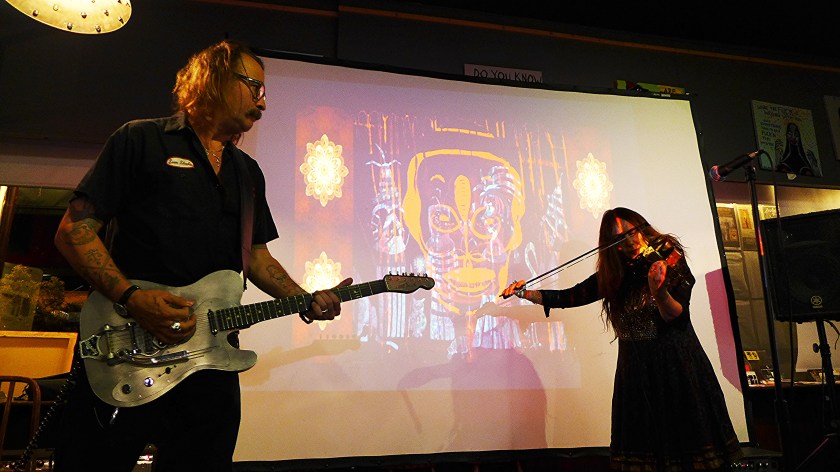
QCS: Why do you feel times have changed and it seems more like a dog eat dog world? That makes it sound like you gave up on the idea of finding a sanctuary like Berlin used to be. Have you?
Alexander: I am grateful to still be able to make a living with music. We are doing pretty well in comparison to almost every other profession. I do really cherish to get to put my energy into creating something meaningful, rather than having to do some kind of slave labor or, even worse, to get paid for being a heart-[less] and soulless corporate prick, in order to pay the fucking rent. And yes, thank God for our wonderful friends who have our backs.
Danielle: Negative news is everywhere and reading it all the time can be very depressing. But there are very many positive things happening all the time and it is important to concentrate on them and give them your support. It just takes more time to find out about them—I try to keep my Facebook page free of negative news and post as much positive news as possible to prove this. There are a lot of small communities getting together everywhere, in the US and Europe, connecting people that are environmentally aware and that actively work on changing things. These communities are incredibly inspiring and one can either join them or learn from what they do and try to integrate this into daily life. All of them are as inspiring as Berlin used to be but in different ways. Berlin’s most creative times were in the 80s and 90s which is now quite some time ago and it would not make sense to turn back time. The world has changed and we need to look into the future not into the past.
QCS: When you speak of displaced people, the thousands of homeless souls you speak of in your press release, what is the essence of what you think many of us have lost in the wake of what made Berlin unaffordable in the way it used to be but also many other cities in the world where creativity found a home?
Danielle: Society has become corrupted. We all seem to believe that what the companies want us to think and we need to become free of this because it is not only killing our health but also our souls.
Alexander: Change, transcendence and reform [are] imperative for the survival of mankind. Luckily it can’t be avoided and will happen anyway no matter how hard reactionaries will cling to their valuables. You have to start with yourself and try not to be too frustrated with the ridiculous amount of time it seems to take for everyone else to get into it.
QCS: The word “Menetekel” means “the writing on the wall” and I take that to mean that what was happening to the creative community and the social and physical infrastructure that made a creative life a viable option and possible to thrive is now happening to everyone. That is to say, in our capitalistic world where rampant greed is the only protected value, creative work is not valued and seen as a luxury and thus more or less the first thing to go, to be sacrificed. My melodramatic language aside, what made the collective despair of the world seem like particularly fruitful material for your new record?
Danielle: When we record it happens instinctively and we were quite surprised how dark some of our tunes had become. It is always interesting to record first and then speak about what happened because that way you can see what your subconscious is saying. Here in Berlin we work in an area that is very poor and in which a lot of refugees are put. Their collective despair can be felt palpably, being displaced is terrible. Living in a country after having lost your family, your job, your home only to arrive somewhere where you are considered a subhuman, cannot speak the language and have almost no prospects besides being alive is unimaginable for anybody that has not experienced it. I think we felt a lot of this despair besides the feeling of homelessness we felt whilst traveling ourselves. When you travel a lot you can experience transcontinental shifts on a one to one daily basis and our world is changing at a breakneck speed. Most people do not think it will affect them because they refuse to see the writing on the wall and go on numbing their minds with fatty foods, alcohol and non stop media. If people do not wake up it will soon be too late.
Alexander: Menetekel is about waking up to the reality of our condition.The reference to the word as it is used expressing impending doom in German, is a biblical story found in the book of Daniel, chapter five.
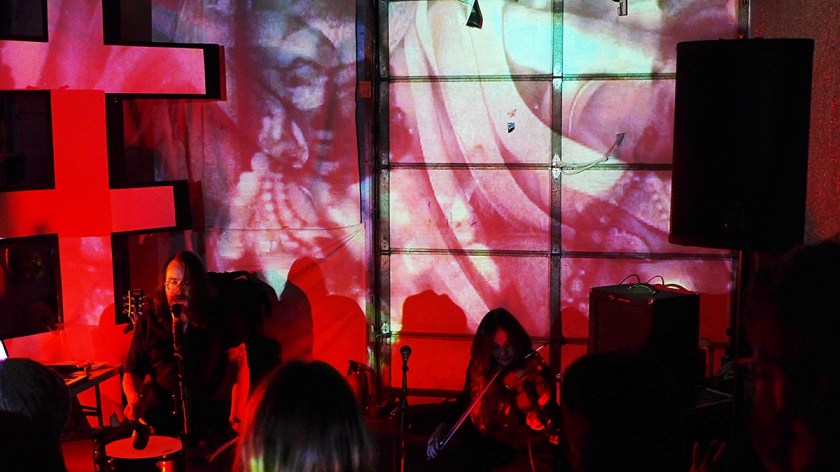
QCS: Obviously the dark intensity of the album matches the subject matter. How does performing this music along with your visuals affect you revisiting the music and channeling that kind of vibe?
Danielle: It makes me want to find as many ways as possible to help change things to a brighter future.
Alexander: Ideally we create with the vibrations of our music and Danielle’s imagery (if we have it) a bond between the audience and us, the performers. By sharing the moment together in the given venue, we get to connect and experience reality as a unit, a community. Separation is an illusion and with our art we try to overcome that false view of the world.
QCS: The final song is “Crossroad.” What kind of crossroad do you feel humanity and human culture may be at this time? What do you see as possible paths that seem likely before us?
Danielle: I think that people have to realize that they cannot wait for others to save us. We are the others. Every single person is responsible to make change possible. As we can see with elections: every body that does not vote makes evil possible.
Alexander: Know thyself. Stop buying into consumerism. Quit drinking and go vegan. Meditate. That’s a start.
 Queen City Sounds and Art
You must be logged in to post a comment.