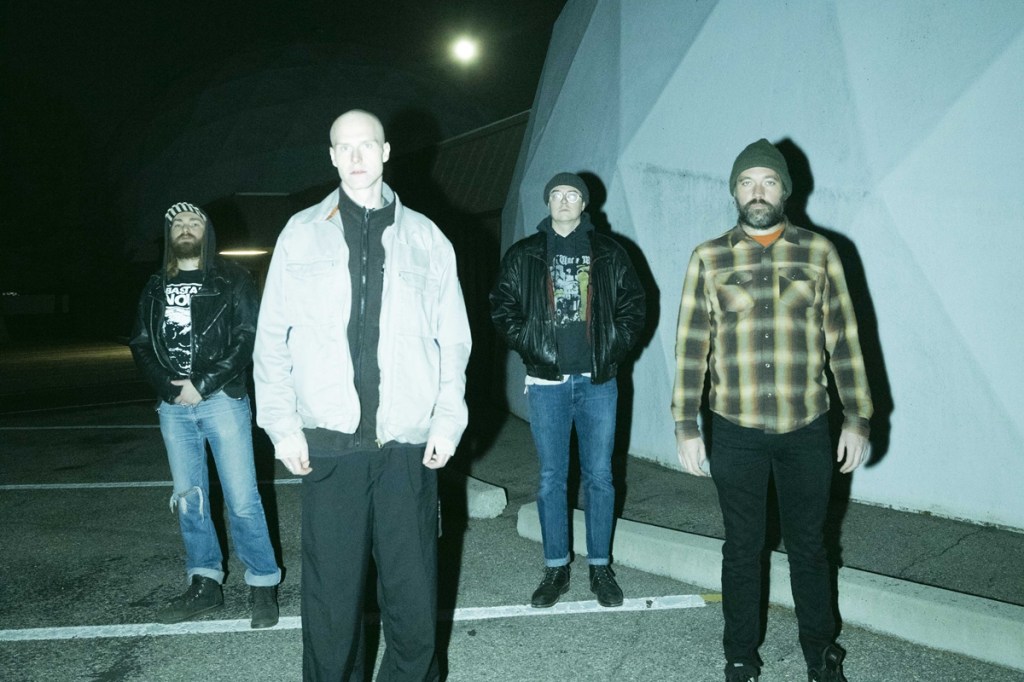
Imagine one of the only weird hardcore bands from your hometown (you know, the one that listened to Crucifucks and Flipper coming up more than the usual suspects) gets bored with hard fast rules and were always into stranger music and the possibilities of sonic extremes in experimental industrial music and noise and makes a band you think would be good on a bill with Chat Pile, Mclusky/The Future of the Left or The Jesus Lizard. Or all three (four if you want to count The Future of the Left separately). TRAUMA KIT is that band from Boise, Idaho, a town that has a lot of secret talent. “PLATEAU” is the first song on the group’s new album TRAIN WRECKS TAKE TIME (which dropped February 23, 2024) is a caustic and seething bit of work that sounds like the story of dead end lives in dead end towns in dead end countries in a dead end civilization. It also sounds like what you do to express the pain of living through those situations and coming into the harrowing disillusion of having the realization of what you’ve inherited as a human in this time crash into you. It also comes across like the next searingly dystopian science fiction film made by Brandon Cronenberg if he teamed up with Harmony Korine for a story idea and really nailed what future looks like for most of us but the story of someone struggling to find some meaning and dignity in the detritus of world history yet not being completely hopeless and finding some glory in the struggle against the level best attempts of late capitalism to crush us into nothing. Musically you’re going to hear the aforementioned but also a bit of late 80s Voivod and maybe more than a little Shellac and a shred of Naked City. No complaints. Listen to “PLATEAU” on Spotify (Apple Music or Bandcamp) and you may recognize some of your own intrusive thoughts in the words and thrilling collisions of sound.
Stinking Lizaveta is a trio from Philadelphia that formed in 1994 creating instrumental rock with roots in prog, jazz and cinematic music. The style the group has developed from the beginning has been summed up with the descriptor “doom jazz” because its sound has often combined heaviness with a musical complexity and elegance. Stinking Lizaveta establishes a mood early in its songs and its compositions vividly express ideas and emotional nuance that engages the listener’s imagination. The band’s sound has evolved and explored ideas and concepts across nine albums including its new record, 2023’s Anthems and Phantoms which features some of Stinking Lizaveta’s most unvarnished compositions and some of its most fully realized. Fans of bands like Earth and Hermanos Gutiérrez will find much to appreciate about the Stinking Lizaveta catalog and in particular the left field paths it takes on the new record into deeply evocative soundscapes. We were able to pose some questions to guitarist Yanni Papadopoulos about the his band’s history and the new album. Currrently Stinking Lizaveta is on tour with a stop in Denver at Hi-Dive on July 6, 2023 with Telekinetic Yeti, Somnuri and Hashtronaut.
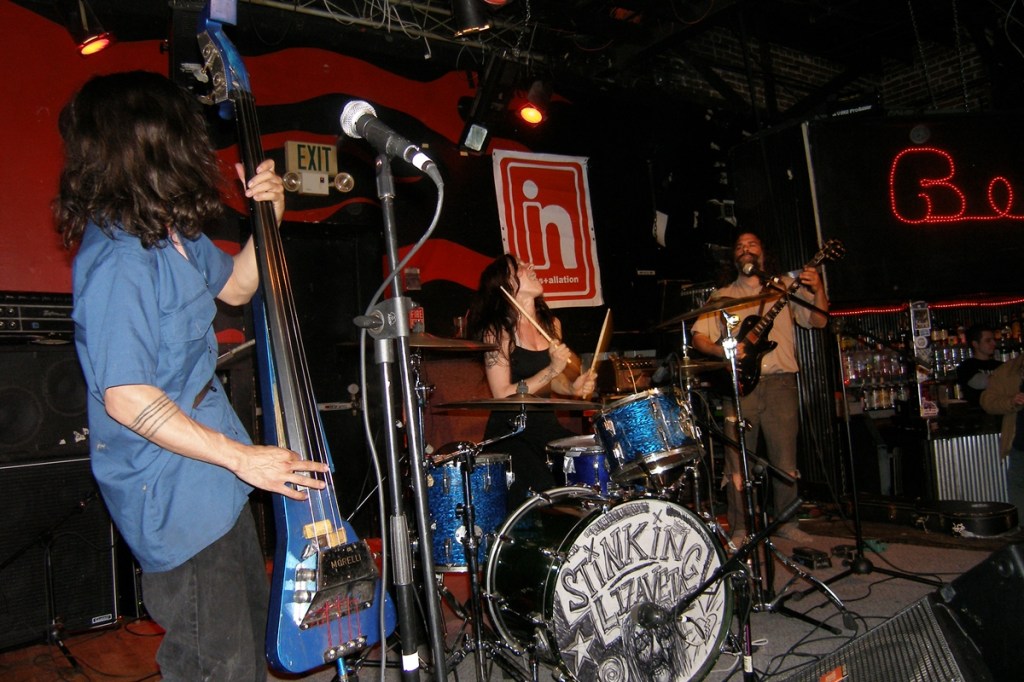
Stinking Lizaveta at Bender’s Tavern in Denver, March 30, 2007, photo by Tom Murphy
Tom Murphy: When you formed this band it was the beginning of the end of alternative music as a force in mainstream music. How did you come upon the idea to do an instrumental band with some heavy sounds and jazz in the mix at that time? What kinds of sounds inspired you? I think back and my brain lands on stuff like what the late Peter Brötzmann was doing with Last Exit, or Naked City, Don Caballero and the like being in the vein of what you have done. Maybe later on stuff like Zs.
Yanni Papadopoulos: Initially we were inspired by Black Flag’s Family Man album. One side was instrumental rock, and the other was Henry reciting poetry. Greg Ginn also had an instrumental band called Gone. I never saw them or even heard their music, but I ran into a couple of guys that loved their show. They said something like, “ Man, those guys just came out and ripped it up!” Another friend of mine named Frank said he saw Gone play on the street in Philly, and it was intense! It was a tradition for bands to have an instrumental track on their albums. So we decided to just make that the whole thing. We were also into progressive rock, out jazz and soundtrack music, all of which gave us the idea that people will like what we do.
How did the band go over early on and where did you find a niche either in clubs or DIY type spaces? Were there other bands that you connected with in the early years of your own group?
Initially we connected with Pittsburgh PA, where Don Caballero was laying the groundwork for underground rock, and we made a deep connection in Richmond VA, where “mathrock” in the form of King Sour and Breadwinner was turning people on. In Philly we made friends with Dysrhythmia Flay, and Ninefinger (Mike Dean of COC’s band). There was also a great connection with an instrumental band in New Orleans called Spikle, and we even played with Clearlight at Check Point Charlie’s. In DC we made friends with Spirit Caravan, and years later Wino took us to Europe with his band The Hidden Hand. Our identity really started to form within the Emissions from the Monolith Festival in Youngstown OH. We played with tons of great bands there like Keelhaul and Mastodon.
What do you feel that instrumental music allows you to express or in general to communicate that might be more challenging if you had to include vocals with lyrics?
Vocals and lyrics tether the music to an image, make it more terrestrial. Instrumental music can occupy a deeper space in your imagination. If I want to write a song, I’ll start with a lyric. If I write a riff, does it need a lyric? I don’t have time for that kind of homework.
The new record, Anthems and Phantoms, continues with the kind of surprisingly clear and energetic lines of music that was there even on …Hopelessness and Shame. But it’s even more sonically spare yet intricate than say the psychedelic sound of Sacrifice and Bliss. Was there anything that helped to inform the different sonic direction of this new collection of songs?
During the Sac and Bliss period I was using a wah pedal, a delay and a tremolo, and I really got into that vocabulary. You can also hear it on 7th Direction, and Journey to the Underworld. On Anthems I put the effects away and just plugged into the amp. That’s how I’m playing live now, and will be for the whole tour. I don’t want any pedals now, not even a tuner, just chord into the same Mesa Boogie amp I bought by accident and have been using for 30 years.
It seems that there are implied themes in song titles that you explore without defining that for your potential listeners throughout your career. Titles like “The Man Needs Your Pain” is so on point and evocative and cultural references like “Zeitgeist, The Movie” and “A Day Without A Murder” from Sacrifice and Bliss seem to point to larger themes of human society and civilization. What sorts of themes do you think run through Anthems and Phantoms?
Anthems feels like an emergence from the dark, a movement into light from uncertainty. There are more major chords. Tunes like Let Live and Serpent Underfoot want to be uplifting without taking too much of your time. It wouldn’t be a Stinking Lizaveta album if we didn’t get down with tunes like “Blue Skunk” and “The Heart.” “Heart” has a little bit of a Manchester vibe for me, and “Skunk” is cracked blues, we go there.
The cover art for the new album is striking and mythological in a way that resonates with your previous record Journey to the Underworld. Who did the visuals and how do you feel it reflects the mood and themes of the album with the squid-legged Medusa type creature with crab arms holding the boat, floating over the world?
The art is done by Alexi’s son, Mike, with no direction at all from us. He just graduated from art school and banged out a good one. We have indeed become such a mythical beast as a band.
There’s a great deal of diversity in the sound palette on all of your records so the descriptor of Stinking Lizaveta as doom jazz while good as shorthand for what to expect seems to be something you’ve outgrown. What new areas of musical expression do you feel like maybe came more to the foreground on the new record?
I’m always trying to answer the question of what is missing from the music that hits me. We see so many bands every year, and when I pick up my guitar I try to be the one that joyfully participates in rock music, but also redeems it from its shortcomings. Not everyone will get us, it takes me years to even listen to my own music, but I’m usually pleasantly surprised once I get some distance from it. Keep finding new things to practice and get out of your comfort zone. Stinking Lizaveta is our life’s work, that’s how we approach it.




 Queen City Sounds and Art
You must be logged in to post a comment.