
Interview: Yanni Papadopoulos of Stinking Lizaveta on the Magic of Instrumental Music and New Album Anthems and Phantoms

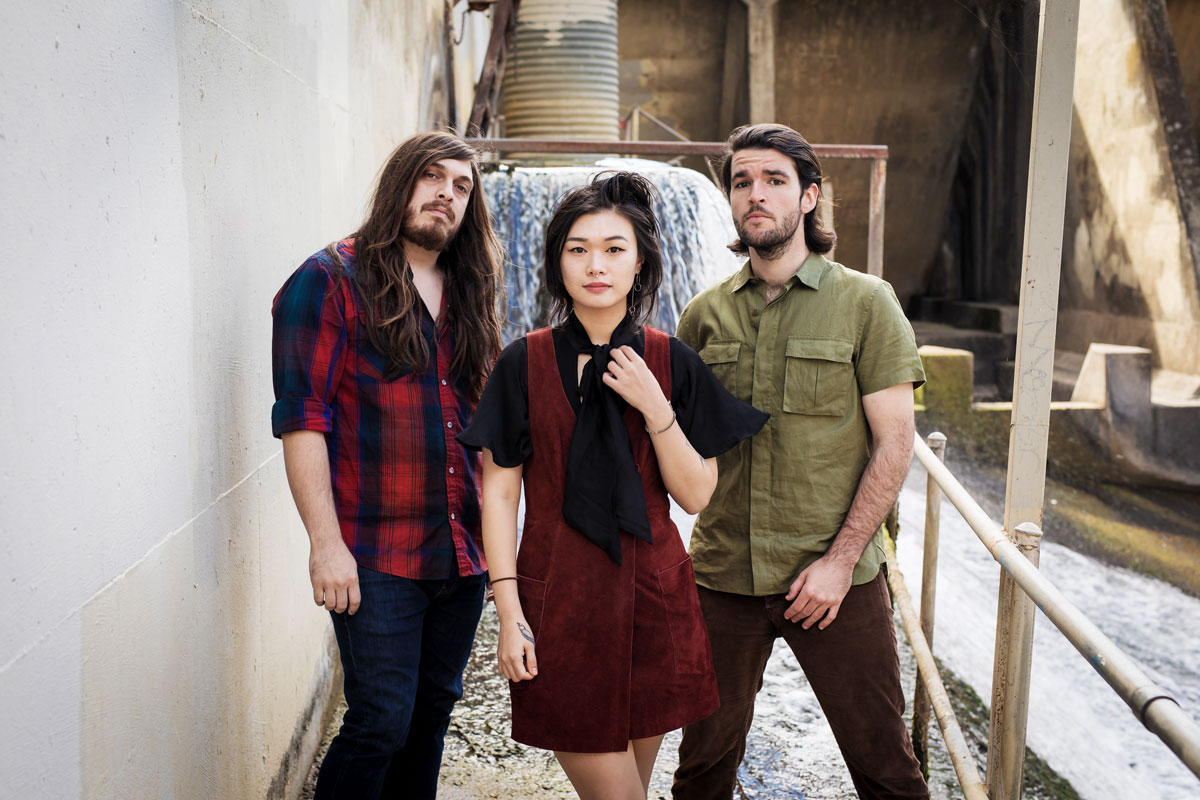
Stinking Lizaveta, photo by John Singletary

Stinking Lizaveta is a trio from Philadelphia that formed in 1994 creating instrumental rock with roots in prog, jazz and cinematic music. The style the group has developed from the beginning has been summed up with the descriptor “doom jazz” because its sound has often combined heaviness with a musical complexity and elegance. Stinking Lizaveta establishes a mood early in its songs and its compositions vividly express ideas and emotional nuance that engages the listener’s imagination. The band’s sound has evolved and explored ideas and concepts across nine albums including its new record, 2023’s Anthems and Phantoms which features some of Stinking Lizaveta’s most unvarnished compositions and some of its most fully realized. Fans of bands like Earth and Hermanos Gutiérrez will find much to appreciate about the Stinking Lizaveta catalog and in particular the left field paths it takes on the new record into deeply evocative soundscapes. We were able to pose some questions to guitarist Yanni Papadopoulos about the his band’s history and the new album. Currrently Stinking Lizaveta is on tour with a stop in Denver at Hi-Dive on July 6, 2023 with Telekinetic Yeti, Somnuri and Hashtronaut.
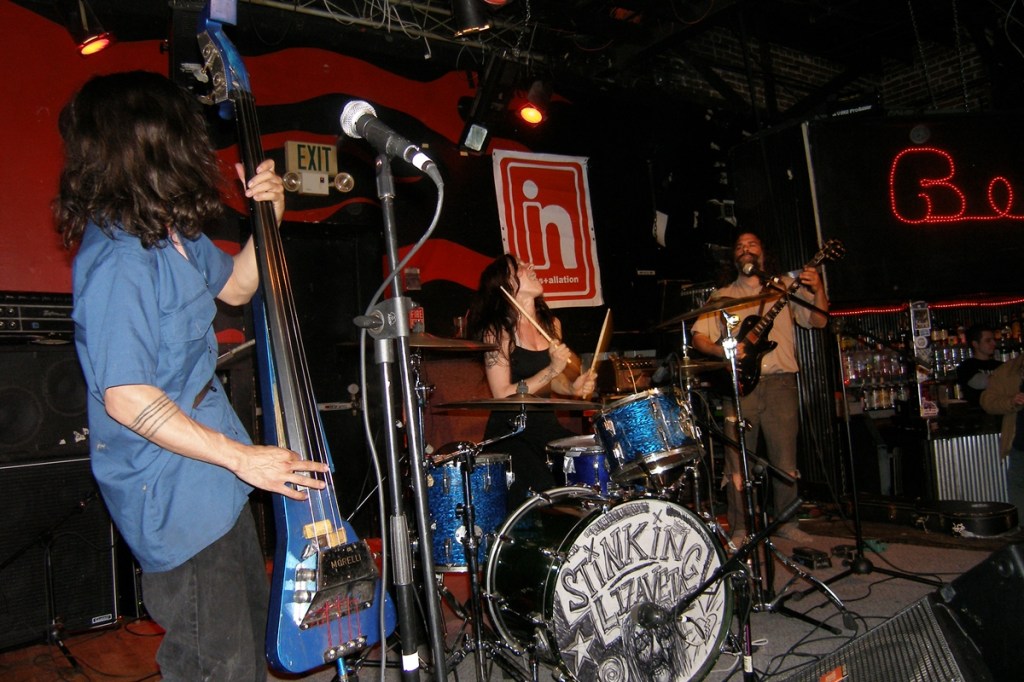
Stinking Lizaveta at Bender’s Tavern in Denver, March 30, 2007, photo by Tom Murphy

Tom Murphy: When you formed this band it was the beginning of the end of alternative music as a force in mainstream music. How did you come upon the idea to do an instrumental band with some heavy sounds and jazz in the mix at that time? What kinds of sounds inspired you? I think back and my brain lands on stuff like what the late Peter Brötzmann was doing with Last Exit, or Naked City, Don Caballero and the like being in the vein of what you have done. Maybe later on stuff like Zs.

Yanni Papadopoulos: Initially we were inspired by Black Flag’s Family Man album. One side was instrumental rock, and the other was Henry reciting poetry. Greg Ginn also had an instrumental band called Gone. I never saw them or even heard their music, but I ran into a couple of guys that loved their show. They said something like, “ Man, those guys just came out and ripped it up!” Another friend of mine named Frank said he saw Gone play on the street in Philly, and it was intense! It was a tradition for bands to have an instrumental track on their albums. So we decided to just make that the whole thing. We were also into progressive rock, out jazz and soundtrack music, all of which gave us the idea that people will like what we do.

How did the band go over early on and where did you find a niche either in clubs or DIY type spaces? Were there other bands that you connected with in the early years of your own group?

Initially we connected with Pittsburgh PA, where Don Caballero was laying the groundwork for underground rock, and we made a deep connection in Richmond VA, where “mathrock” in the form of King Sour and Breadwinner was turning people on. In Philly we made friends with Dysrhythmia Flay, and Ninefinger (Mike Dean of COC’s band). There was also a great connection with an instrumental band in New Orleans called Spikle, and we even played with Clearlight at Check Point Charlie’s. In DC we made friends with Spirit Caravan, and years later Wino took us to Europe with his band The Hidden Hand. Our identity really started to form within the Emissions from the Monolith Festival in Youngstown OH. We played with tons of great bands there like Keelhaul and Mastodon.

What do you feel that instrumental music allows you to express or in general to communicate that might be more challenging if you had to include vocals with lyrics?

Vocals and lyrics tether the music to an image, make it more terrestrial. Instrumental music can occupy a deeper space in your imagination. If I want to write a song, I’ll start with a lyric. If I write a riff, does it need a lyric? I don’t have time for that kind of homework.

The new record, Anthems and Phantoms, continues with the kind of surprisingly clear and energetic lines of music that was there even on …Hopelessness and Shame. But it’s even more sonically spare yet intricate than say the psychedelic sound of Sacrifice and Bliss. Was there anything that helped to inform the different sonic direction of this new collection of songs?

During the Sac and Bliss period I was using a wah pedal, a delay and a tremolo, and I really got into that vocabulary. You can also hear it on 7th Direction, and Journey to the Underworld. On Anthems I put the effects away and just plugged into the amp. That’s how I’m playing live now, and will be for the whole tour. I don’t want any pedals now, not even a tuner, just chord into the same Mesa Boogie amp I bought by accident and have been using for 30 years.

It seems that there are implied themes in song titles that you explore without defining that for your potential listeners throughout your career. Titles like “The Man Needs Your Pain” is so on point and evocative and cultural references like “Zeitgeist, The Movie” and “A Day Without A Murder” from Sacrifice and Bliss seem to point to larger themes of human society and civilization. What sorts of themes do you think run through Anthems and Phantoms?

Anthems feels like an emergence from the dark, a movement into light from uncertainty. There are more major chords. Tunes like Let Live and Serpent Underfoot want to be uplifting without taking too much of your time. It wouldn’t be a Stinking Lizaveta album if we didn’t get down with tunes like “Blue Skunk” and “The Heart.” “Heart” has a little bit of a Manchester vibe for me, and “Skunk” is cracked blues, we go there.

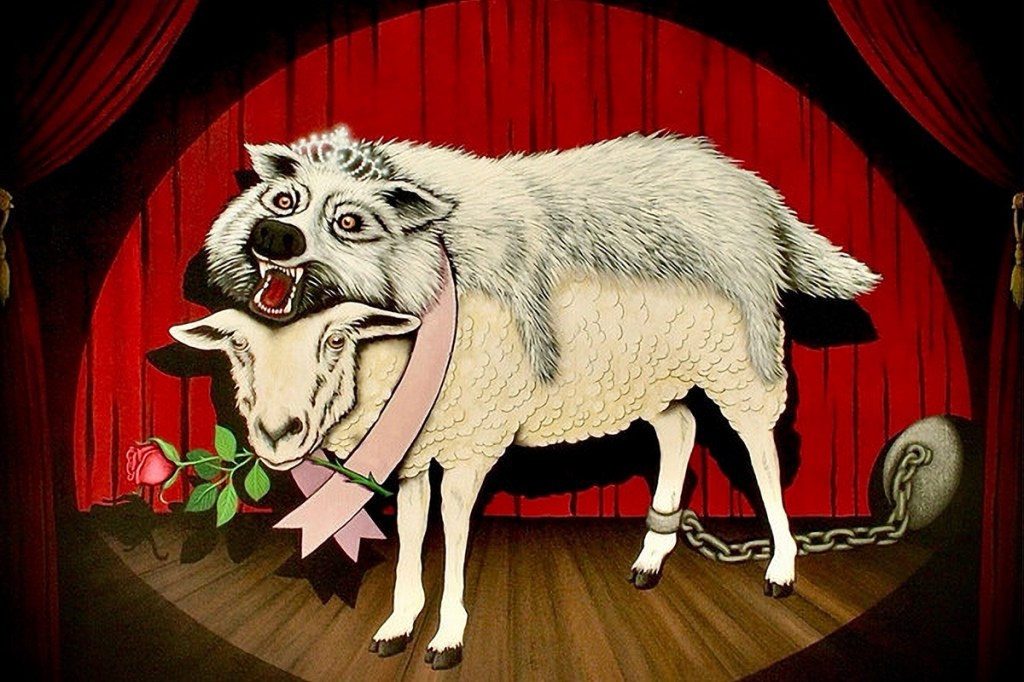
The cover art for the new album is striking and mythological in a way that resonates with your previous record Journey to the Underworld. Who did the visuals and how do you feel it reflects the mood and themes of the album with the squid-legged Medusa type creature with crab arms holding the boat, floating over the world?

The art is done by Alexi’s son, Mike, with no direction at all from us. He just graduated from art school and banged out a good one. We have indeed become such a mythical beast as a band.

There’s a great deal of diversity in the sound palette on all of your records so the descriptor of Stinking Lizaveta as doom jazz while good as shorthand for what to expect seems to be something you’ve outgrown. What new areas of musical expression do you feel like maybe came more to the foreground on the new record?

I’m always trying to answer the question of what is missing from the music that hits me. We see so many bands every year, and when I pick up my guitar I try to be the one that joyfully participates in rock music, but also redeems it from its shortcomings. Not everyone will get us, it takes me years to even listen to my own music, but I’m usually pleasantly surprised once I get some distance from it. Keep finding new things to practice and get out of your comfort zone. Stinking Lizaveta is our life’s work, that’s how we approach it.
Stinking Lizaveta on Facebook

DigDog’s Apocalyptic Video for “Sirens of Hell” is a Heavy Math Rock Warning Against Future Disasters Coming At Us From Humanity’s Collective Blind Spots

Images of a tunnel, a gas-masked figure, a skull flowing with dark clouds from its crown, the inside of a cathedral, people in prayer cast in grey overtones all combine to give the early parts of the video for DigDog’s “Sirens of Hell” video a properly apocalyptic feel. The lyrics seem to take on the perspective of someone with a Millenarian mindset outlining humanity’s fall from grace through the auspices of social media and other outlets of manipulating people’s consciousness and public opinion. Given the impact of conspiracy theories and communities for them made more widely accessible because of various social media platforms and digital media making it easier to gain a broad audience for someone capable of presenting whatever ideological perspective they please in an entertaining way or at least in a manner that seems cohesive but may not be and is essentially accountable to no one as long as it makes money. DigDog sets this narrative to dynamic, heavy math rock like the mutant child of Don Caballero and Primus trading between scorching riffs and an elegantly intricate, introspective, spindly guitar figure contrasting the fragile balance of human existence and what looks like its doom from seemingly harmless sources as suggested in the song when the vocalist sings “it’s gonna hit when you least expect” referring to the acts of the devil as a metaphor for humanity’s most self-destructive impulses shielded from clear view by our collective hubris. In the video images of a virus certainly points out one of those vectors of the downfall of our species because of how we’ve failed to act appropriately and what obvious thing could be next to land in our lap to wreck civilization as we know it? Watch the video for “Sirens of Hell” on YouTube and listen to more DigDog on Spotify.

Yvette Young of Covet on the Use of Technique as a Tool to Transport Listeners

Covet_HowieChen
Covet, photo by Howie Chen

When Yvette Young of math rock band Covet started posting videos of her guitar sketches on Facebook and then on YouTube and other online outlets several years back she didn’t necessarily see herself doing music professionally. “I started posting those songs as an incentive to finish songs and share them with friends,” says Young. “There were a lot of cool communities on Facebook of people that liked the same music I did. I posted the videos just to keep track of my progress. I did it for the same reasons I post riffs on Instagram—to incentivize finishing them.”

Young earned herself a well-deserved reputation as a guitar shredder on par with the math rock inspirations in bands like Don Caballero, Pelican, TTNG, Tera Melos and Enemies. But her musical technique has never been done for its own sake and never really learned to merely show off technical skill. Young is also a visual artist and views musical technique in the same was she does artistic technique.

“I see technique as a tool kit,” says Young. “The more technique you have and applications you have for guitar—for instance two handed tapping, picking chords, tugging—it’s like a painter’s toolbox , [to use] the visual artist analogy. To me music is sonic painting and I want to transport someone with my music. I want as many colors and as many tools as I can. That’s my incentive for figuring out my technique—to get to the closest to what I want to achieve. For a lot of people they hear stuff in their head but their hands aren’t there. You have the potential to do this thing but you don’t have the tools so you have to learn the tools.”

“I write with my ears and then I find it on the guitar,” continues Young. “Usually I don’t know how to play it yet or how to do what I heard. I know where the notes are but I don’t know how to connect it all yet. So I’ll keep practicing until I get it down. That’s how I get my technique. I try doing stuff I think is impossible and once I do it, it feels good. Then I can apply that technique to any other song I want to write in the future. I always write songs I can’t play yet. I don’t go to comfortable shapes, I always try to push myself to do weird stuff that is uncomfortable at first. That’s a good way if you want to break out of your routine. Change your tunings so you can’t do those shapes anymore. Totally disable yourself so you have to use your ears and you’ll be able to write stuff that sounds totally natural because you end up having to write with your head and not just with technique itself. You can’t just do an arpeggiated sweep, the shape is gone. So you have to find something that’s much more creative.”

Young’s music is like her drawings and paintings—diverse, rich in style and evocative power. She does the artwork for all of her albums and there is an element of what Young refers to as “escapist” or fantastical, intended to transport the viewer to another place or another time in their lives. Whether it’s the albums or the artwork Young has shared on various online outlets, her development as a visual artist is seemingly in parallel with her development as a musician. The group’s new EP, 2018’s Effloresce, is Covet’s most fully-realized work to date with an appeal beyond what might be immediately to the taste of connoisseur’s of math rock. As Young discussed earlier, her method of learning and employing technique is a bit unorthodox but which has resulted in music that steps creatively out of what one might expect of the genre or of what Covet has done before.

The EP is named as a kind of tribute to British post-rock band Oceansize and its own debut full-length, Effloresce. “It kind of means to bloom and flour and in chemistry it means to dry up to a point to powderize and disappear,” says Young. “I like the idea of blooming. I feel this is a departure from our last album production-wise and songwriting-wise. We all have different influences and we want to take all our passions, influences and backgrounds and mesh them into one sound. This album is like a person with a bunch of flowers as a face because we’re growing.”

At moments the songs on Effloresce employ the familiar, elegantly melodic guitar tapping compositions and other techniques Young has mastered but Covet never seems to get stuck in a particular technique across the EP’s six tracks and the inventive creation of atmosphere and dynamics take the music beyond math rock and beyond rock itself into more experimental musical territory. The tracks “Glimmer” and “Gleam” in particular all but cross over into the realm of ambient music at points.

“I’m fascinated with how much you can push a sound and how many different genres you can [combine],” says Young. “Also, on a practical level, it makes touring a lot easier. I think metal is a cool genre but is unfortunately a niche genre. There’s only so many huge metal bands and you end up going out with the same kinds of bands all the time. If you are more like a chameleon you open yourself up to more touring opportunities. I don’t write to open up more touring opportunities, I write because I really enjoy multiple styles of music and I want to do all of it in one.”

Yvette Young may have initially seen a career for herself in the sciences, at least according to what she hints at in her refreshingly candid interview with Sidewalk Talk in May 2018, but for now she has carved out for herself a life as a professional musician.

“Essentially I became my parents’ nightmare but it’s working out,” says Young in typically humorous fashion. “I might as well join a gang.”

See Covet in Denver on Tuesday, July 24, 2018 with Vasudeva and Quentin at Lost Lake, 7 p.m., 16+, $12-15