

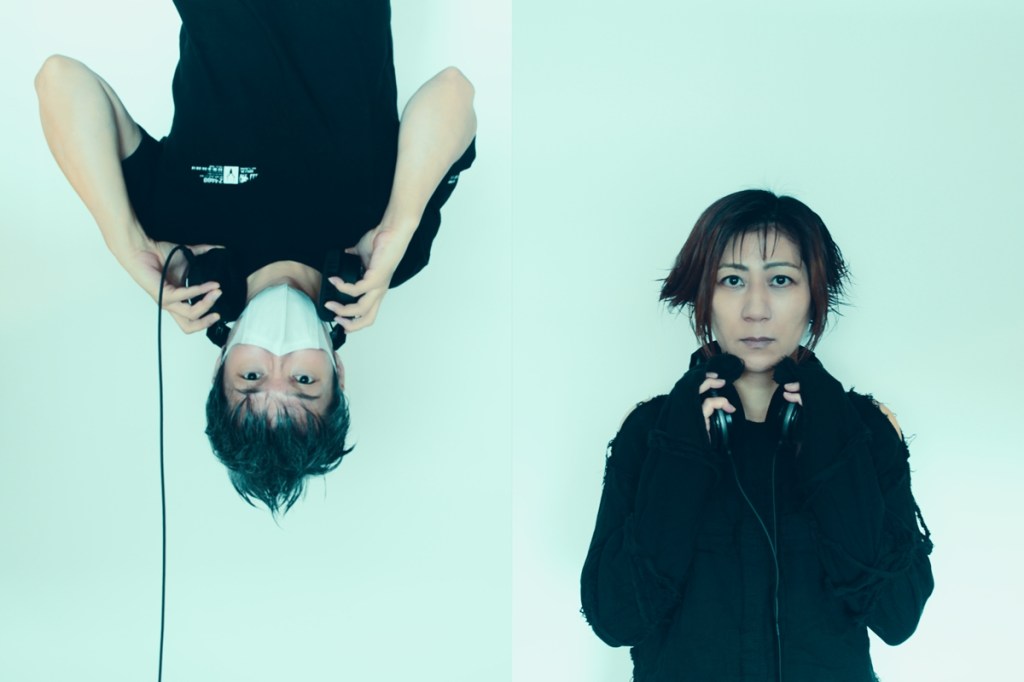
Since 1992 Tokyo’s Melt Banana has freely fused noise, hardcore, pop, grindcore and experimental electronic music in a uniquely frenetic and ever evolving mode of expression that has translated into furious live shows and a body of uniquely compelling recorded output. If you get to see the now duo of Yako and Agata live there is a raw, visceral power paired with an intense playfulness that creates a riveting energy that brings the audience along for a wild ride of sounds, ideas and rhythms. Year after year Melt Banana is consistently one of the most memorable live bands going from anywhere in the world. The band released its latest album 3+5 in 2024 marking it’s ninth in its long career and its first in eleven years. The new record finds Melt Banana offering what might be its most accessible songs to date but also some of its most exploratory material seeming to soundtrack and combination of video game and manga-based anime because of its gloriously frantic switches of pace, tonal richness and the musical equivalent of jagged jump cuts. We had the opportunity to pose some questions to Onuki and Agata via email. 3+5 is available now digitally, on CD and LP. Find links to connect with the band after the interview. Introduction and interview by Tom Murphy.
Tom Murphy: 3+5 is your first album in 11 years. Do you feel like you had to take some time off from Melt Banana to develop new ideas or methods of performing the music before making a new album?
Yako: We didn’t feel like it took 11 years. After we released “Fetch,” we kept doing our usual live shows and tours, then the COVID-19 pandemic happened, and we were busy with various things like starting our Patreon page and writing songs available only there. Time just flew by.
Agata: We never took a break from Melt-Banana during these 11 years. It’s not like we spent 11 years making “3+5,” but it feels like the album was made possible because of those 11 years. During that time, I started using new effect pedals like the Ricochet and the SY-300, which I used a lot on “3+5.”
TM: The title of the new album as well as songs titles like “Code,” “Puzzle,” “Case D,” “Stopgap” and “Hex” in particular point to mysteries or problems to solve or temporary solutions to complex challenges. Did you find yourselves faced with similar challenges to inspire songs like those?
Yako: For this album, I kept the song titles simple. Each of the nine tracks on the album feels like an independent piece, and using simple titles allows listeners more room to imagine their own interpretation of the songs.
Agata: Nowadays, everything is explained in detail and answers are easily found, so I think some ambiguity is needed.
TM: When adding 3+5 you get 8 which is a significant number in Chinese culture and numerology, a number of perfect balance and such. In splitting it into prime numbers was that maybe a commentary on the illusion of perfection and equilibrium through unconventional rhythms?
Agata: Yako came up with the album title. We had never used numbers or symbols before, and I thought it was a very good idea.
Yako: I don’t know much about Chinese culture and numerology, but in general, the number 3 is considered significant in this world. Since this is our 8th album, we needed to add 5 to make it 8.
TM: The album cover looks like a black and white collage art and ragged edged origami. Who designed the artwork and what is its significance for you and the album?
Agata: We always create our own album artwork. We make what we think looks good at the time, so we don’t usually decide on a specific theme beforehand.
Yako: As you pointed out, the initial idea was to create something by tearing and layering paper. When we create songs, sometimes they come together quickly, but often we go through many revisions, examining them carefully, cutting, pasting, and experimenting. The feeling of completion finally comes when we reach the end of that process. The artwork for this album wasn’t specifically designed with that image in mind, but it might represent that kind of process.
TM: What role did samples and field recordings play, if any, in the songwriting on the new album and how you are able to perform the music live?
Yako: For this album, we didn’t use field recordings or natural sounds. Instead, we used more digital samples.
Agata: We used synths more this time. On our previous album, “Fetch,” we incorporated field recordings, which resulted in an organic feel despite using computers. With this album, we focused on what can be achieved using computers, so we didn’t use field recordings. It’s more about how the synth sounds can coexist with Yako’s vocals and my guitar. When we play live, these sounds are handled similarly to how we treat drum sounds.
TM: Have you adapted any of your music to the pace of gaming? Are there games you find resonate well with your music?
Yako: We haven’t tried adapting our music into games. I can’t think of any specific examples, but I think fast-paced games would probably suit our music well.
Agata: We often hear that our music fits well with games like Splatoon, though I’ve never played Splatoon myself.
Yako: When I played Rez, the music synced very well with the game, and it was a lot of fun. I think music is a very important element in games.
TM: Are there Twitch streamers whose content you find especially engaging and why?
Yako: I don’t watch Twitch much, so I’m not familiar with it, but I occasionally watch game streams on YouTube. Since I use a Mac, I check out PC games that I’m interested in, as it’s very convenient for keeping up with new game releases.
Agata: I also watch more Japanese game streams on YouTube rather than Twitch. Sometimes, watching these streams makes me want to play certain games, but if I already plan to play a game from the start, I avoid watching those streams. However, recently, I haven’t had much time, so I haven’t been watching streams much.
TM: With services like Crunchyroll anime and gaming can be enjoyed by people around the world. Are there any anime series and films that have particularly captured your imagination of late?
Yako: Unfortunately, I haven’t come across any anime that has really captured my interest recently. Over the past few years, I found “Made in Abyss” and “Ousama Ranking” to be interesting. So, I’m looking forward to the next season of “Made in Abyss.”
Agata: I watch anime more randomly than Yako. I tend to watch whatever catches my eye or what Yako or friends recommend. So, I usually only watch something once, and I tend to forget the story quickly. Recently, I watched an anime called “Sing a Bit of Harmony”. Initially, I thought it probably wasn’t for me and even considered stopping halfway, but by the end, I found it really interesting.
TM: Are there any manga adaptations to anime you feel have been especially well executed like maybe Banana Fish, One Piece, Attack on Titan or Blue Lock? Others?
Agata: It’s an old example, but I think both the manga and the anime of AKIRA were great.
Yako: Manga adaptations to anime can turn out really well or be quite disappointing. It often depends on the production company and director. It’s sad to see interesting manga fail as anime. I think “Attack on Titan,” “Demon Slayer,” and more recently “Oblivion Battery” are examples of manga that have been successfully adapted into anime. When I first read these manga comics, the art was a bit hard to understand, and there were many aspects that didn’t come across well, but the anime made things clearer and was very well done. Sometimes anime adaptations include unique elements of their own, but recently, I think the anime adaptation of “Bocchi the Rock!” was done very well.
 Queen City Sounds and Art
You must be logged in to post a comment.