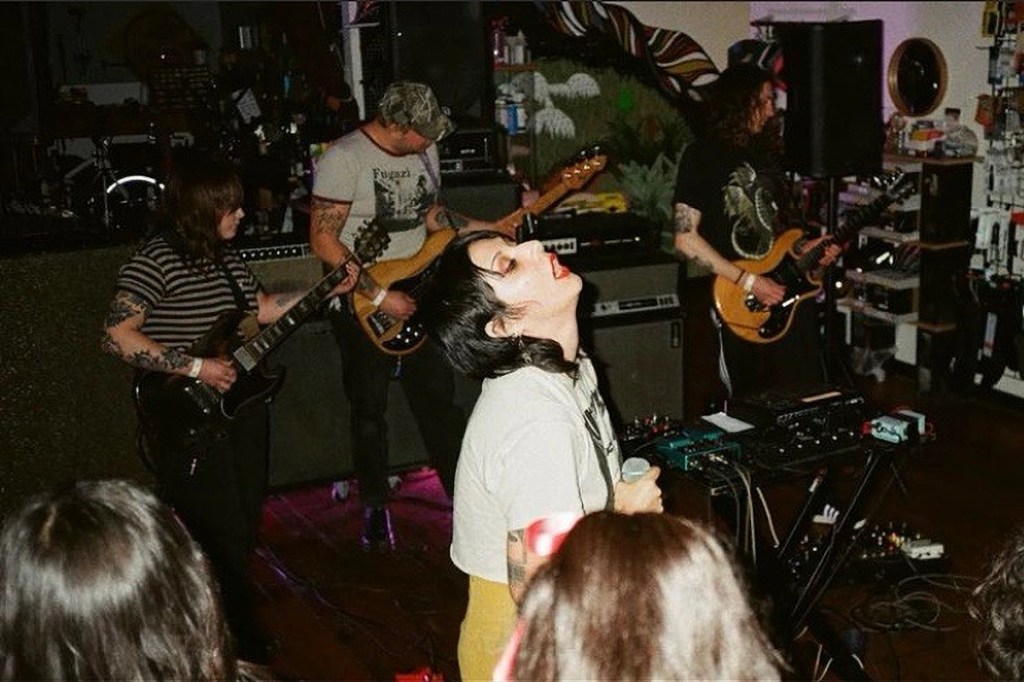
The Royal Arctic Institute, photo by Charlotte Hysen
The Royal Arctic Institute calls itself “an instrumental, post-punk, cinematic jazz quintet” and is currently based out of New York City. Its compositions strike one as soundtrack music for coastal noir with the hard to define sense that part of its sonic DNA is nearby large bodies of water and the ways sunrise and sunset ripple across the ocean. There is the mood of day into night as though the music was conceived and written for a time between an active workday and night time plans. The elegant melodies and percussion rise and resolve with an intuitive grace and evoke emotional states like the musicians have in mind creating imagery with luminous layers of tone and sonic shading. In 2022 the group released the From Catnip to Coma EP and in 2023 a companion EP From Coma To Catharsis perhaps charting and processing the long stretch of the early pandemic and its effects on life and the psyche. Both records were recorded and produced by James McNew of Yo La Tengo fame in the historic Neumann Leather Factory in Hoboken, New Jersey. The band consists of veteran musicians drummer Lyle Hysen (Das Damen, Arthur Lee), guitarists John Leon (Roky Erickson, Summer Wardrobe, Abra Moore) and Lynn Wright (And The Wiremen, Bee And Flower, Shilpa Ray), bassist David Motamed (Das Damen, Two Dollar Guitar, Arthur Lee, Townes Van Zandt) and keyboardist Carl Baggaley (Headbrain, Gramercy Arms) whose musical chemistry is obvious across the project’s recorded output. On August 4, 2023 Already Dead Records and Tapes will release a full length album on 12” LP vinyl of the two EPs combined as Catnip to Coma to Catharsis.
Listen to our interview with Carl Baggaley on Bandcamp and follow The Royal Arctic Institute at the links below.
On “your progress” Kelly Garlick and Agnar truly dive deep into exploring in tone and texture the journey into the psyche of a person processing trauma whether of the kinds everyone experiences and/or more specifically the kind one imagines or knows directly of the agony of gender dysphoria. The sample of a male-sounding voice saying “In order for me to progress I had to shed everything I was, I had to be put through psychological torture in order to be seen as an equal as human, now I don’t think I can regain that part of me every again, just gone and I just wish I had my life back” in the first half the song is so haunting and poignant, vulnerable and real that pretty much anyone that has had to conform to some bizarre, arbitrary social and cultural standard and has had to work through it can identify with that sentiment. All around, the sounds of machinery run in the background, processed metallic sounds, sharp drones like distorted electronic wind, an assembling ambient circle of tone, abstract chimes in the near distance, shuffling, percussive sounds traversing in stereo effect, the sounds of an autoharp, field recordings of crickets and other animals near a body of water, acoustic guitar strumming in an informal rhythm giving an identifiable form to the emotional expression even as one feels the other emotions though they can be challenging to identify in standard language, glimmerings of bell tones. This array of sensory stimulation through pure composition of sources can be subtle and dazzling. Later in the track a female sounding voice says “and if I’m being honest I’m scared that I’m going to harm myself beyond repair” before the soundscape takes a turn for the darker with more industrial type moods and more menacing drones and tonal swells, gibbering voices echoing in reverse delay like an interdimensional creature in Twin Peaks: Fire Walk With Me, rippling repeating textural bubbling, panning sounds like machines speaking and then more melodic chimes at the end like the peaceful sound of a time of agony fading out. It’s a work with a lot of depth and emotional nuance that can really only be described in that impressionistic way and one worth revisiting as it articulates a challenging emotional and psychological space with elegant poetry of sound design and organic structure. Listen to “your progresss” on Spotify and follow Kelly Garlick on Instagram. Garlick recently released an excellent album Wild Goose Victim on Multidim also available to stram on the Spotify link.
The Salesmen open “From Behind” with a vocal sample that sounds like something recorded in the 1940s or 1950s with an old man talking about a conversation he had with an “independent businessman” who complained about not being able to get poor people our narrator was saying he was trying to help and discouraging him from helping them. It turns out his so-called job paid $4 a day sunup to sundown and the narrator said it’s like slave wages and no wonder no one would work for him. But, really, isn’t that the kinds of conversations people have these days with massive income inequality hitting hard now but more like the famous frog example in systems theory but with the working class going back to the 1970s when austerity politics and economics began to be implemented in the banking and finance sector ahead of the Reagan administration and then accelerated over decades. So when the band kicks in with sounds like they grew up listening to a lot of weirdo art/progressive rock like Mr. Bungle and Frank Zappa alongside The MC5 and 1980s DC post-punk (i.e. Fugazi) it’s a fitting soundtrack to its lyrics about having to basically work yourself to death to survive often enough or certain not have enough time for yourself often enough. Certainly not many politicians are doing anything to put in regulations and corrections for this oppressive state of affairs like implementing modern monetary theory principles and putting in brakes on the accumulation of wealth and effectively ending the billionaire class with a robust return to anti-trust type of regulations put into place in the 1930s and 1940s including a full restoration of laws like the 1933 Glass-Steagall Act. But The Salesmen in identifying some core issues with the song,and with the sample seem aware of American economic history, and setting it to the kind of psychedelic progressive punk on this song is more than a hint that people know that things have gotta change. Listen to “From Behind” on Spotify and follow The Salesmen at the links below.
JENTL brings a soulful introspection to his hazy pop song “Better For Me.” Accents of percussion and guitar touch at the edges of splashes of synth tone but the melody is ably carried by JENTL’s smooth vocals. He describes an immediately relatable feeling of how our own minds can sabotage our best intentions and instincts and reroute our energy into unproductive habits. JENTL questions the desire to get comfortable in the throes of a dysfunctional psychology because it inhibits the will to change. He ponders whether he’s a “good guy” but concedes “at least I try” and in that nugget of hope he finds the impetus to work toward behaviors and practices that are, yes, better for him. This deep exploration of personal accountability couched in lush atmospheres and luminous melodies just makes it seem like the best route overall and one that is easier than we might imagine when we’ve gotten comfortable with what are essentially self-destructive and soporifically twisted. This style of songwriting and purpose imbues the rest of JENTL’s new EP Terminal as well which released on April 7, 2023. Listen to “Better For Me” and the rest of the EP on Spotify and follow JENTL at the links below.
Richard Tripps’ ever so slightly husky voice lends an immediacy to “Dog Days” as he relates impressions of the end a time in life that feels comfortable and days pass at a leisurely pace because it’s too hot to do otherwise. But when that time ends, like a summer break or a summer vacation, you miss it a little and the people with whom you whiled-away the hours. Tripps expertly conveys that liminal moment. The percussion is light yet gives the song a vivid coherence. The synth, some of it sounding like a touch of Mellotron to give it a dreamlike haze, brings a charmingly whimsical spirit to the song and comes to the fore for an interlude before the outro. The song recalls the song “A Month of Sundays” by The Church from its underrated and top shelf 1984 album Remote Luxury and the way it conveys the way the relatively brief periods of leisure we get in life under the prevailing economic system allow us the time to stretch out our psyche to entertain the full feeling of life outside of the endless treadmill of productivity expected of us but which is antithetical to a full human life. Richard Tripps gives us a bit of that headspace with this song as well. Listen to “Dog Days” on Spotify and follow Richard Tripps on Instagram.
REZN is a heavy psych band from Chicago whose forays into evocative and haunting music incorporate the aesthetics of doom, shoegaze and cinematic ambient to create dynamic soundscapes that capture a sense of the cosmic and of the deep mystery of nature. The group recently released its new album Solace. The record’s cover looks like something one might have expected on an old Rainbow or Hawkwind record of windswept mountains and the sunlight breaking through a raging storm. The music within is not unlike that expectation set of epic journeys and existential catharsis through finely sculpted and orchestrated volume and majestically accented rhythms. If Lovecraft and Michael Moorcock had somehow collaborated on a dark science fantasy trilogy in the modern era this is the music for that story—menace, spiritual contemplation and transcendence.
Listen to our interview with bassist Phil Cangelosi on Bandcamp and catch REZN on tour now (dates, streaming music and more information available at rezn.band) including a stop at the Hi-Dive in Denver with local doom legends Oryx on Friday, July 7, 2023.
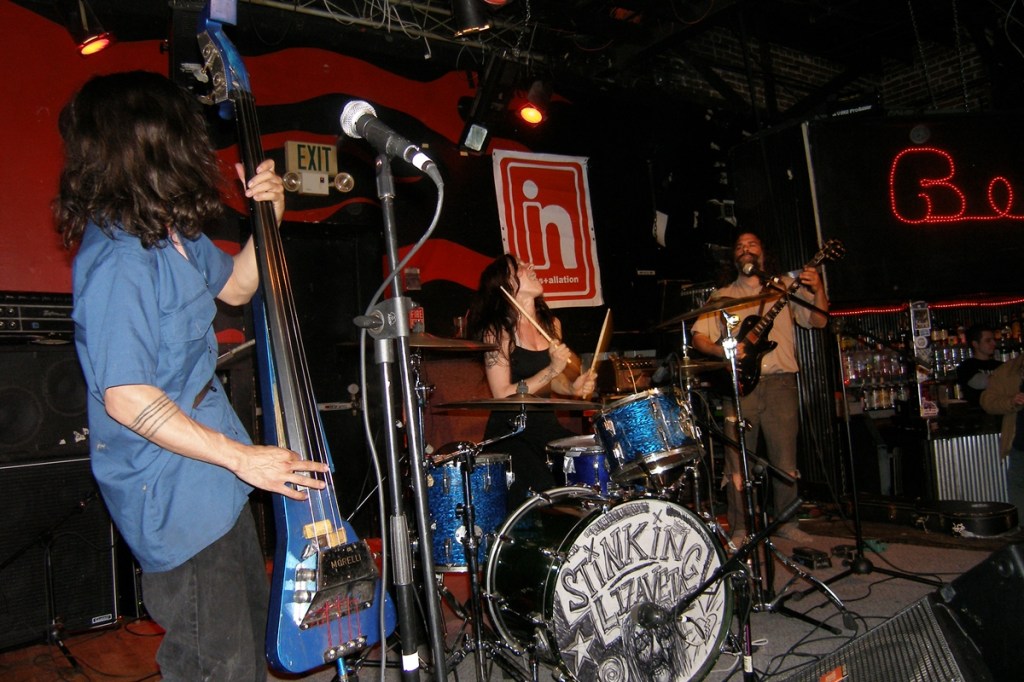
Stinking Lizaveta is a trio from Philadelphia that formed in 1994 creating instrumental rock with roots in prog, jazz and cinematic music. The style the group has developed from the beginning has been summed up with the descriptor “doom jazz” because its sound has often combined heaviness with a musical complexity and elegance. Stinking Lizaveta establishes a mood early in its songs and its compositions vividly express ideas and emotional nuance that engages the listener’s imagination. The band’s sound has evolved and explored ideas and concepts across nine albums including its new record, 2023’s Anthems and Phantoms which features some of Stinking Lizaveta’s most unvarnished compositions and some of its most fully realized. Fans of bands like Earth and Hermanos Gutiérrez will find much to appreciate about the Stinking Lizaveta catalog and in particular the left field paths it takes on the new record into deeply evocative soundscapes. We were able to pose some questions to guitarist Yanni Papadopoulos about the his band’s history and the new album. Currrently Stinking Lizaveta is on tour with a stop in Denver at Hi-Dive on July 6, 2023 with Telekinetic Yeti, Somnuri and Hashtronaut.
Stinking Lizaveta at Bender’s Tavern in Denver, March 30, 2007, photo by Tom Murphy
Tom Murphy: When you formed this band it was the beginning of the end of alternative music as a force in mainstream music. How did you come upon the idea to do an instrumental band with some heavy sounds and jazz in the mix at that time? What kinds of sounds inspired you? I think back and my brain lands on stuff like what the late Peter Brötzmann was doing with Last Exit, or Naked City, Don Caballero and the like being in the vein of what you have done. Maybe later on stuff like Zs.
Yanni Papadopoulos: Initially we were inspired by Black Flag’s Family Man album. One side was instrumental rock, and the other was Henry reciting poetry. Greg Ginn also had an instrumental band called Gone. I never saw them or even heard their music, but I ran into a couple of guys that loved their show. They said something like, “ Man, those guys just came out and ripped it up!” Another friend of mine named Frank said he saw Gone play on the street in Philly, and it was intense! It was a tradition for bands to have an instrumental track on their albums. So we decided to just make that the whole thing. We were also into progressive rock, out jazz and soundtrack music, all of which gave us the idea that people will like what we do.
How did the band go over early on and where did you find a niche either in clubs or DIY type spaces? Were there other bands that you connected with in the early years of your own group?
Initially we connected with Pittsburgh PA, where Don Caballero was laying the groundwork for underground rock, and we made a deep connection in Richmond VA, where “mathrock” in the form of King Sour and Breadwinner was turning people on. In Philly we made friends with Dysrhythmia Flay, and Ninefinger (Mike Dean of COC’s band). There was also a great connection with an instrumental band in New Orleans called Spikle, and we even played with Clearlight at Check Point Charlie’s. In DC we made friends with Spirit Caravan, and years later Wino took us to Europe with his band The Hidden Hand. Our identity really started to form within the Emissions from the Monolith Festival in Youngstown OH. We played with tons of great bands there like Keelhaul and Mastodon.
What do you feel that instrumental music allows you to express or in general to communicate that might be more challenging if you had to include vocals with lyrics?
Vocals and lyrics tether the music to an image, make it more terrestrial. Instrumental music can occupy a deeper space in your imagination. If I want to write a song, I’ll start with a lyric. If I write a riff, does it need a lyric? I don’t have time for that kind of homework.
The new record, Anthems and Phantoms, continues with the kind of surprisingly clear and energetic lines of music that was there even on …Hopelessness and Shame. But it’s even more sonically spare yet intricate than say the psychedelic sound of Sacrifice and Bliss. Was there anything that helped to inform the different sonic direction of this new collection of songs?
During the Sac and Bliss period I was using a wah pedal, a delay and a tremolo, and I really got into that vocabulary. You can also hear it on 7th Direction, and Journey to the Underworld. On Anthems I put the effects away and just plugged into the amp. That’s how I’m playing live now, and will be for the whole tour. I don’t want any pedals now, not even a tuner, just chord into the same Mesa Boogie amp I bought by accident and have been using for 30 years.
It seems that there are implied themes in song titles that you explore without defining that for your potential listeners throughout your career. Titles like “The Man Needs Your Pain” is so on point and evocative and cultural references like “Zeitgeist, The Movie” and “A Day Without A Murder” from Sacrifice and Bliss seem to point to larger themes of human society and civilization. What sorts of themes do you think run through Anthems and Phantoms?
Anthems feels like an emergence from the dark, a movement into light from uncertainty. There are more major chords. Tunes like Let Live and Serpent Underfoot want to be uplifting without taking too much of your time. It wouldn’t be a Stinking Lizaveta album if we didn’t get down with tunes like “Blue Skunk” and “The Heart.” “Heart” has a little bit of a Manchester vibe for me, and “Skunk” is cracked blues, we go there.
The cover art for the new album is striking and mythological in a way that resonates with your previous record Journey to the Underworld. Who did the visuals and how do you feel it reflects the mood and themes of the album with the squid-legged Medusa type creature with crab arms holding the boat, floating over the world?
The art is done by Alexi’s son, Mike, with no direction at all from us. He just graduated from art school and banged out a good one. We have indeed become such a mythical beast as a band.
There’s a great deal of diversity in the sound palette on all of your records so the descriptor of Stinking Lizaveta as doom jazz while good as shorthand for what to expect seems to be something you’ve outgrown. What new areas of musical expression do you feel like maybe came more to the foreground on the new record?
I’m always trying to answer the question of what is missing from the music that hits me. We see so many bands every year, and when I pick up my guitar I try to be the one that joyfully participates in rock music, but also redeems it from its shortcomings. Not everyone will get us, it takes me years to even listen to my own music, but I’m usually pleasantly surprised once I get some distance from it. Keep finding new things to practice and get out of your comfort zone. Stinking Lizaveta is our life’s work, that’s how we approach it.
“Murmur” begins with what sounds like a loop of broken, distorted guitar before Cheree bursts into layered, near chaotic aggression. The programmed drums sound like a particularly disciplined hardcore or death metal drummer because the rhythms aren’t just steady and urgent but seem to sync in when the band goes off the map with rapid echoing guitar and unhinged vocals. It’s like the wildest and most cathartic industrial music fused with noise rock’s disregard for standard melodic structure and the righteous fury of both a grindcore and anarcho punk band. Listen to “Murmur” on Spotify where you can listen to the rest of the band’s 2023 album Factory which is fueled with a similar fervor, intensity and beautifully thorny aesthetic. Catch up with Oakland’s Cheree at the links below.
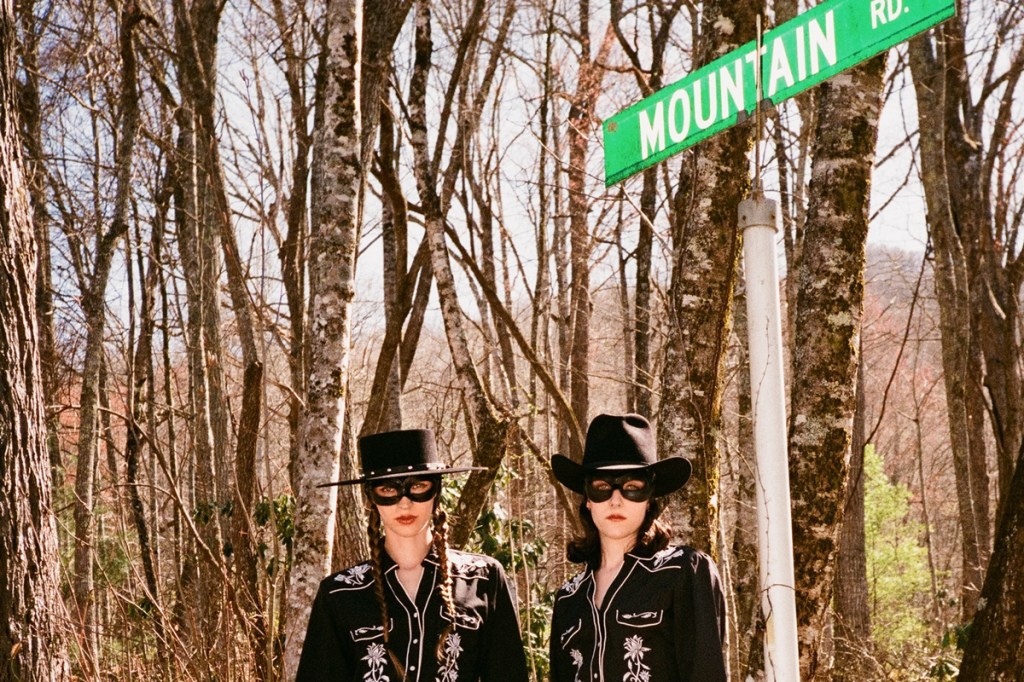
It’s tempting to call Bad Flamingo’s recent run of singles, and really much of its earlier output, Laurel Canyon Gothic. “Mountain Road” is crafted from delicately intricate folk rock style guitar work, strings and near whispered vocals and one hears in its sonic DNA the sensibilities and musical spirit Donovan absorbed from West Coast bands in the USA in the mid 60s before writing his own interpretation of that collective sound on his 1966 album Sunshine Superman. There are the ghosts of “Season of the Witch” haunting “Mountain Road.” But Bad Flamingo’s song seems to be another one about a partnership on the run from the enervating tendrils of mainstream society and fueled by personal myths and narratives and the romance of how the adventure of it all is exciting and the secret greatness shared between two people except that it’s precarious and the lifestyle doomed in the end. It’s a twenty-first century noir like a darker early Gordon Lightfoot song and yet another fine example of the duo’s unique and consistently engaging songwriting. Listen to “Mountain Road” on Spotify and follow Bad Flamingo at the links below.
Alina Skiffska wrote “Time Is Now” for her Urbanistic’sDream project in Kyiv during the air alerts and blackouts in 2022. But the synthpop song is reminiscent of something that might have come out of the 1980s with the processed guitar sound and fusion of R&B and what was then called New Wave. And because of that it has a spirit and sound of unvarnished hopefulness and scrappy attitude. The words are forward looking, “Time is now/to be daring/Time is now, Time is now/forget your failing/The future is here in these neon lights.” Its bright melodies and upbeat rhythms infused with a steadfast energy is fitting for a song in which the songwriter has adopted an attitude of not being held back by the past or being discouraged by setbacks or defeats because one has to be in it for the long haul when you’re striving for not just your freedom but your very lives. Even without the context of the artist being from Ukraine and based out of Kyiv “Time Is Now” has the quality of a classic modern electronic pop song that encourages one to live your best life and push through your challenges even in times when you’re not feeling it because you’re living for a time when things won’t be so tough and and you can enjoy yourself even when they are because often enough now is all we are guaranteed. Listen to “Time Is Now” on Spotify and follow Urbanistic’sDream at the links provided.







 Queen City Sounds and Art
You must be logged in to post a comment.