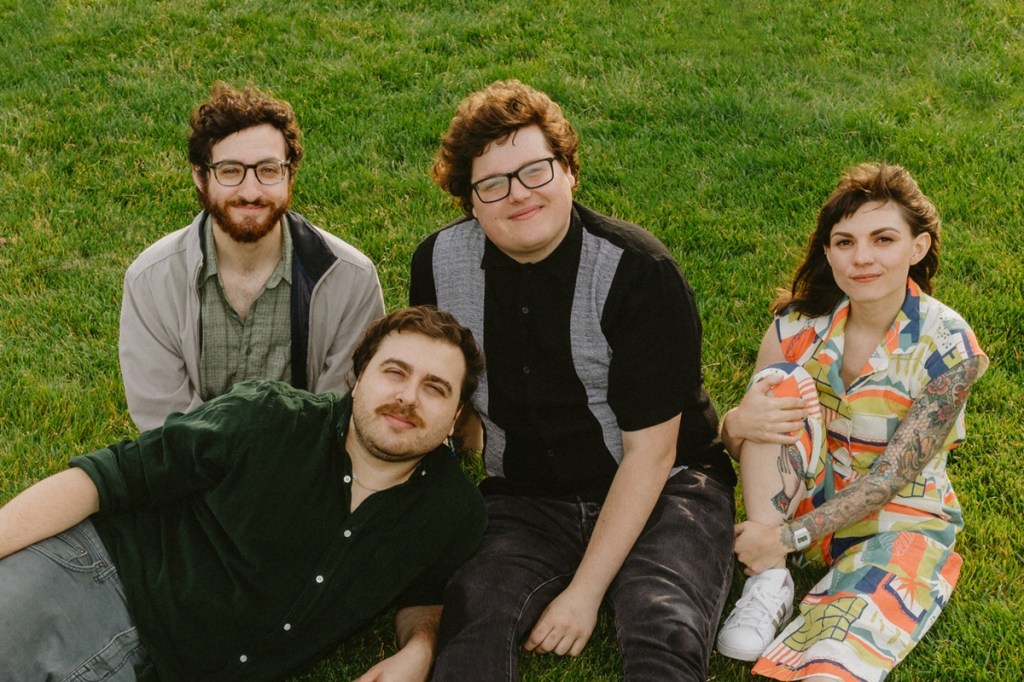
The music video for Teenage Halloween’s combined singles “Supertrans/Takeaway” directed by Jordan Serrano shows vocalist Luk Henderiks living out the the frustrations and reconciliations in the songs themselves that seem to be perfect companions in expressing the struggles many people go through in life whether its the social pressure of gender conformity or generational trauma or genetic health issues making living itself complicated. But the exuberance of the songs in that triumphant yet self-aware and vulnerable modern pop punk and emo style with Henderik’s impassioned and commanding vocals makes these songs irresistible anthems of resistance and personal dignity that ring true whatever your struggles and challenges might be because we’ve all got them and Teenage Halloween is definitely tapped into a collective zeitgeist of this moment. Watch the video for “Supertrans/Takeaway” on YouTube and follow the group from Asbury Park, New Jersey at the links below. Its new album Till You Return drops October 20, 2023 on digital and vinyl via Don Giovanni Records. And catch Teenage Halloween on tour October through December in support of the new record. Dates on the Bandcamp page.
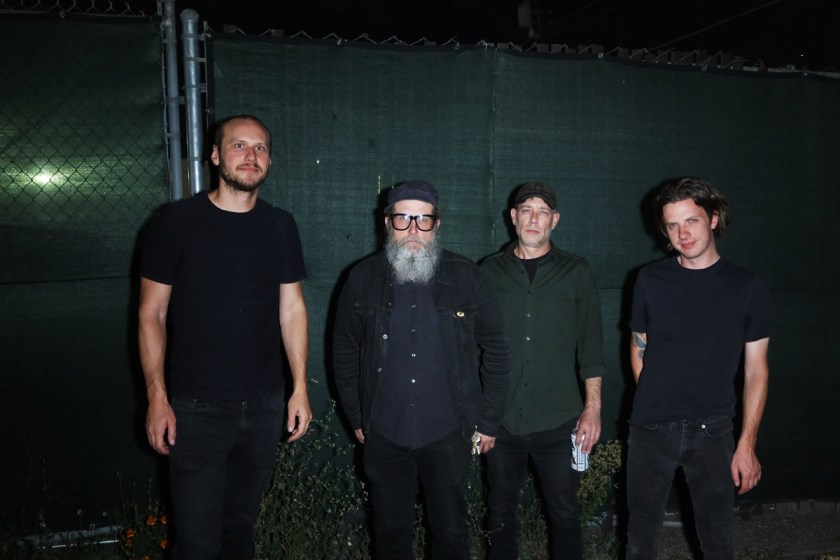
Chris Portka’s “your music is trash” sounds like something Ween and the Flaming Lips secretly did together in the early 90s before a larger public got hip to their deal. It’s a gloriously noisy, brashly lo-fi psychedelic anti-rock, splintered and deconstructed melody with vocals that are blown out with much of the rest of the sounds beyond explicable recognition other than keeping a strange consistency and a tripped out sweetness in the song. Had this been the 2000s you’d assume this was a new band on the Siltbreeze label or a cousin band to Times New Viking. That vibe that isn’t for everyone but true connoisseurs of untamed and rebellious weird music. And Portka released an entire album of this sort of thing with various incarnations and sounds like a dissected and reassembled No Age with a cool bit of freak folk dropped in called what else but Trash Music which released on August 1, 2023 and available now on streaming, digital download and very limited edition vinyl. Listen to “your music is trash” on Spotify and connect with Portka at the links below.
Charm School seems to have tapped into a well of influence on the angular and splayed dynamics of “Simulacra” that includes both The Fall and Pere Ubu and more modern No Wave-esque post-punkers Lithics and Protomartyr. The steady bass line carries the lifeblood pulse of the song on a slow arc of tonality. Guitar spikes and quick echo fades off like the musical equivalent of splashes of garish color on a white background. At other times the guitar provides a haunted melody before transforming back into a more mechanistic sound. The drums frame it all with rapid fills and moments of sustained texture. All as enhancements of a song that seems like pointed commentary no the youth culture of today and the context in which it emerged in a fractured and dissolving political monolith like “the skittish empire of the ‘United’ States/trying to make haste to eliminate each other.” The lyrics mention the counterfeit endless copies of everything being peddled as something to be excited about and the counterfeit personal gestures and aspirations that serve as a psychological and civilizational feedback loop to nowhere. But the closing line of these litanies “But I’m not listening” suggests the option of rejecting the foundations of these ersatz choices which was as Greil Marcus said over the course of his classic 1989 book Lipstrick Traces: A Secret History of the 20th Century one of the great contributions of punk as passed down from the Situationists and their spiritual and philosophical ancestors. But here it sounds like a knowing way to call all the hullabaloo about nothing real a load of nonsense no one needs to take seriously. Listen to “Simulacra” on Spotify and follow Charm School from Louisville, Kentucky at the links below. The band’s EP Finite Jest, which as a title speaks much and more succinctly clever than it has a right to be, released on July 21, 2023.
Contact sheet of Nick Cave and the Birthday Party in a disused church in Kilburn, London on 22 October 1981
Mutiny In Heaven: The Birthday Party is a 2023 documentary about Australian post-punk band The Birthday Party. Formed in 1977 in suburban Melbourne as The Boys Next Door the band quickly realized that they needed to be where most of the music that interested them was happening meaning outside their home country. The documentary tells the story of the influential group’s modest beginnings as local weirdos into art and literature that pursued music almost as an afterthought only to become a band described in its heyday as the most dangerous band in the world. Led by Nick Cave and guitarist Roland S. Howard the group also comprised of drummer Phill Calvert, bassist Tracey Pew and guitarist Mick Harvey The Birthday Party still come off like figures of rock and roll myth.
Directed by Ian White, Mutiny In Heaven: The Birthday Party utilizes extensive archival footage, photography, animated sequences and contemporaneous and more recent interviews with the band including the late Roland S. Howard who passed away in 2009. Dissatisfied with much of the music going on around them The Birthday Party first moved to London, England for a few years and quickly signed to legendary post-punk label 4AD on the strength of its harrowing and thrilling music and incendiary live shows fueled by tensions within the group and their collective disdain for an uninspiring and disappointing cultural milieu in the UK minus likeminded artists like The Fall and The Pop Group. That experience pushed four members of the quintet to move to Berlin leaving founding drummer Phill Calvert behind and to new creative heights before issues with drug addiction and unsustainable expectations caused its abrupt dissolution in 1983 leaving behind a legacy for excellence in deeply imaginative songwriting, unparalleled live performances and an aesthetic that was striking and unique even through today.
The Birthday Party set a high benchmark as a band and the little live footage one could find before now on more or less bootleg copies of the 1984 video release Pleasure Heads Must Burn gave glimpses of a group of artists that were universally respected by peers like Thurston Moore, Lydia Lunch and Henry Rollins. With Mutiny In Heaven: The Birthday Party you get to experience previously unreleased live performances, hear unreleased material and witness the rise and collapse of one of the most impactful and influential bands out of the post-punk canon whose legacy continues in the likes of IDLES, Viagra Boys, Amyl and the Sniffers and Sprain. The documentary is currently being screened throughout the USA including three times in Denver on October 10 at 7:30 pm. 13 and 14 at 9:15 pm and October 15 at 4 pm at Sie FilmCenter. For more information and to look for other screenings please visit birthdaypartymovie.com. At select screenings and from the movie website a limited edition t-shirt commemorating the release of the film will be available.
Anton Barbeau is one of those musicians still very active and prolific whose roots stretch back to American and international underground music with great creative distinction if not household fame. He has worked with the great neo-psychedelic band The Bevis Frond, he has collaborated with the late, great Scott Miller of The Loud Family and Game Theory fame, and for the new album his guest performers include Colin Moulding (XTC), Andy Metcalfe (Soft Boys/Robyn Hitchcock’s The Egyptians) and Chris Stamey (dB’s). That new album being Morganmusik/Nachtschlager which released on September 22, 2023. The lead single “Waiting On The Radio” features Barbeau on a trip on a bus across the country bemoaning the tire on the bus being busted yet taking solace in the promise of hearing “something golden” on the radio. In the story we get updates about how the driver should have retired years ago but in this America needed the money to get by and how everyone on the bus including himself is losing patience. But Barbeau and the band take us into gloriously beautiful psychedelic passages of expansive melody. It’s the kind of power pop song that made the first wave of “college rock” in the 80s so rewarding with tight yet imaginative songcraft that could resonate with frustrations of everyday life yet provide the kind of emotional release that was both soothing and captivating. Yet the song doesn’t feel like a throwback. Rather, it highlights how everyone has static in their lives that they have to get through and it needn’t feel like some end of the world inconvenience. It’s a very sane song in less than sanguine times. Watch the video for “Waiting On The Radio” on YouTube and follow Anton Barbeau at the links below.
“Okukomawe” or “The Return Of The King Mutesa” is a song by Abadongo Abaganda recorded in 1948 in Kampala, Uganda. It is part of an LP that released on September 15, 2023 called The Secret Museum of Mankind: Atlast of Instruments – Fiddles Vol. 1 available now on digital and vinyl as well as a special limited edition with a lithograph through Jalopy Records. The song has a sound that seems like it had to have been accomplished through electronic means today but the rapid solo on the endingidi (tube fiddle) was done with analog instruments played with an energy and mastery of the fiddle that allows for a resonance that goes beyond everyday experience with a hearty vocal delivery in the local language of the time of the recording that too transcends time and specific cultural context. The white noise from imperfections of transference to now just adds to the authenticity and charm of the music as something a modern producer might introduce digitally whereas here it’s unclear when or where this track might be from and yet it keeps you listening in to its passionate performance for the nearly three minute duration. Listen to “Okukomawe” on YouTube and for more information on the album and to order please visit the links below.
Quits is a noise rock band from Denver, Colorado that got off the ground around 2016 when some veterans of other left field and weirdo punk bands finally got together to deliver splintered and thorny yet thoughtful music into the world once again. Guitarists/vocalists Luke Fairchild and Doug Mioducki had met each other in underground music circles in the mid-90s as members of the punk-adjacent Why Planes Go Down and also punk-inspired but indiepop Felt Pilotes respectively. The two would go on to form Sparkles later in the decade, an unhinged noise rock quartet that seemed as at home playing hardcore shows as well as what might be described as indie rock shows of that time. Over the next decade Fairchild took his gift for poetic manifestation of modern anxieties and feral vocals to various projects including the still oft-spoken-of sludge metal band Kingdom of Magic and the noisy post-hardcore band Git Some which is still a going concern and includes former members of Planes Mistaken For Stars. Mioducki performed in free jazz, anti-rock group Witch Doctor before taking a break from music and moving to Pittsburgh for a time.
While Mioducki was decamped to Pennsylvania, drummer Darren Kulback was becomig active in the DIY world of Denver was a member of Hot White, a group that seemed inspired by Japanese art punk, noise and 31G and Load Records bands. The classic lineup of that outfit was fronted by bassist Tiana Bernard and included guitarist Kevin Wesley and its thrilling and confrontational sound and performances made waves within the Denver underground scene and beyond before splitting in 2011. Bernard and Kulback would continue in various bands including CP-208 for a few years with Mioducki who had returned to Denver and looking to do something well outside of mainstream music. Tripp Nasty was the band’s vocalist and it made music that brought together elements of avant-garde jazz and noise rock. But Bernard, Mioducki and Kulback were wanting to do something a little different and Mioducki had been hanging out with Fairchild more frequently at the time and the foursome started writing the foundations of the new band eventually called Quits.
Quits released its self-titled debut album in 2017 having recorded with Bart McCrorey at The Crash Pad Studio but within about a year Bernard’s academic, professional and personal pursuits took her to Portland, Oregon and friend of the band Justin Ankenbauer stepped in on bass. Ankenbauer had moved to Denver from Cincinnati earlier in the decade having a background in visual art and that city’s noise scene and shortly into his first tenure with Quits he had to focus on his work for a time and the pandemic hit putting most bands on effective hiatus for over a year. But during that time Quits recruited Sweetness Itself songwriter and guitarist Cyrena Rosati on bass and it is Rosati who performed on the recordings for the new Quits album Feeling It, again recorded with McCrorey. Now the long awaited record out now through New York City label Sleeping Giant Glossolalia run by former Denver-ite Michael Reisinger is available on vinyl and digital. The band with its reconstituted lineup with Ankenbauer back I the folk now plans to take the music more widely outside of Denver in 2024.
Listen to our in-depth interview with Quits on Bandcamp and follow the band at the links below. Quits has an album release show on Sunday, October 8, 2023 at the Hi-Dive with Djunah and Almanac Man and future announced dates on October 13 at The Wolcott Galleria Theatre in Casper, WY and October 14 at Buckhorn Bar & Parlor in Laramie, WY.
CALAMITY began as the solo project of Kate Hannington whose journey to her current musical endeavors has been unorthodox, circuitous and in the end seemingly inevitable as a culmination of a life in creative work in various ends of that world. Hannington grew up in the Cleveland are and was involved in performing classical music as an oboe player who initially went to college to be in the sciences but found that deeply unsatisfying despite having a gift for engineering and she went on to New York City and ultimately earned a degree in music and got involved in the avant-garde music community in the city. But Hannington found herself at a life crossroads again and landed a job in Denver working on repairing musical instruments and then working in an engineering capacity for a major defense contractor near the Mile High City and discovered the local underground music world. Falling in with a circle of friends including Chris Adolf, Joe Sampson and Adam Baumeister Hannington found a group of people with whom to casually perform and exchange ideas in weekly get-togethers. Out of that milieu she started writing the songs that would form the core of the music for the early CALAMITY which she performed at the open mic at Syntax Physic Opera just in time for the COVID-19 pandemic to hit. It was around that time that Hannington had been working on her latest live film score in collaboration with a friend. The extended time off from even having performing live as an option allowed Hannington the time to refocus on her decision to make music a priority as it was the only thing over the course of a successful regular work life that felt like where she wanted to be. When shows started happening again, CALAMITY became an active project and most often during 2022. The musical style would be difficult to narrow down to something definitive except to say that it has elements of shoegaze, left field punk, Americana and all united by strong songwriting and Hannington’s powerful and expressive voice and strong stage presence. All of this can be heard strikingly on the debut CALAMITY full-length Chiromancy. From the gorgeously symbolic cover art to the vividly captured and produced recordings there is a unified intentionality that seems obvious in every detail. Hannington’s stories hit as deeply personal but also as a widely relatable set of narratives of letting go of relationships, the beliefs, the habits and associations that hold us back from a fulfilling and rewarding life and moving on toward it.
Listen to our extensive interview with Hannington on Bandcamp and follow CALAMITY at the links below. The band is having an album release show at The Skylark Lounge on Friday, October 6, 2023 with Allison Lorenzen and Soy Celesté. Also catch Hannington performing with local rock supegroup Easy Ease.
Alex McArtor returns with a new single called “Oxygen Thief.” The guitar sound sits in the background like droplets of water on the ocean and the bass sound and percussion setting a steady pace as McArtor relates a story of love and conflicted feelings about its dissolution. Clearly the song is written from the perspective of having moved on but looking back with some yearning for what that bond brought into their shared life and the sense of romance and sweet feelings and how in some ways it felt like a relationship defined by a kind of unspoken dependence and McArtor sings about how she felt addicted to the love of her beloved like oxygen and that she was the oxygen thief. It’s a clever and revealing twist in the song that lends some weight and depth to a song that has such an upbeat mood underneath the touch of melancholic mood and ethereal atmospheres and a creative flourish that McArtor has brought to her body of work thus far. Watch the lyric video for “Oxygen Thief” on YouTube and follow McArtor at the links provided.
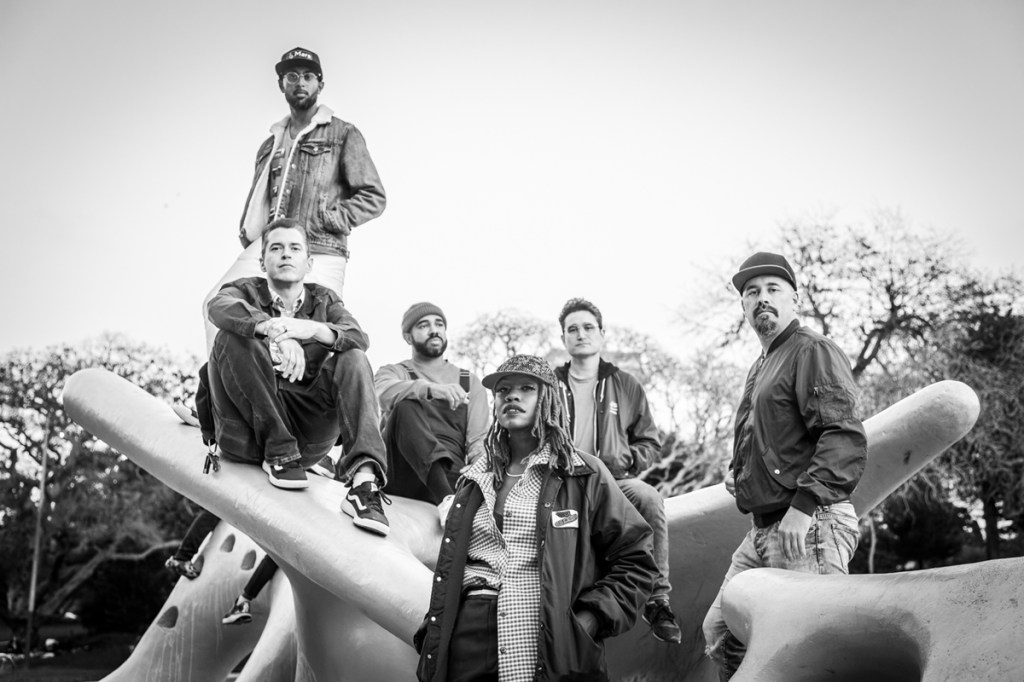
Bay Area art rock/post-punk luminaries The Seshen is releasing its new album Nowhere on October 6, 2023. The album traces the group’s development and struggles as people and as a band with the marriage and divorce of Lalin St. Juste and Aki Ehara as part of the backdrop and emotional resonance of the songwriting. The single “Lost at Night” evokes a deep sense of personal disconnect and wistfulness for a time and place when things felt “normal” or at least like one was on some kind of footing even if that could feel tenuous at times. But everyone in the past few years has probably had their foundations shaken a little personally and in life in general. This song and its hazy production and echoing melodies with spectral tones and warping, bending guitar sounds in the mist of synths with St. Juste’s soulful vocals and the propulsive percussion anchoring the song and keeping those disconsolate moods from carrying us off to places even more removed from our center. It’s a song that feels gentle and compassionate in its ability to transport us from a place of utterly mystified reverie to one of acceptance of the inherent impermanence of almost all things in our lives and to find hope in how things can resolve when we make the effort or have the privilege of indulging patience in allowing events and hearts to reach their eventual places when they are beyond our ability to influence them. Listen to “Lost at Night” on Spotify and follow The Seshen on Instagram.








 Queen City Sounds and Art
You must be logged in to post a comment.