“Step by step and day by day I’m removing the powder,” the chorus of Bliss Carmxn’s “Powder” is about the way we use and put on various things to cope and adjust to a world that’s ever changing and leaves us seemingly always off balance but how when we recognize these habits of mind and living we have some chance of finding our equilibrium even if it’s a lifelong endeavor. It might be seen as another way of saying the path is the destination and that that consciousness of it all is where we will find our balance. The song itself embodies this in its fusion of Calypso beats and percussion with pop structure and melodies giving a balance of tonal and rhythmic elements that gives the song a way to be fresh in each iteration of the chorus. The playfulness with which it’s performed also suggests a comfort with the ambiguity that is unavoidable in life and thus a cultivated ability to roll with what comes your way. Listen to “Powder” on Spotify and follow experimental pop artist Bliss Carmxn at the links provided.
Esbie Fonte paces “Time Traveler” as though she’s walking down a corridor with images from the past several decades and giving a guided tour of where the human race has been and where it’s going. What gives it an unusual and interesting quality is how it is sometimes related from the first person like an autobiography related by someone who has been able to partake of that timeline in its tragically poetic, heartbreaking moments. Musically its somewhere in the realm of dark, lush folk in instrumentation and in free use of natural textures and rhythm. There is a vulnerable, even fragile, quality to the songwriting that is as inviting as it is foreboding. Fans of Marissa Nadler will appreciate the way Fonte’s mythical storytelling imbues it with a subconscious quality as though coming from a place of raw subjectivity. The vocals in being unconventional and quavering with the heft of emotion should resonate for those with an appreciation for Kimya Dawson’s idiosyncratic delivery of her own insightful poetry in song. Listen to “Time Traveler” on Soundcloud and follow Esbie Fonte at the links provided.
The descending keyboard line in Gone Sugar Die’s “Grey Eyes” is like a stylized series of raindrops in the melancholic melodic haze that runs through most of the song. The processed vocals shift slightly in tone and in echo so that it is easily takes on the role of omniscient observer. Lightly distorted synth swells mark time as the vocals relate what sounds like the story of a a girl with a troubled conscience with her sleep interrupted by anxiety. What the source of that nervous energy might be remains mysterious but the narrator of the song and the soothing, chill tones are aimed directly at dissolving those worries so that she can get some rest from a long stretch of emotional duress. The song hearkens back to the chillwave style of around a decade ago but with a more modern sheen in the production without sacrificing the emotional immediacy and introspection that much of that music excelled at evoking. Listen to “Grey Eyes” on YouTube and follow Gone Sugar Die, which includes members of The Bravery and The Cut Losses, at the links below.
YZMUTi’s “The Space Out,” the fourth and final epic from the group’s debut album Tipota, begins with sounds like voices calling wordlessly across the water on a moonlit night. But when the beat comes in the abstraction coheres a bit and then comes into focus with the lyrics toward the first third of the more than nine minute composition. Yet there is a beautifully disorienting element that vibes with the name of the song. Swelling, textured tones bubble up, sparkling sounds hover and zip by in the soundscape as our imagined narrator wanders through a futuristic landscape with distractions from reality aplenty so that one can be spaced out to the point of a perpetual dissociative episode. The line “I overdosed on pleasantries by the age of three” and “I hope I never have to return from delirium” speaks to that state of things as a swing from becoming too readily attached to things and to people. It is exploring that spectrum in ethereal and effervescent dynamics and imaginative, poetic imagery on which this unusual and ambitious song work. We experience the intimacy of thought while taking a trip into emotional stratosphere in the melody. The lyrics talk about that process and mechanism of dissociation while coming from direct experiences that are themselves a ladder out of endless distraction through self-awareness and recognizing that process as a choice made easier by circumstance. Musically it’s reminiscent of Alice Coltrane’s more ambient, spiritual records and Stevie Wonder’s more unusual 1970s experimental records but with a modern ear for sound design. Although the song is over nine minutes long it feels like a short, colorful journey through a life in dreamlike stasis yearning to wake up into a conscious life filled with genuine joy rather than soporific bliss. Listen to “The Space Out” on Soundcloud.
Shaeen’s hip-hop single “Leyla” is a stark story about an ongoing issue in his home country of Iran. It might be safe to say most Americans know little about Iran, its culture and its history except for cartoonish propaganda and distortions. After the Islamic Revolution of 1979 concluded in the declaration of an Islamic republic plenty of Iranians supported and were already been used to a more modernist, secular government with freedoms for women. Marjane Satrapi’s excellent 2000 graphic novel Persepolis and the 2004 follow-up Persepolis 2 discuss some of those tensions with the Islamist takeover for her own family and life. “Leyla” is about one facet of life faced by women by telling the story of a 17-year-old girl who is forced to marry an older man, twenty years her senior, who is just now coming into the middle class because he has a job and not because she loves him. She resists by declaring she doesn’t love the man but in that society these choices are not hers to make, she can be essentially sold off to a man. While this is passed off as part of a culture, no one really wants to be married off to someone they don’t know and when the abuse happens, they don’t want to stay with that person. Shaheen describes how the girl is told to wear a hijab and “act modestly” as a symbol of the supression of her wishes and agency as a human. Following that, depression and other mental health issues ensue as would be a normal reaction from anyone given the same situation. But of course a divorce is a sin no matter the abuse inflicted. And of course the girl has a daughter with the man in question and the cycle repeats into a generational kind of abuse. The lines “Take me to heaven what do I got to do? To be at peace I’ve got nothing to lose” suggest much and a tragic conclusion to the story. Shaeen uses some traditional Persian music sounds and scales in the beat while delivering the lyrics with a compassionate urgency. While that specific scenario may be a major problem in Iran, it has resonance with so many situations in even America where cultural indoctrination of various kinds and poverty has convinced and continues to convince people they have no other options in life other than those imposed on them. That resonance gives the track another dimension of power. Listen to “Leyla” on Spotify and follow Shaheen at the links below.
This second EP from The Non-Functional Saints (Phil Minns of Non-Functional Harmony and Nick Lewis of Nicolas and the Saints) and its title track, the sprawling, evolving “2,” is a composition in five parts. But all are unified by a pacing that seems consistent but never seems stuck. The song opens with hazy drones imbued with a hint of urgency and spiritual unrest as though a journey has been undertaken after long preparation. But that energy gives way to a more contemplative tenor with electromechanical sounds like a great engine pumping along. One imagines the voyage of a vehicle like the trains in Snowpiercer if they existed in a world that wasn’t built on a techno-authoritarian, post-civilizational model. When the high-pitched flaring sounds come in over the constant pulse it’s as though some kind of process has been initiated to slow the vehicle down. Then, on a dime, the track transitions to more expansive, spaciously melodic territory akin to having arrived at one’s destination and walking about in a large metropolis constructed from metal and crystal and on into a darkened plain lit intermittently by bioluminescent trees, the moon above hidden by low lying clouds. The effect of this hazy abstract drone thrumming with low end puts you in a reflective mood. Over the horizon is the flickering of light from nearby buildings, the flash of transportation streaming by in the near distance as well as expressed with splashes of bright, shimmering tones. The ambient drone subtle turns to a revolving set of tones as the journey is drawing to an end and the climax part of the piece approaches like a meeting with some kind of destiny. The ambient haze clears but the low end presence and revolving tones guide your mind to a place of deep rest after a traveling away from the distractions of the world to a place where your mind can free itself from the inessential before going back to normal life again. Fans of Robert Rich, Numina, Tim Hecker and Phaedra-period Tangerine Dream will likely appreciate this entrancing sonic journey. Listen to “2” on Spotify and follow The Non-Functional Saints on Soundcloud.
Star Parks The New Sounds of Late Capitalism cover (cropped)
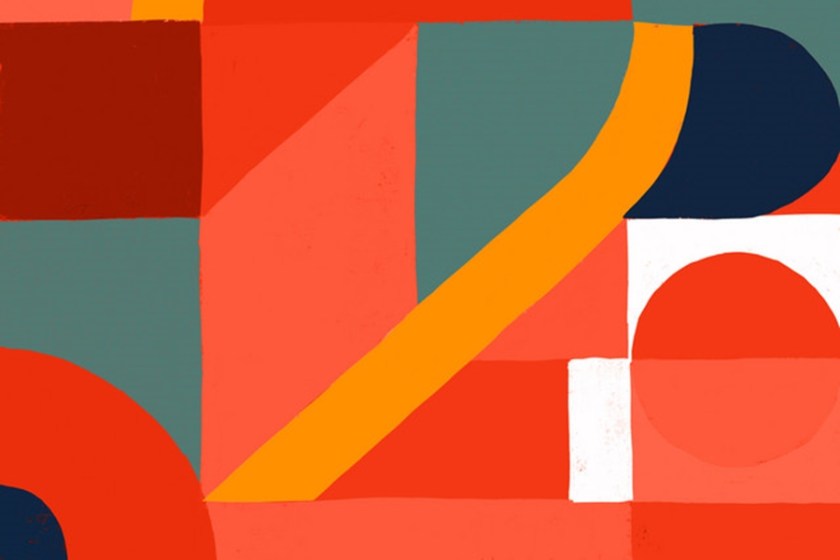
With its single “Something More,” Star Parks sounds like it’s simultaneously drifting in the influence of 90s indiepop and Gold Star Studios recordings. The plaintive vocals are produced to give it a lo-fi sheen to match the vintage tonal quality of the song and in contrast to the uplifting melody and energy that runs throughout. It comes across like someone looking back on an old romance and thinking about what they wish they had been able to say and express rather than the exact words at the time things were ending. Though the words are remorseful and melancholic it comes from a place of having moved on. Lines like “I just needed more than you can give” and “Don’t say I love you, I can’t go back” suggest the wisdom of hindsight projected back to a present tense conversation. And there’s no malice in the song, just some mild yet heartfelt regret and savoring of when things were going well mixed together in equal proportion. The horns and elegant keyboard flourishes give the song a sweeping, dreamlike quality that serves as an unexpected counterpoint to what might otherwise be heavy subject matter to look back upon. Listen to “Something More” on Soundcloud and look for the group’s full length album The New Sounds of Late Capitalism.
Biiko and ttypes team up for a vocal duet on hazily downtempo song “Mixee.” The percussion has enough production on it to take off any hard edges, synths pulse on the periphery as though to mark time on a casual stroll, a simple piano figure and a smooth bass line sets an underlying tempo that comes to the fore toward the end of the song. The song is a plea to an ex-lover in the form of reminders of how things were and what the relationship meant yet it doesn’t sound desperate, it doesn’t come off mournful, simply gentle melancholic. At times it’s reminiscent of Slowdive’s “Blue Skied An’ Clear” in its own, abstract, jazz-like flourishes and dreamlike, languid dynamics. Though the song is relatively short at a little over two minutes, Biiko and ttypes bring together enough poignant details and emotional coloring to convey much more than some artists get to at twice the length. Listen to “Mixee” on Spotify.
Logan Nelson approached a bit of his writing for his new album Lavender Echoes from a more orchestral composition perspective. But for the single “Satellites, In Orbit” he seems to have drawn some inspiration from the subject of the title both in the encountering such objects in the night sky and imagining what it must be like to be one or to be there with it. Where the organic and electronic instrumentation begins and ends in the production matters very little as it evokes the composition of the universe itself with material, concrete objects sitting in the vastness of space carried along by energy, affected by gravitational forces and in the case of satellites put into a stable orbit modulated by onboard equipment to make fine adjustments. Perhaps Nelson gazed out into the night sky one night and saw what he thought might have been an odd star moving but realized it was not a plane but rather the twinkling of a satellite, then let his imagination run to pondering how many satellites must be out there and the elegant balance of forces that make such things possible and what existence might be like for a satellite if it was imbued with an artificial intelligence. The level of sonic details, cast in overlapping layers of minimalism, in Logan’s song is impressive as it manages to convey both vast spaces and the minutiae of activity that goes on every day. Often when art contemplates cosmic places and time it focuses on how insignificant we really are in the grand scheme of things but “Satellites, In Orbit” takes the opposite view by highlighting the specificity of existence even of artificial machines humans put in place around the planet to help us communicate and provide us with a broad spectrum of information, as an extension of our own civilizations and consciousness. Listen to “Satellites, In Orbit” on Soundcloud and follow Logan Nelson at the links provided.
The Hardly Boys The Search for the Electric Void cover (cropped)
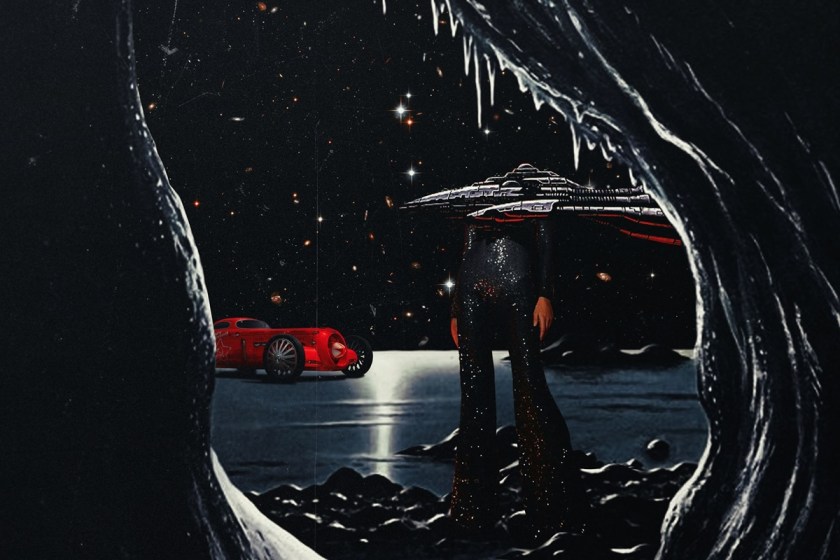
The whole aesthetic of The Hardly Boys and their new EP The Search for the Electric Void is like something informed by Church of the Subgenius and 1960s and 1970s science fiction and suspense TV. Based in Vancouver, British Columbia, the project, particularly on its single “Moving Without Religion,” has leapfrogged past the obvious industrial, noise, post-punk and psychedelic rock touchstones into its own thing seemingly born out of not wanting to sound like everything around them or what they’ve heard ad infinitum out in the world today. Hovering, cycling, menacing tones drive the song as well as vocals that catalog a journey in search for meaning without reference to established, sometimes oppressive beliefs and subcultures. Which could be seen as emblematic of the band’s approach to songwriting as its tripped out tone bending and otherworldly sound wedded to an almost lo-fi production style sets it outside too many obvious influences. The band is based out of the city that produced D.O.A., Skinny Puppy, Japandroids, Modern Creatures and Mutators and it would have been easy to fall back on any of that but fortunately The Hardly Boys have chosen a different path while not discarding the fingerprints of its influences completely. Listen to The Search for the Electric Void on Spotify and follow The Hardly Boys on Instagram linked below.









You must be logged in to post a comment.