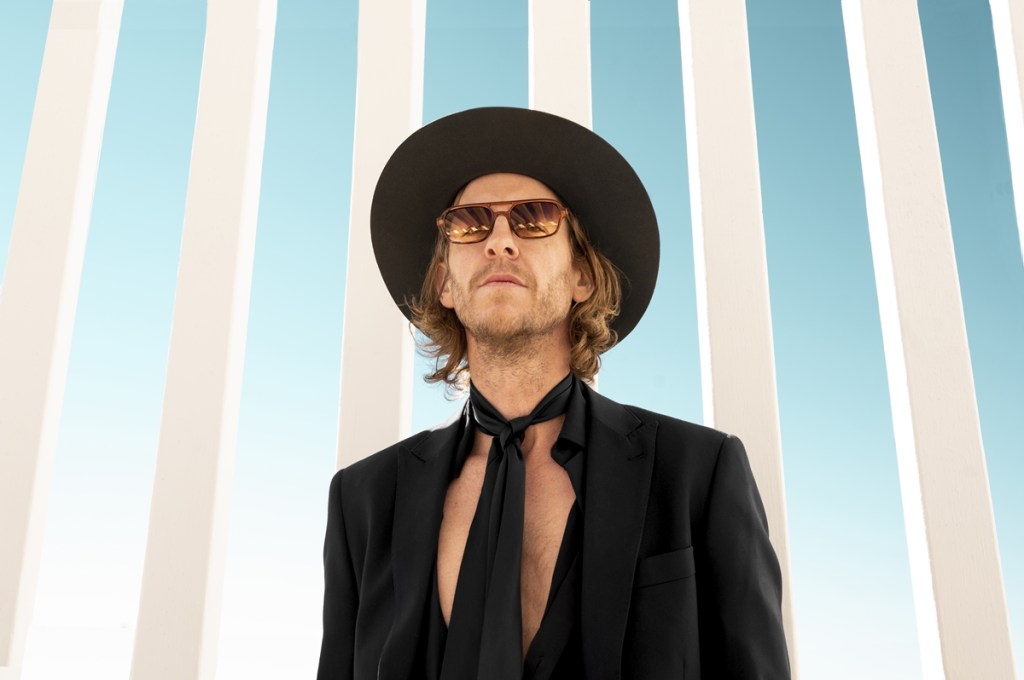
Wellbeloved, illustrated picture courtesy the artist
Wellbeloved brings together some seemingly disparate elements for its single “The Values” from its most recent album The Rusty. Distorted yet slightly shimmering guitar to psychedelic effect, splayed percussion tracing the edges of rhythm while also keeping the unconventional beat, Velvet Underground-esque guitar solos that burn over and through a drone of keyboards and bass holding the song together through force of while. It all sounds like its coming apart and colliding together elements that shouldn’t work but somehow do. David Wellbeloved lists a bevy of things going wrong in the world, all well familiar to anyone that has survived the past several years, and in listing them you get the feeling he is trying to make sense of these phenomena as well and all the angst that comes from having to deal with this flood of negative stimuli every day. But the line “Everybody’s yelling but nobody’s saying anything new” gets to the core of the collective psychological issue that is perhaps blocking actually dealing with the world as it is and with issues as they are and that is not questioning the dominant paradigms that seem to be running most people’s lives. The outsized faith in one’s own ideas and beliefs is a common shortcoming and maybe Wellbeloved isn’t suggesting he has the answers but there can be no doubting maybe taking some time off pointless self-assertion and taking the time to figure out if our stories make as much sense as we think is in order but with most people having to work too much to get by we’ll see if a more nurturing and sane world can emerge in spite of the failings of our crumbling worldwide civilization. Listen to the psychedelic blues punk of “The Values” on YouTube and follow Wellbeloved at the links provided.
Nasim Khushnawaz is a master of the Afghan rubab, one of the national instruments of Afghanistan. It’s a stringed instrument in a range of three sizes so that the smallest has 5 sympathetic strings, the medium has 19 strings and 13 sympathetic strings and the large has 21 strings with 15 sympathetic stings. It has a widely expressive range with a dazzling array of tonal, rhythmic and textural voicings that give the instrument its distinctive sound. Khushnawaz’s father is the late Ustad Rahim Khushnawaz who is considered one of the great players of the rubab and who helped to expose the West to the instrument and its music when ethnomusicologist John Bailey in the 1970s made recordings of Rubab of Herat, Afghanistan to an audience outside that country. The younger Khushnawaz recently put out his latest album of traditional Herati pieces and three classical Afghani including the lead track “Sahargah.” Captured with beautiful sonic detail and evocative power, one hears the musician’s technical prowess but also a masterful interpretive mastery with counter melody and rhythm switching effortlessly between single note syncopation and strumming utilizing drone and rapid arpeggios that give the music a fluidity and energy that is both inviting and immediately engaging even for listners who are unfamiliar with this style and form of music. The title means “Priceless” in English, a concept that should apply to one’s cultural heritage which Khushnawaz preserves ably here and across the entirety of the album Songs From The Pearl of Khorasan. Listen to “Sahargah” on Spotify and follow Nasim Khushnawaz at the links below.
Unfortunately the really boring and narrow patriarchal mindset is so common in American society rendering many men and male identified people incapable of living a full human life. It’s beyond toxic masculinity though that is the extreme end of this cultural indoctrination. Orlando, Florida based punk band Call in Dead (why call in sick when you can, you know) uses the musical language of hardcore to land a thrilling and unabashed critique of that aspect of the culture on its single “Patriarchy.” Musically it’s reminiscent of Minor Threat’s “I Don’t Wanna Hear It” in terms of ferocity and the spirit of not having regressive behavior and it’s even shorter at 1:05 versus the Minor Threat song at 1:14. But it’s not just the patriarchy that Call in Dead takes to task but an entire set of gender norms that are entirely out of date and social conditioning that stunts one’s development as a person and finding amusement in how ridiculous it is to live your life like nothing can hurt you, like violence is the only answer and the way to asset your personal power as a display of a need for dominance and as though having connection with others and even feeling love is a weakness which is just absurd and in this life you’re going to need more capacities than the patriarchy and its culture has to offer and being able to understand oneself and others beyond simple, binary gender norms is always cooler and more liberating long term and more regularly than truncating one’s cognitive framework for the sake of holding onto a dubious value system just because it’s a story you’ve been encouraged to tell yourself your whole life. Listen to “Patriarchy” on Spotify and follow Call in Dead at the links below.
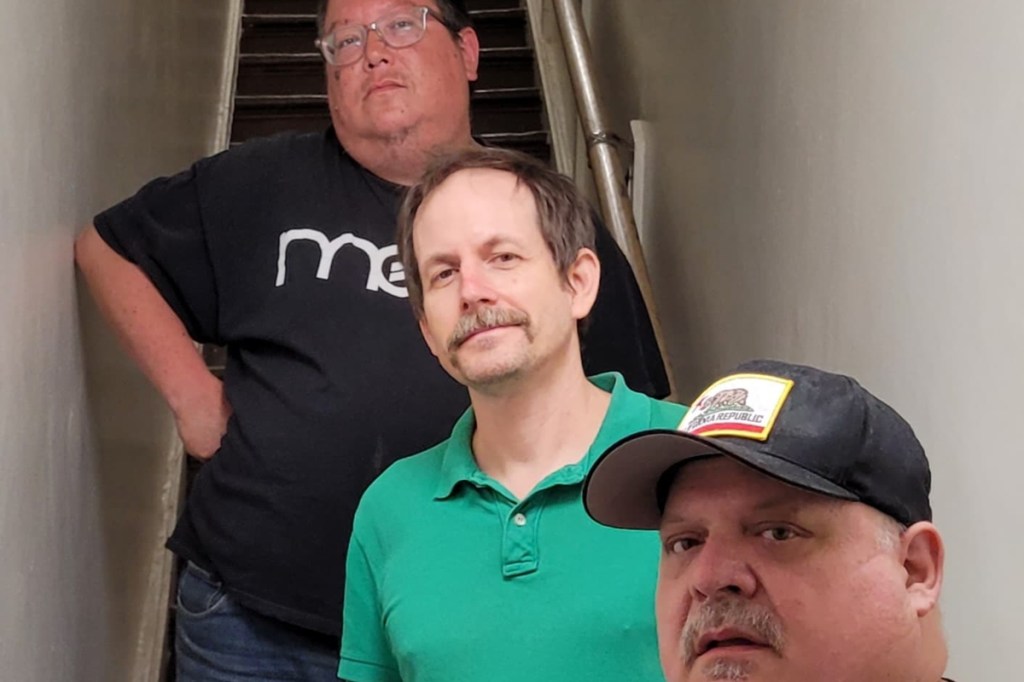
Man’s Body is a band based in both Los Angeles and Chicago. The “soft punk” band recently released its second full-length album A Set Of Steak Knives on NocturnalSol (a division of Heyday Media Group) which was recorded at KooPin in Queens, NY, Kingsize Sound Labs in Chicago, IL and Grandma’s Warehouse in Los Angeles, CA representing perhaps the sensibilities, influences and roots of the music. The music is an eclectic form of what might be called power pop but with the kind of post-punk that has vivid moods and strong atmospheric elements and the loud-quiet dynamics that are often attributed to Pixies but which can be traced to Mission of Burma. Whatever influences the group has absorbed Man’s Body has its own sound born of its members’ various backgrounds. Greg Franco came up in the Hollywood punk and underground rock world of that city having formed The Blasphemous Yellow with his brother at age 16 and played shows with bands like Psi Com (which included a pre-Jane’s Addiction Perry Farrell) and Tex & The Horseheads (which included Jeffrey Lee Pierce of Gun Club fame in its early incarnations). J. Niimi has been in and around the Chicago music scene since the late 80s as a multi-instrumentalist, a songwriter, a luthier and as a music journalist. The two met when Niimi’s band Ashtray Boy played one night in Los Angeles and the two hit it off as friends and a year later Franco’s band Rough Church played at Schubas in Chicago where Niimi was invited to fill in on drums. From there the emergent band Man’s Body would go on to record the Found EP at Steve Albini’s studio Electrical Audio and two full length albums. A Set Of Steak Knives and its lush production and evocative and imaginative songwriting is proof that though Niimi and Franco live in different parts of the country that their creative chemistry is yielding a compelling body of work.
Listen to our interview with Niimi on Bandcamp linked below and to listen to A Set Of Steak Knives visit the NocturnalSol Bandcamp page also linked below where you can also order a limited vinyl edition of the record.
The shimmery, shining, repetitive synth line that runs through much of 100%’s “Prisoner” is like an analogous representation of a transmission through a landline. The other synth melodies sound like something that could have come about in 1985, 1995, 2005 or 2025. Which is fitting given the themes of the song and Lena Molnar’s vocals striking an inquisitive and low-key confrontational tone questioning the nature of power relations, justice, public safety and the habits of a society choosing to self-medicate rather than deal with serious social issues and how we deal with them or don’t in an adequate way. The song is a lo-fi, mostly electronic post-punk track but that fits these eternal themes that never seem to get resolved and though technology develops society finds a way to sweep problems that science and a current dominant form of economics, almost always in lock step with one another, doesn’t seem to be able to address to anyone’s satisfaction. Is this a song inquiring about the life of a prisoner? Who is the prisoner? Are we all of habits and ways of being and living? Does this song expand upon the meaning of “The Prisoner’s Dilemma”? This song invites the listener to contemplate these questions on a fundamental level. Fans of early Ladytron will appreciate how the song seems both retro and out of normal time. Listen to “Prisoner” on Spotify, give the rest of the album Clear Visions out on It Records now, and follow the Australian band 100% at the links below.
WITXHES launch us into “A Part Ache” with an urgent Motorik beat and an urgent, distorted synthesizer melody. Barely discernible but clearly troubled/conflicted vocals offer snapshots of what it means to be aging, if the introduction to the unusual video is any indication. The visuals are historical pictures in the daily life of children in a town in South Dakota during the Great Depression as shot by Ivan Besse and edited for the song by Emanuel Lundgren. The latter added color anomalies and warping and visual distortion as though turning old photographs into an old VHS tape image. The song is reminiscent of the bizarre and wonderful mashup of industrial, punk and psychedelic Krautrock that was early music by Pop. 1280 circa The Grid. It has a similar appealingly scuzzy aesthetic that lends the sentiments of the song an authenticity that a more pristine soundscape couldn’t really do justice. Aging is something that happens to us all if we’re lucky and the experience of it can feel like an accelerating process that stretches out memory that can hit most people like a feedback loop if they don’t take the time to put one’s experiences into perspective, a luxury many of us aren’t regularly afforded. And in the end these experiences and memories and direct connections with others really only matters to us and the people we know. A hundred years from now most of us won’t even be part of official history. The song reflects that phenomenon and realization well in all its confusion and moments of cognitive clarity. The track comes from the Swedish post-punk band’s June 3, 2022 album Bury your Witxhes and you can watch the video on YouTube, maybe check out the rest of the record on Bandcamp and otherwise connect with WITXHES at the links below.
The Body at Larimer Lounge 5/31/22, photo by Tom Murphy
The Body has long been a band that you could rely on to roll into town once a year or so for years before the early phase of the COVID-19 pandemic put a stop to live shows as we know it for a good long while. The band’s uniquely cathartic, experimental extreme metal, monolithic onslaught was something you could take for granted as an inevitability. And finally the duo returned to Denver for a show at Larimer Lounge that was not a bill of all metal or heavy bands in any conventional sense and that is part of why this show felt particularly impactful. On a personal note when I walked up to the merch table drummer/programmer Lee Buford complimented by Chari XCX t-shirt and it was sincere. I would have been surprised but The Body is a band that has made no bones about its appreciation for music far afield of that for which it’s known and its 2016 album No One Deserves Happiness paired heaviness with 80s dance tracks. For me this acknowledgment of a mutual appreciation for one of the more interesting pop artists of today set a mood for the show to come.
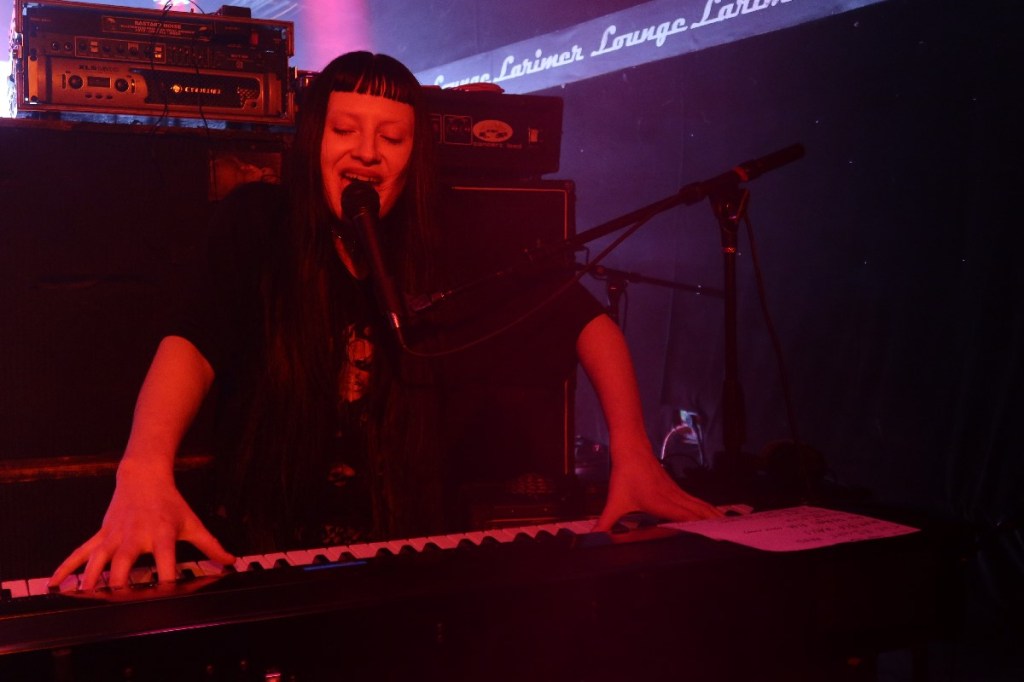
Polly Urethane at Larimer Lounge 5/31/22, photo by Tom Murphy
Less than a week prior Polly Urethane had performed with Rusty Steve for a powerful set opening for A Place to Bury Strangers. For this show Polly Urethane performed alone for a set of music completely different from her performance the previous Thursday. She had the long white cowl on hand for part of the set but performed much of the show in black with a t-shirt. Elegant piano work and operatic classical style vocals paired with an old Realistic Air Force Sound Effects record sampled directly and some of Polly’s electronic pieces.
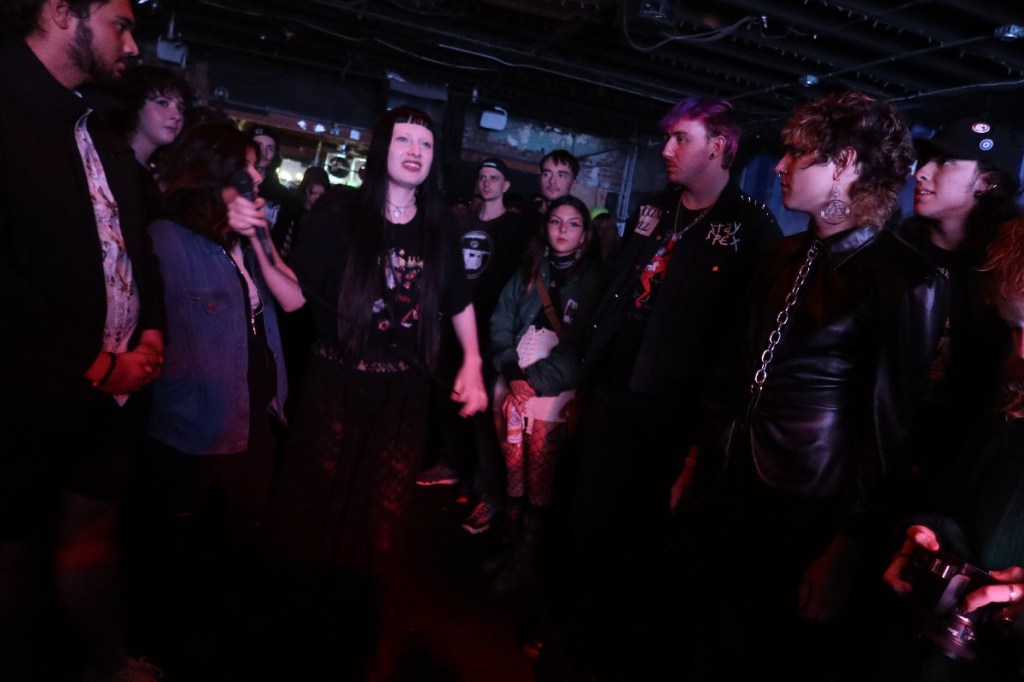
Polly Urethane at Larimer Lounge 5/31/22, photo by Tom Murphy
The music felt like part of a greater arc of performance wherein Polly broke that stage and audience barrier by going out into the crowd with her extended mic chord and while on stage stood on top of monitors balancing there somehow as if setting an example of fearlessness vulnerability. When she brought her left leg up on top of the piano while leaning forward to play it and sing it challenged notions of how the instrument is “supposed” to be played in performance and gave a visual element to the show that seemed to change regularly so that you really had no chance to get bored not that the music itself gave that opportunity either as it fused classical convention with the avant-garde in equal measure and performance art as much as musical.
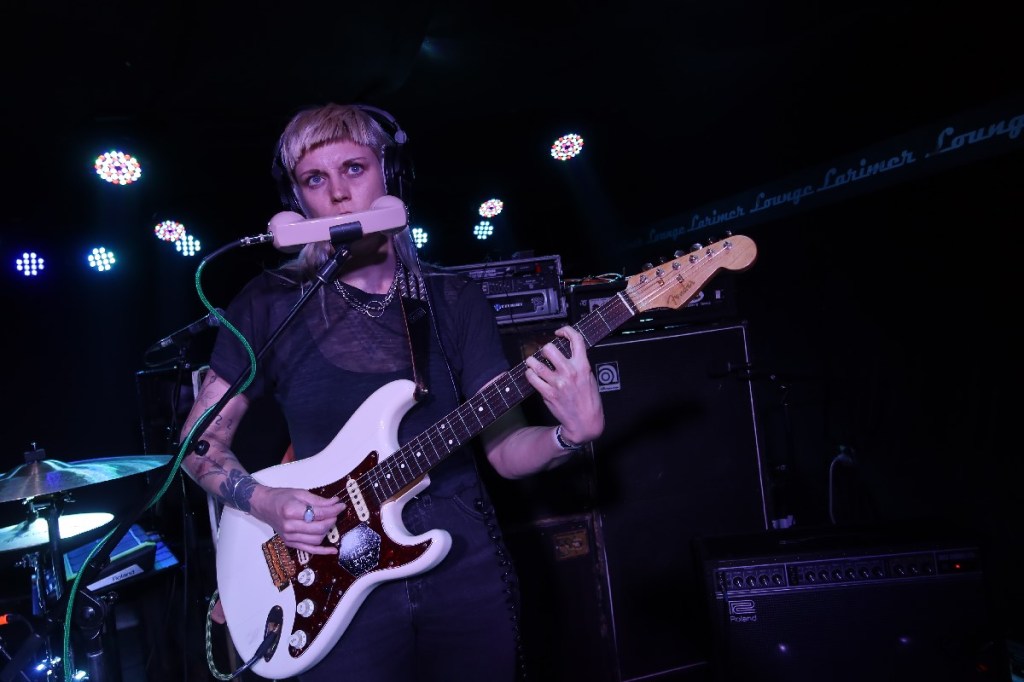
Polly Urethane at Larimer Lounge 5/31/22, photo by Tom MurphyMidwife at Larimer Lounge 5/31/22, photo by Tom Murphy
Anyone that hadn’t seen Midwife in a good long while, like many of us, couldn’t have been quite prepared for how much Madeline Johnston has honed her set. Not that she lacked for emotional power before and maybe it’s all just a matter of the weight of the past few years that went into the writing of the music and fine tuning its performance and presentation but every song hit deep. If your heart didn’t break from the way Johnston held pauses in the flow of the song to allow the unspoken emotional swell to build before heading back in to direct that energy to greater heights and depths you have probably lost the capacity to be affected by music. It’s just Johnston, her guitar and maybe some backing tracks and it’s spare stuff but it has all been refined for maximum evocative power at this point. You can feel the anguish and sorrow cathartically flowing through songs like the utterly crushing and devastating “S.W.I.M.” – the hazy soundscapes and perfectly accented guitar riffs coupled with Johnston’s warmly gentle vocals and ability to draw out the distillation of despair and memories of better times honors the loss she depicts in her songs in a way that hits all the emotional keys in your brain the way maybe they need to be more often.
Midwife at Larimer Lounge 5/31/22, photo by Tom Murphy
The whole set felt like one, extended, beautiful exorcism for a few moments the sadness of the living memory of people and places and situations you’ll never get back. It was shamanic in effect and transcended simple music which is an utter rarity in live music with how Johnston is able to make your time with her feel so intimate, moving and healing.
The Body (Chip King) at Larimer Lounge 5/31/22, photo by Tom Murphy
Maybe it never hit full before but the colossal, gritty and unusual sounds that had made The Body such an interesting band in the past had always been something of an orchestration of sounds, textures, rhythms and moods that Chip King and Lee Buford orchestrate in a two person format to accomplish nuances that full bands sometimes don’t. King’s eccentric, screechy vocals have subtleties of their own and part of that is the syncopation of his vocals with guitar and percussion. Buford using both electronic drums and acoustic is somehow both utterly bludgeoning and elegant in execution like he is fully aware of how every aspect of what he’s doing has the potential to have an effect on the listener and his partner in crime King’s emotional state during the performance and vice versa. And yet it felt so spontaneous and raw it was easy to miss unless you were keyed into that dynamic between the two musicians and the crowd. King’s feedback sculpting spiraled out like a jet engine at times and within those scorched gyres of distorted guitar fragments there was a great sense of release and a joyful abandon that seemed like the reason to play and to witness music like this.
The Body (Lee Buford) at Larimer Lounge 5/31/22, photo by Tom Murphy
King and Buford performed with a zen-like intensity and focus yet released the energy they coiled up across the set with a dynamic force that was impossible to rest and in which to be caught up. After over a decade of seeing this band now and then this show made it obvious that The Body has built into its craft and its songwriting a lack of laurels upon which to rest and if its eclectic and prolific set of releases isn’t proof enough it’s that absorbing of disparate influences into its music that is channeled into the show that sets it apart from many other extreme metal bands experimental or otherwise.
The Body at Larimer Lounge 5/31/22, photo by Tom Murphy
JoobieSeaz apparently recorded the guitars for “Cramps” on “amateur” equipment a couple of winters ago and couldn’t replicate the sound on more professional gear. And there’s something to be said for laying down a mood with a unique texture and sonic quality. The completed song as it is doesn’t sound like it’s coming from any conventional realm of rock even given its psych aesthetic. Like the band took the aforementioned guitar work that sounds like Cranes and Bardo Pond had an acoustic jam session and sketched out some delicate passages that couldn’t help but be unusual and mysterious and built the rest of the song around it with a framework of a loping, descending bass line, soft percussion and vocals that whisper with an intimate, diarist quality that both ponder and seem to beckon. Really JoobieSeaz’s song doesn’t sound like much else except it has a feel like something that could have come out on a 1990s American underground label that was home to unique and some would say eccentric artists like a K Records, Kill Rock Stars or early Matador. Listen to “Cramps” on YouTube and follow the German band JoobieSaez at the links below.
The video for Fox Fagan’s “Let’s Get Lost,” directed by Jon Delouz begins inauspiciously enough with the songwriter lost in the desert carrying a plastic gas can when he stumbles across a trio of what look like desert cowboy mystics. But the simple, distorted shimmer of the guitar riff keeping up an almost hypnotic melody alongside Fagan’s direct yet hazy vocals gives the whole scene some thematic direction as it is given a funk flavor with the synths and subtle bass. This colorful and fanciful soundtrack we follow our hero out of being lost into an enclave of the aforementioned mystics and joins them in a set like a jam space out of a 1970s road adventure movie. But is it all a wonderful dream? You’ll have to watch the video to find out. But the song is kind of an ear worm in its simplicity and Fagan’s inviting energy to go along on the journey of its jaunty pace and gently infectious energy. Watch the video for “Let’s Get Lost” on YouTube (featuring cameos from Orenda Fink of Azure Ray and Todd Fink of The Faint) and connect with Fox Fagan at the links provided.
The sonics of Spirits of Leo’s single “Solaris” are so vivid and detailed it’s easy to get lost in its ethereal drift of vocal and guitar melody guided gently by the accenting rhythms. The way the elements of the song synergize gives a sense of intuitive composition, an organic feel in how well everything syncs up. In the studio and perhaps in the songwriting it’s Ryan Santos Phillips (vocals, guitars, bass and synth) and Alex Lichtenstein (drums) but that can turn into an exercise in self-indulgence but you can tell the musicians considered the place and role of the instrumentation and the possibilities of expression when reinforcing and complementing each other. The processional pace and elegant dynamics of course recalls the likes of The Cure and Cocteau Twins but Spirits of Leo has clearly taken that inspiration and crafted its own musical character. The song though invoking the title and themes of both the Stanislaw Lem’s 1961 novel and Andrei Tarkovsky’s 1972 film uses that poetic imagery as a vehicle for song about the meaning of one’s life and its direction and getting back into focus after feeling adrift for too long. “Sift core from ether/Lest I forget what I’m made of” is a beautiful image of rediscovering one’s essence and the line “This is my time now/Retake my Solaris” speaks to reclaiming one’s power and engaging in the activities and habits of mind that make life feel worth living. Listen to “Solaris” on Spotify, connect with Spirits of Leo at the links below and look out for the full length album Gossamer Blue available August 12 on á La Carte Records.












You must be logged in to post a comment.