WITXHES launch us into “A Part Ache” with an urgent Motorik beat and an urgent, distorted synthesizer melody. Barely discernible but clearly troubled/conflicted vocals offer snapshots of what it means to be aging, if the introduction to the unusual video is any indication. The visuals are historical pictures in the daily life of children in a town in South Dakota during the Great Depression as shot by Ivan Besse and edited for the song by Emanuel Lundgren. The latter added color anomalies and warping and visual distortion as though turning old photographs into an old VHS tape image. The song is reminiscent of the bizarre and wonderful mashup of industrial, punk and psychedelic Krautrock that was early music by Pop. 1280 circa The Grid. It has a similar appealingly scuzzy aesthetic that lends the sentiments of the song an authenticity that a more pristine soundscape couldn’t really do justice. Aging is something that happens to us all if we’re lucky and the experience of it can feel like an accelerating process that stretches out memory that can hit most people like a feedback loop if they don’t take the time to put one’s experiences into perspective, a luxury many of us aren’t regularly afforded. And in the end these experiences and memories and direct connections with others really only matters to us and the people we know. A hundred years from now most of us won’t even be part of official history. The song reflects that phenomenon and realization well in all its confusion and moments of cognitive clarity. The track comes from the Swedish post-punk band’s June 3, 2022 album Bury your Witxhes and you can watch the video on YouTube, maybe check out the rest of the record on Bandcamp and otherwise connect with WITXHES at the links below.
The Body at Larimer Lounge 5/31/22, photo by Tom Murphy
The Body has long been a band that you could rely on to roll into town once a year or so for years before the early phase of the COVID-19 pandemic put a stop to live shows as we know it for a good long while. The band’s uniquely cathartic, experimental extreme metal, monolithic onslaught was something you could take for granted as an inevitability. And finally the duo returned to Denver for a show at Larimer Lounge that was not a bill of all metal or heavy bands in any conventional sense and that is part of why this show felt particularly impactful. On a personal note when I walked up to the merch table drummer/programmer Lee Buford complimented by Chari XCX t-shirt and it was sincere. I would have been surprised but The Body is a band that has made no bones about its appreciation for music far afield of that for which it’s known and its 2016 album No One Deserves Happiness paired heaviness with 80s dance tracks. For me this acknowledgment of a mutual appreciation for one of the more interesting pop artists of today set a mood for the show to come.
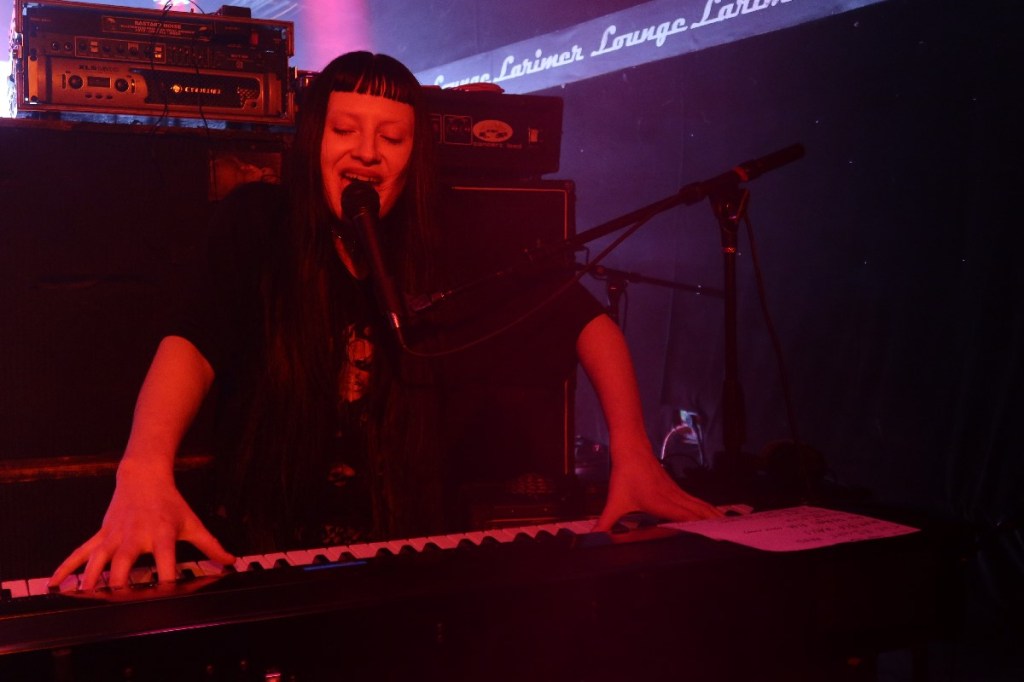
Polly Urethane at Larimer Lounge 5/31/22, photo by Tom Murphy
Less than a week prior Polly Urethane had performed with Rusty Steve for a powerful set opening for A Place to Bury Strangers. For this show Polly Urethane performed alone for a set of music completely different from her performance the previous Thursday. She had the long white cowl on hand for part of the set but performed much of the show in black with a t-shirt. Elegant piano work and operatic classical style vocals paired with an old Realistic Air Force Sound Effects record sampled directly and some of Polly’s electronic pieces.
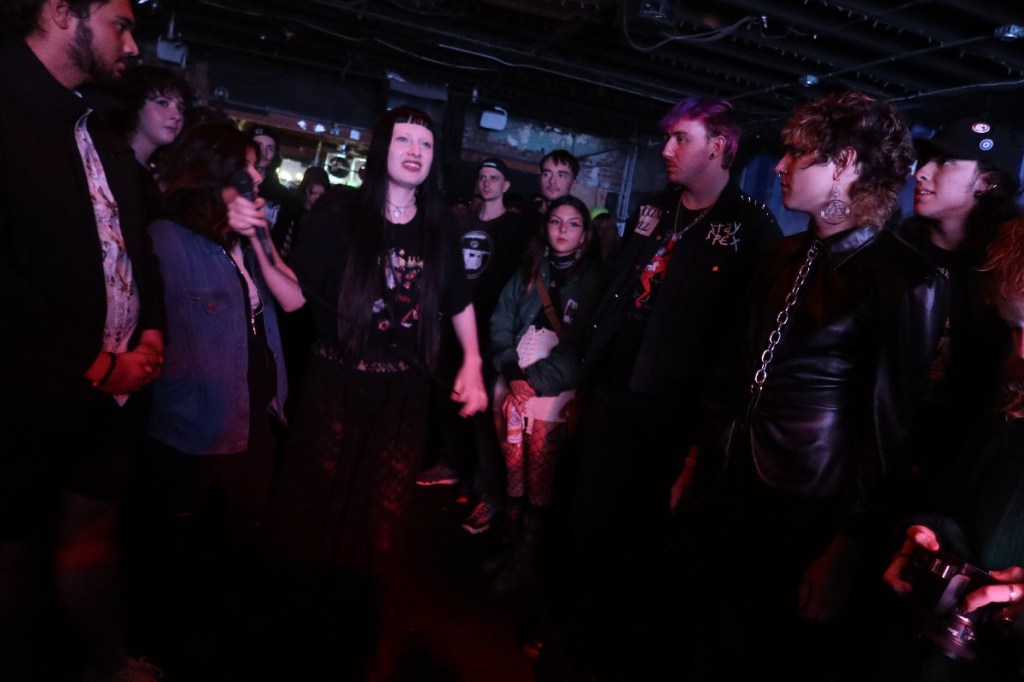
Polly Urethane at Larimer Lounge 5/31/22, photo by Tom Murphy
The music felt like part of a greater arc of performance wherein Polly broke that stage and audience barrier by going out into the crowd with her extended mic chord and while on stage stood on top of monitors balancing there somehow as if setting an example of fearlessness vulnerability. When she brought her left leg up on top of the piano while leaning forward to play it and sing it challenged notions of how the instrument is “supposed” to be played in performance and gave a visual element to the show that seemed to change regularly so that you really had no chance to get bored not that the music itself gave that opportunity either as it fused classical convention with the avant-garde in equal measure and performance art as much as musical.
Polly Urethane at Larimer Lounge 5/31/22, photo by Tom MurphyMidwife at Larimer Lounge 5/31/22, photo by Tom Murphy
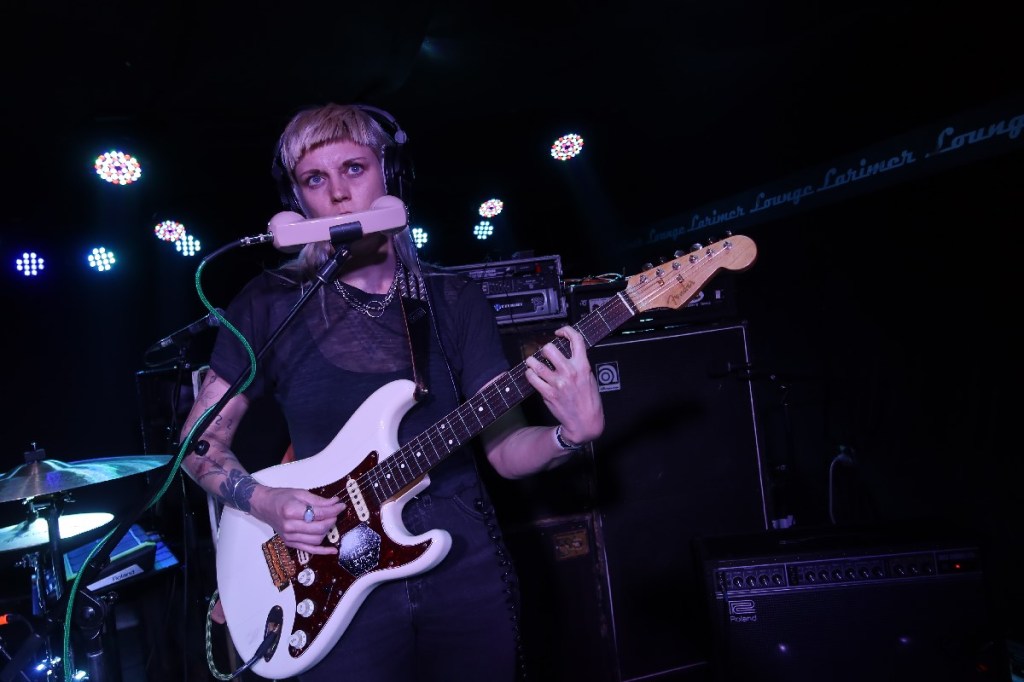
Anyone that hadn’t seen Midwife in a good long while, like many of us, couldn’t have been quite prepared for how much Madeline Johnston has honed her set. Not that she lacked for emotional power before and maybe it’s all just a matter of the weight of the past few years that went into the writing of the music and fine tuning its performance and presentation but every song hit deep. If your heart didn’t break from the way Johnston held pauses in the flow of the song to allow the unspoken emotional swell to build before heading back in to direct that energy to greater heights and depths you have probably lost the capacity to be affected by music. It’s just Johnston, her guitar and maybe some backing tracks and it’s spare stuff but it has all been refined for maximum evocative power at this point. You can feel the anguish and sorrow cathartically flowing through songs like the utterly crushing and devastating “S.W.I.M.” – the hazy soundscapes and perfectly accented guitar riffs coupled with Johnston’s warmly gentle vocals and ability to draw out the distillation of despair and memories of better times honors the loss she depicts in her songs in a way that hits all the emotional keys in your brain the way maybe they need to be more often.
Midwife at Larimer Lounge 5/31/22, photo by Tom Murphy
The whole set felt like one, extended, beautiful exorcism for a few moments the sadness of the living memory of people and places and situations you’ll never get back. It was shamanic in effect and transcended simple music which is an utter rarity in live music with how Johnston is able to make your time with her feel so intimate, moving and healing.
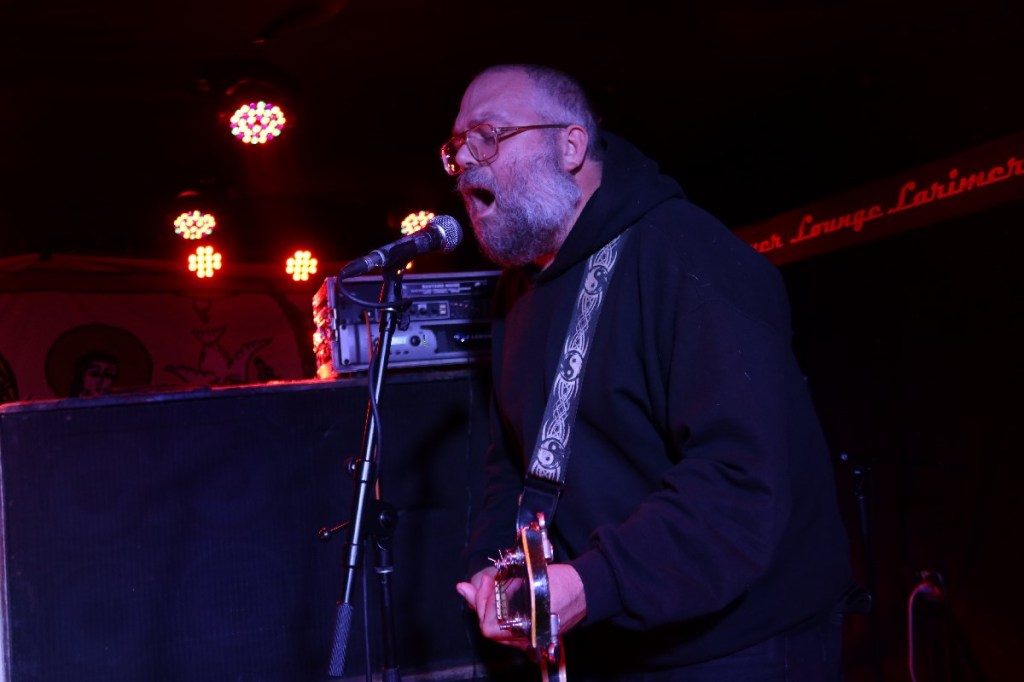
The Body (Chip King) at Larimer Lounge 5/31/22, photo by Tom Murphy
Maybe it never hit full before but the colossal, gritty and unusual sounds that had made The Body such an interesting band in the past had always been something of an orchestration of sounds, textures, rhythms and moods that Chip King and Lee Buford orchestrate in a two person format to accomplish nuances that full bands sometimes don’t. King’s eccentric, screechy vocals have subtleties of their own and part of that is the syncopation of his vocals with guitar and percussion. Buford using both electronic drums and acoustic is somehow both utterly bludgeoning and elegant in execution like he is fully aware of how every aspect of what he’s doing has the potential to have an effect on the listener and his partner in crime King’s emotional state during the performance and vice versa. And yet it felt so spontaneous and raw it was easy to miss unless you were keyed into that dynamic between the two musicians and the crowd. King’s feedback sculpting spiraled out like a jet engine at times and within those scorched gyres of distorted guitar fragments there was a great sense of release and a joyful abandon that seemed like the reason to play and to witness music like this.
The Body (Lee Buford) at Larimer Lounge 5/31/22, photo by Tom Murphy
King and Buford performed with a zen-like intensity and focus yet released the energy they coiled up across the set with a dynamic force that was impossible to rest and in which to be caught up. After over a decade of seeing this band now and then this show made it obvious that The Body has built into its craft and its songwriting a lack of laurels upon which to rest and if its eclectic and prolific set of releases isn’t proof enough it’s that absorbing of disparate influences into its music that is channeled into the show that sets it apart from many other extreme metal bands experimental or otherwise.
The Body at Larimer Lounge 5/31/22, photo by Tom Murphy
JoobieSeaz apparently recorded the guitars for “Cramps” on “amateur” equipment a couple of winters ago and couldn’t replicate the sound on more professional gear. And there’s something to be said for laying down a mood with a unique texture and sonic quality. The completed song as it is doesn’t sound like it’s coming from any conventional realm of rock even given its psych aesthetic. Like the band took the aforementioned guitar work that sounds like Cranes and Bardo Pond had an acoustic jam session and sketched out some delicate passages that couldn’t help but be unusual and mysterious and built the rest of the song around it with a framework of a loping, descending bass line, soft percussion and vocals that whisper with an intimate, diarist quality that both ponder and seem to beckon. Really JoobieSeaz’s song doesn’t sound like much else except it has a feel like something that could have come out on a 1990s American underground label that was home to unique and some would say eccentric artists like a K Records, Kill Rock Stars or early Matador. Listen to “Cramps” on YouTube and follow the German band JoobieSaez at the links below.
The video for Fox Fagan’s “Let’s Get Lost,” directed by Jon Delouz begins inauspiciously enough with the songwriter lost in the desert carrying a plastic gas can when he stumbles across a trio of what look like desert cowboy mystics. But the simple, distorted shimmer of the guitar riff keeping up an almost hypnotic melody alongside Fagan’s direct yet hazy vocals gives the whole scene some thematic direction as it is given a funk flavor with the synths and subtle bass. This colorful and fanciful soundtrack we follow our hero out of being lost into an enclave of the aforementioned mystics and joins them in a set like a jam space out of a 1970s road adventure movie. But is it all a wonderful dream? You’ll have to watch the video to find out. But the song is kind of an ear worm in its simplicity and Fagan’s inviting energy to go along on the journey of its jaunty pace and gently infectious energy. Watch the video for “Let’s Get Lost” on YouTube (featuring cameos from Orenda Fink of Azure Ray and Todd Fink of The Faint) and connect with Fox Fagan at the links provided.
The sonics of Spirits of Leo’s single “Solaris” are so vivid and detailed it’s easy to get lost in its ethereal drift of vocal and guitar melody guided gently by the accenting rhythms. The way the elements of the song synergize gives a sense of intuitive composition, an organic feel in how well everything syncs up. In the studio and perhaps in the songwriting it’s Ryan Santos Phillips (vocals, guitars, bass and synth) and Alex Lichtenstein (drums) but that can turn into an exercise in self-indulgence but you can tell the musicians considered the place and role of the instrumentation and the possibilities of expression when reinforcing and complementing each other. The processional pace and elegant dynamics of course recalls the likes of The Cure and Cocteau Twins but Spirits of Leo has clearly taken that inspiration and crafted its own musical character. The song though invoking the title and themes of both the Stanislaw Lem’s 1961 novel and Andrei Tarkovsky’s 1972 film uses that poetic imagery as a vehicle for song about the meaning of one’s life and its direction and getting back into focus after feeling adrift for too long. “Sift core from ether/Lest I forget what I’m made of” is a beautiful image of rediscovering one’s essence and the line “This is my time now/Retake my Solaris” speaks to reclaiming one’s power and engaging in the activities and habits of mind that make life feel worth living. Listen to “Solaris” on Spotify, connect with Spirits of Leo at the links below and look out for the full length album Gossamer Blue available August 12 on á La Carte Records.
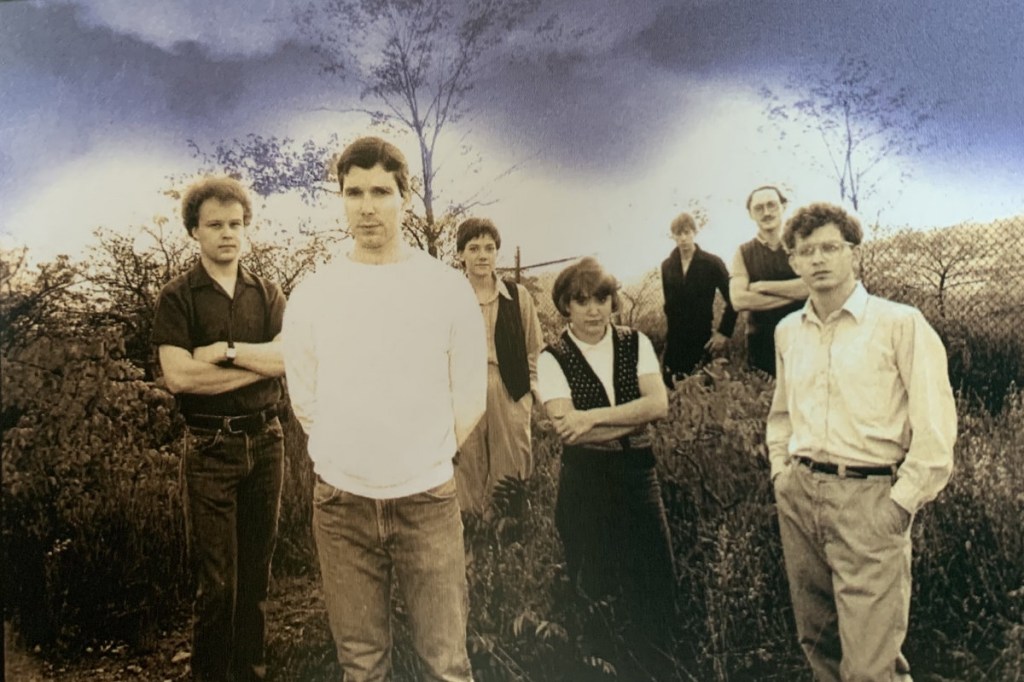
The Trypes is an experimental, psychedelic folk band that began in 1982 in Haledon, New Jersey. It’s instrumentation began with an eclectic mix of sounds and textures so that its music was difficult to narrow down to an established genre. Fans of Savage Republic (who were contemporaries) and Stereolab will find something to like in The Trypes’ unconventional use of rhythm and composition at times seeming to favor compound time signatures and textural atmospheric elements. Its brand of folk and psychedelia sounded like it had tapped into a bit of the minimalist post-punk of the early 80s like Young Marble Giants and the more avant-garde Swell Maps whose own use of noise collage has some resonance with what you hear in a song by The Trypes. Around the mid-80s Glenn Mercer and Bill Million of influential post-punk band Feelies joined The Trypes for a time when their own band was on hiatus adding to some of this group’s artistic legacy. In 2012 Acute Records released the collection Music fore Neighbors which collected the group’s 1984 EP The Explorer’s Hold as well as unreleased demos and a compilation track not so easy to come by. But now in 2022 that compilation has been reissued on Pravda Records to celebrate the band’s 40 year anniversary and now includes songs from a 1984 showcase at the Bottom Line in New York and two tracks recorded when the original Trypes performed a reunion show in 2017. The CD is available now with a gatefold vinyl to be issued later in 2022. This interview was conducted with founding keyboard player John Baumgartner and delves into the group’s early days in New Jersey and its development and for many rediscovery.
Listen to the interview with Baumgarnter on Bandcamp linked below and for more information on The Trypes and to order the CD/download of Music For Neighbors visit the links below.
London Plane employs a lo-fi sensibility on its psychedelic post-punk single “Come Out of the Dark.” With the imaginative music video for the song one gets a taste of what feels like a more humanized science fiction concept album that is its new record Bright Black (which released on June 17, 2022). It’s not really comparable sonically or songwriting-wise to Failure’s 1997 masterpiece Fantastic Planet. But conceptually and in terms of how some of the imagery and language used makes for a more colorful storytelling and the ability to tell stories of human psychology and relationships in ways that don’t seem hackneyed or trite. “Come Out of the Dark” deftly incorporates electric and acoustic guitar with synths, drums, bass and poignant vocals for an effect like Siouxsie and the Banshees’ “Dazzle” but repurposed as more modern indie pop space rock song. The easy sweep from major chord progression to minor and back throughout the song at unexpected points enhances the emotional impact of its layered melodies. The message of the song encouraging a specific person or the generalized you for whoever needs to hear the words to stop being disengaged, jaded and above it all when you can “be cool” and “come out of the dark” and “be adored,” “Be a defender,” “be a hero.” Yet the tenor of the song is one of understanding of a desire to disconnect with the world and events and community because of how it can wear you down or alienate but if you have some great personal qualities and skills and knowledge it’s wasted in wallowing in cynicism and bitterness when you can enjoy putting that all into the world in a productive way. Even if only a little. The music video is like something that Panos Cosmatos would make if he were in the business of such things and really captures a desire for isolation when the human community needs people of creativity and imagination more than ever. Watch the video on YouTube and follow London Plane at the links below.
Listening to “Push” by Big Empty Zero one hears a softly industrial beat like something that might have been conceived in experiments with 8-bit sounds and early video games but paired with luminously moody synth lines and an abstract, extended melody that gives a sense of being pushed along through a near future cityscape where automated processes see to the maintenance of urban spaces and can thus seem like living in an MMO or the world of an old cyberpunk video game but without the menace, just the sense of ambient and steady movement. The track has momentum but it never reaches the point of urgency, just a solid sense of energy and place that continues on day and night often unnoticed unless you take the time to be aware of those things around you that make your way of life flow more efficiently than it would be otherwise. Listen to “Push” on Spotify and follow Big Empty Zero at the links below.
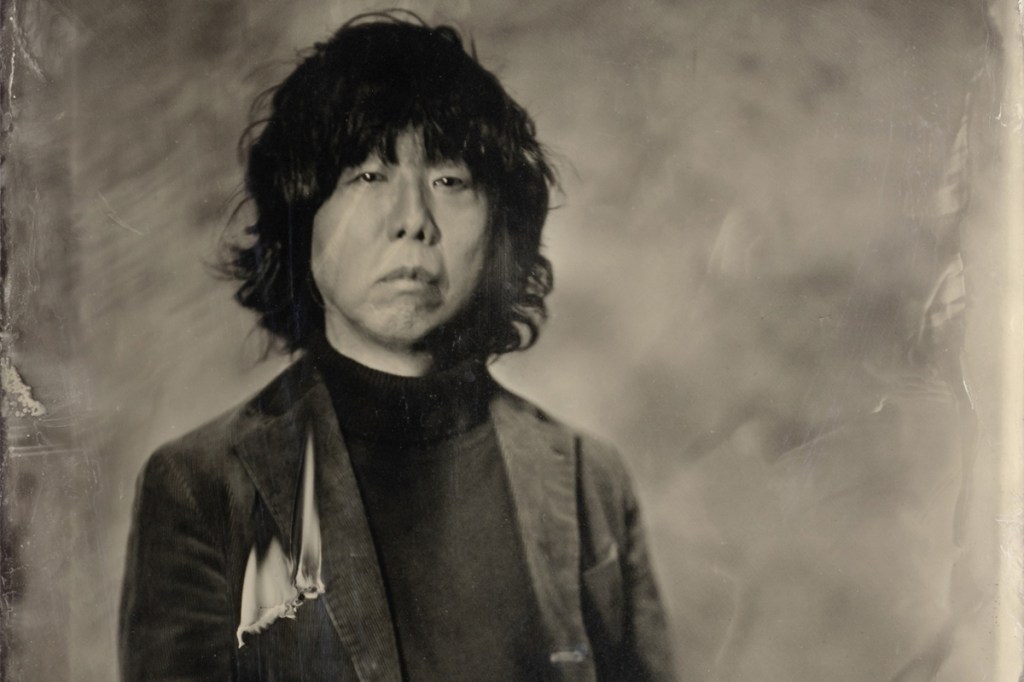
Shintaro Sakamoto was the vocalist and guitarist for Japanese psychedelic rock band Yura Yura Teikoku (“The Wobbling Empire”) for 21 years from 1989-2010 when the group amicably split. Since then he’s embarked on a solo career with music that has gone stylistically well beyond that of his former project. The title track for Sakamoto’s new album Like A Fable (which released in June 2022) finds the songwriter sounding like he’s making music for relaxing at a seaside resort in the evening. But as with the earlier parts of his career the lyrics are more existential and this time around speak to an anxiety that emerged perhaps unbidden and mysterious in origin. He sings about taking a trip back in time the way stories were told in the kamishibai style where illustrations were used on cards to give the stories a visual component and it was a form of storytelling most popular in the 1930s but of course when the art form was taken on by future manga artists like Shigeru Mizuki it was a direct predecessor of what would become manga. Sakamoto is invoking going back to roots and falling in love “like in a fable” as a way to figure it all out or at least to connect with the spirit of a time and place that seemed free of being “Plagued by terrible thoughts.” And all to get to where one can feel an excitement for life instead of the wave of despair that sits like an ambient energy on a lot of the world by reconnecting with older forms of popular entertainment. With this blend of psychedelic folk, lounge jazz and that era of Japanese folk rock embodied by Happy End’s 1971 album Kazemachi Roman and the strange, otherworldly yet playful music video Sakamoto is creating a passage to a headspace that may make it possible to have a respite from the stress of dire world events and sometimes that’s what you need to get through it to be able to face what has to be done. The video looks like something that was shot on a Betamax machine yet benefits from modern video production while maintaining the aesthetic and there’s an undeniable charm to this eccentric visual presentation of the song. Watch the video for “Like A Fable” on YouTube and connect with Sakamoto at the links below.
Matthew And The Arrogant Sea did something unusual with its song “D F K” (perhaps from the opening words of “Dumb fuck kids”) by writing a melancholic and beautiful psychedelic folk pop song that turns generational bravado on its head. You see too many people having really idiotic discussions about what generation is best or worst and why when it doesn’t matter. Different social, economic and political forces are at play at all times and putting anyone on a pedestal or self-aggrandizing or any of it is just another effort at self-defeat or blowing up someone’s ego for your own selfish purposes. But in “D F K” at least the self-critique is one that seems regretful and empathetic. And in that mix is a level of self-reflection that keeps it from slipping into maudlin self-pity. When older people talk about the mayhem young people get up to and an impatience with seeming and too often actual lack of action even when such is absolutely called for without only following official channels and established methods for doing so. There is an admission at a little jealousy at how clever someone’s approach to things might be and the audacity to do something you might have done yourself at a younger age. When you’ve essentially passed on to just doing the basic in getting through life under the impression that being active in society even if just expressing resistance to a status quo that has become destructive due to the complacency of well-meaning folks what can you expect from people who feel things so immediately. The line “Don’t matter at all, we’re only just existing” is a kind way of stating that self-criticism. Later in the song the bit about “In the midst of it all, it feels like the worst thing, walls closing in” is a direct result of embracing one’s comfort a little too closely when perhaps pushing back when you could while still possessing a bit of one’s youthful spirit might have made a difference before things got too intense. Within that realization, though, is the implicit acknowledgment that despite having hit bottom too many times in life, despite having become a touch jaded about life and society, it’s still possible to stop hoping for a younger generation to take care of the problems you helped to generate and do at least a little something yourself even something as minor as a change of spirit and outlook. The song’s sweeping vistas of emotion and texture and contemplative tone makes that realization not hurt but is a salve to a psychology that has maybe taken a few too many blows and remains tender but can be nudged to a better place. The title is thus a bit of a self-deprecating joke about a mindset and sentiment that is too common but has long been outmoded. Listen to “D F K” on YouTube and follow Matthew And The Arrogant Sea on at the links provided.









 Queen City Sounds and Art
You must be logged in to post a comment.