Kraftwerk at Red Rocks 6/30/22, photo by Tom Murphy
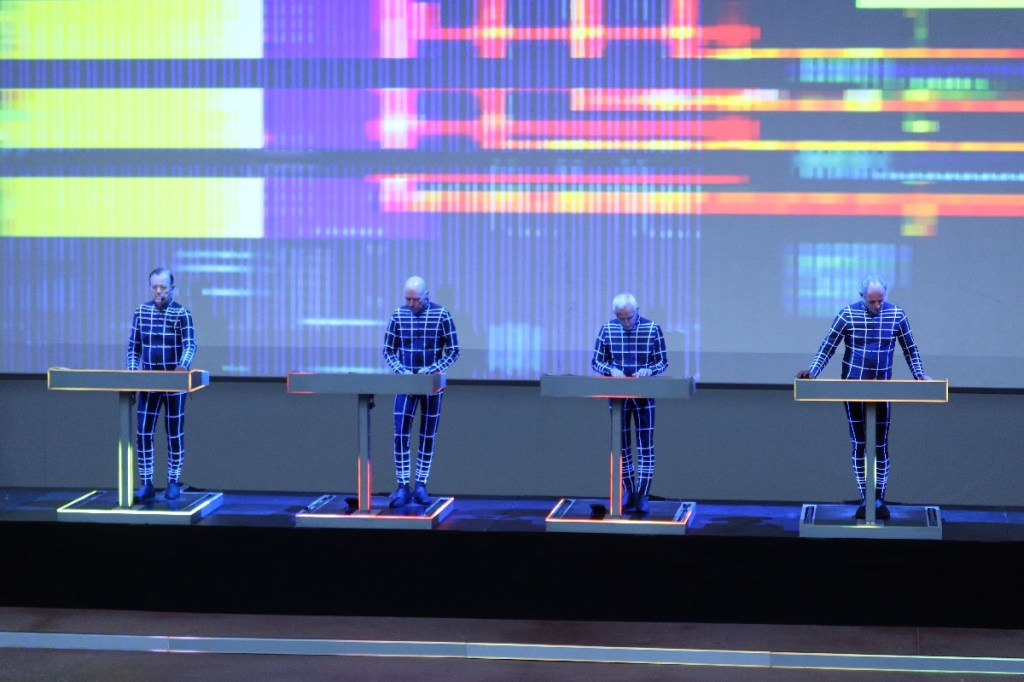
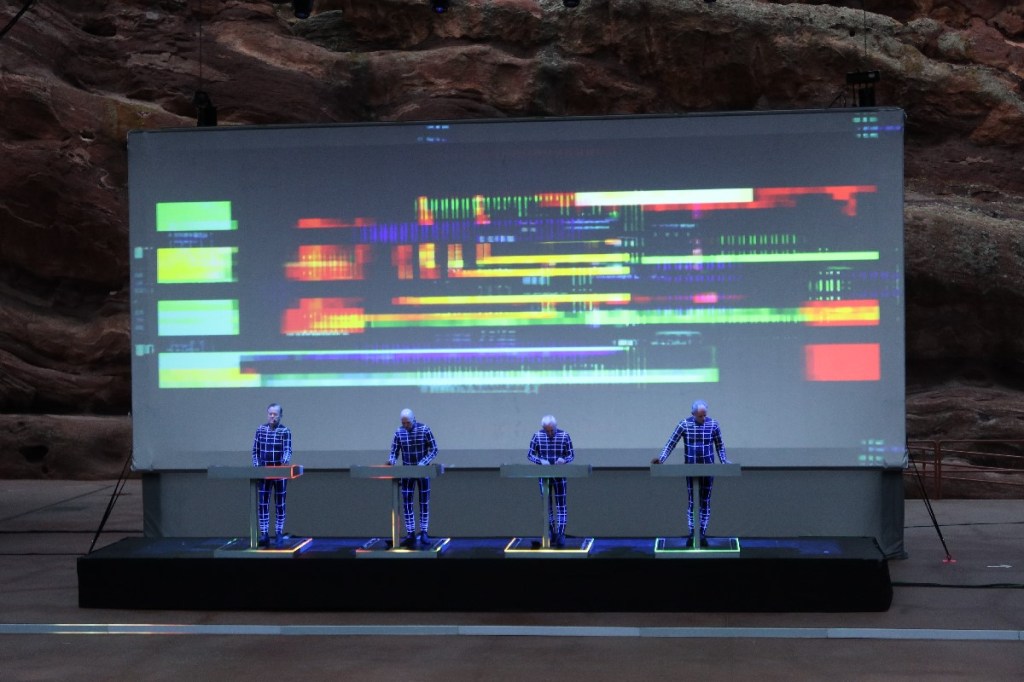
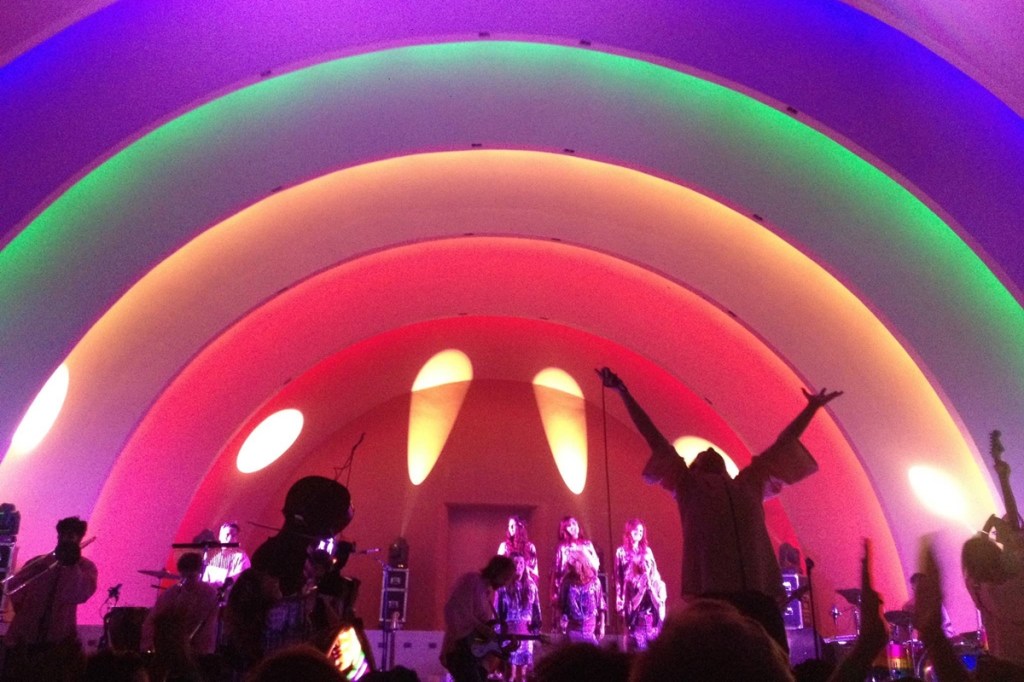
Kraftwerk went beyond the 3D presentation for the 2022 Red Rocks show. Seemed like it couldn’t work when the light was still strong well into the evening but apparently it was oddly effective and surreal if you got a pair of the glasses to fully take in that aspect of the performance. But even without the glasses whoever set up the sound for this night managed to give the renowned amphitheater a robust level of sonic fidelity adequate to one of the greatest and most influential bands of electronic and popular music.
Kraftwerk at Red Rocks 6/30/22, photo by Tom Murphy
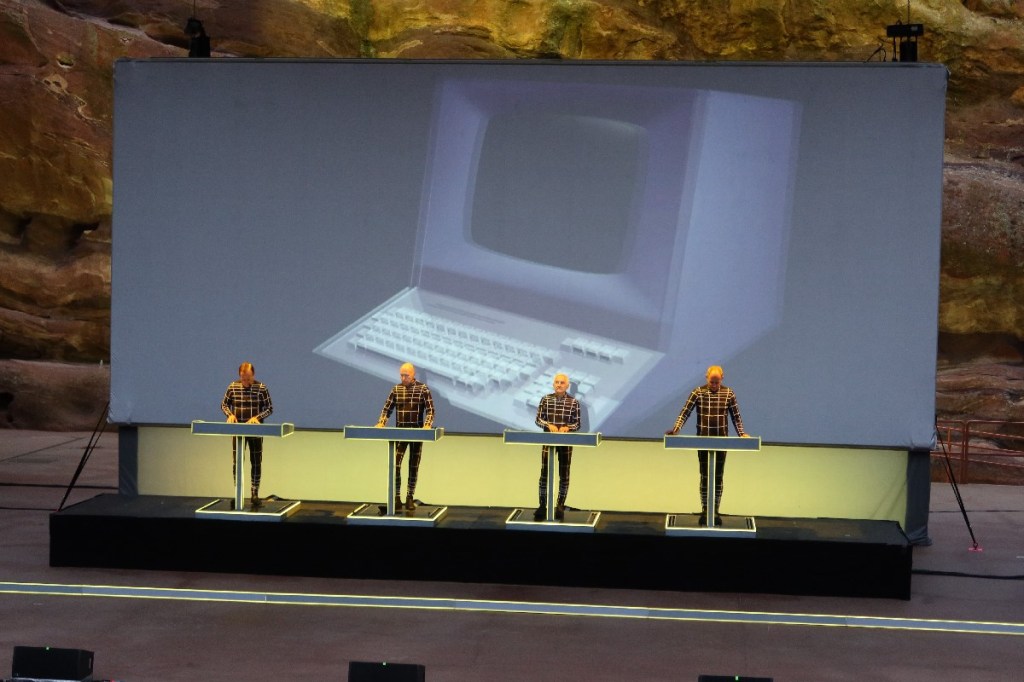
On stage Kraftwerk walked on to a platform on the stage that gave the impression that we were watching the quartet on a television lending the whole show a meta quality that enhanced the group’s own implicit commentary on society, media and technology by employing the simple prop of a familiar cultural artifact write large from which to project the music to the audience. Behind the four members of Kraftwerk was one projection screen and when 8-bit graphic numbers counted to eight it was clear the concert would open with “Numbers.”
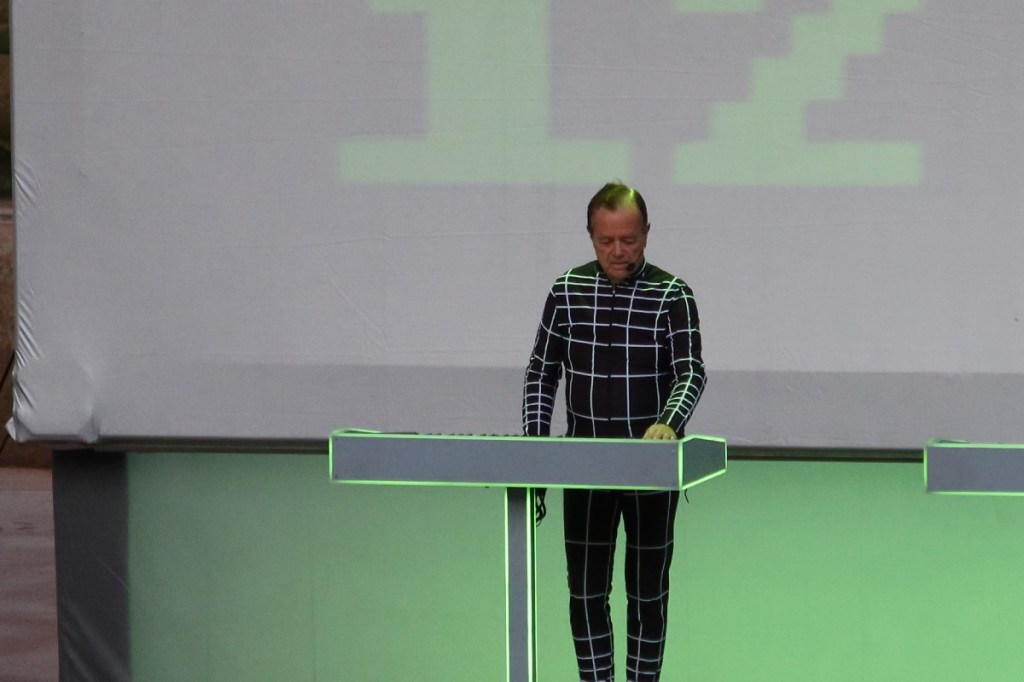
Ralf Hütter of Kraftwerk at Red Rocks 6/30/22, photo by Tom Murphy
Across the evening with so many of Kraftwerk’s great songs from the breadth of its recorded catalog one thing that had to have struck anyone close enough to see the expressions on the faces of the band and their movements is how much they put themselves as humans into the music even though they appeared to be standing at consoles simply pressing buttons and looking impassive. But Ralf Hütter looked impassioned at points and with the projections flowing depicting the settings and actions of the song it was the members of Kraftwerk that kept this music grounded in a shared human experience of music made using science seemingly written for cyborgs but performed by physical people and not an A.I.. Not that Kraftwerk might not find that a useful element of its compositions going into the future.
Kraftwerk at Red Rocks 6/30/22, photo by Tom Murphy
It’s easy to think of songs like “The Model,” “Autobahn,” “Trans-Europe Express,” “Tour de France,” “The Robots” and “Spacelab” as existing and best enjoyed purely in the mind but the low end and the broad frequency range of the music hit strongly and moved through you in this environment in a way that made it feel like the most transcendent music in the world. This music many of us have heard for most or all of our lives but maybe weren’t fortunate enough to witness other times Kraftwerk made a stop in Colorado came to life as day turned to night and even when the wind rose precipitously and the group left the stage for an intermission and came back it seemed to accentuate how Kraftwerk’s sounds and ideas have weathered well the decades and still sound fresh, unusual and strikingly original.
Kraftwerk at Red Rocks 6/30/22, photo by Tom MurphyKraftwerk at Red Rocks 6/30/22, photo by Tom MurphyKraftwerk at Red Rocks 6/30/22, photo by Tom Murphy
Foyer Red’s ebullient pop single “Pickles” contains a richness of ideas and concepts both thematic and musical if you take the time to give its nearly four minutes a listen. It starts off with a spare but intricate twin guitar line and accented bass line before the vocals come in with lines seemingly sketching thoughts and observations on modern living and its attendant anxieties. But also imagery suggesting how in clinging to certain relationships and associations from those romantic, social, civic, artistic can hold us back from growth until we’re willing to let it go. When the two vocals trade off lines we are treated to a literary examination of these social phenomena as we feel them and not in some theoretical or ideological way but in how they impact us daily though at the time we can ignore how things are decaying and failing to serve our life or the function these things had for us or for anyone. The lines “torpid/standstill/what grew/shriveled/pillars of sand/are no match for tempered winds/facing the north side/you don’t get enough light” and then “huffing/slow burn/building/friction/save what/you can/watch the walls as they give” could really refer to anything but is so poignant in capturing what it’s like to be around when you’re the lifer in any situation (job, music scene, band, DIY space, school, relationship etc.) and maybe you should salvage what you care about and move on. You don’t need to carry the pressure of preserving some ideal that isn’t there anymore. It’s not a song about giving up or being cynical about what matters, it seems to be about self-care and with the aim of actually getting on with what’s important once again and maybe building something somewhere else with other people or at least not clinging past the time when all the juice and life is gone. Musically it has resonance with classic C86 bands but more contemporaneously with groups like Palm, LVL UP and Lithics with a bit of math rock and twee and the clear, yet unpretentious, artistic ambition of not just the lyrics but the dazzling array of sounds and song dynamics that are irresistible from beginning to end. Listen to “Pickles” on YouTube and follow Foyer Red at the links below.
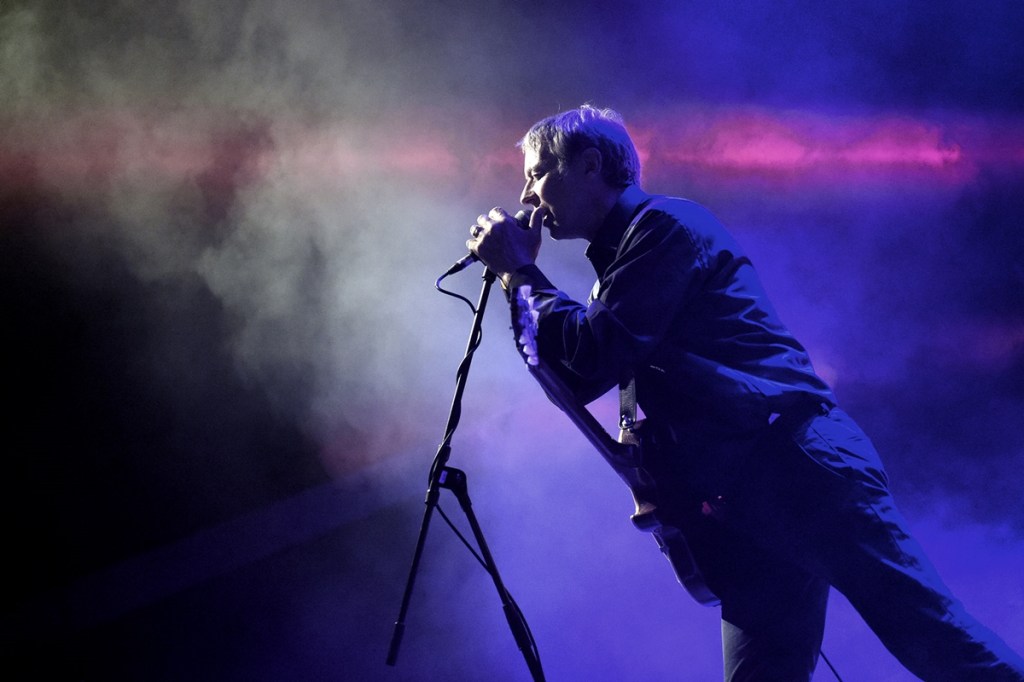
Mic Jogwer of Pink Turns Blue, photo by Daniela Vorndran
Pink Turns Blue is one of the foundational bands of modern darkwave. When the group formed in Berlin, Germany in 1985 its blend of then New Wave and dark, moodier post-punk was in line with the fusion of those elements one heard in The Cure, The Chameleons, Comsat Angels and The Sound. The group’s first two albums If Two Worlds Kiss (1987) and Meta (1988) had a spacious and dusky vibe with undertones of emotional urgency giving expression to the on the brink tensions of that decade when the world seemed in a tenuous and conflicted state. Pink Turns Blue split in 1995 for several years before coming back together in 2003 after the post-punk revival was well under way and ahead of the darkwave resurgence of the 2010s and in some ways benefited from both as a cult band that had influenced connoisseurs of adjacent styles of music. In 2019 respected experimental and more or less darkwave label Dais reissued If Two Worlds Kiss and Meta and introduced a new generation to one of the still extant legends of German post-punk. In 2021 Pink Turns Blue released its latest record TAINTED with its decidedly political content as a critique of a human civilization bringing to bear a completely and utterly inadequate response to anthropogenic climate change and the political and economic systems in place that ensure future destruction to the world we took for granted in a kind of feedback loop of escalating devastation. The future climate scientists have warned about for decades is now here. But it’s not all doom and gloom and the music of Pink Turns Blue isn’t a nihilistic analysis of world events, the new record, as with previous efforts, offers poignant personal portraits of love and loss and the life experiences and connections to others that give our existence its essential meaning beyond our utility in some economic context.
Pink Turns Blue performs at the Hi-Dive on Thursday, September 15, 2002 with Radio Scarlet and Redwing Blackbird (doors 8 p.m.) and ahead of that date we were able to pose some questions to founding vocalist/bassist/synth player Mic Jogwer via email about the band’s origins, background, the content of its music and the challenges of operation as a band from Europe in the USA.
Queen City Sounds: Before forming bands what kinds of things did you see or experience that prompted you to pursue making music? Was Rockpalast a part of your youth in getting exposed to some of the more adventurous music as well as more mainstream faire?
Mic Jogwer: I have to honest and say that my love for music began very early when I was 8 years old. And also that my first heroes were The Rubettes, Sweet, Abba and the likes.
I started with trumpet at 9 and changed to guitar at 12 (Genesis, Pink Floyd), then bass with 14 (Santana). And so on. Blues, Rock and then Punk. It wasn’t before I started Pink Turns Blue when we got compared to The Chameleons and The Sound and we got listen to those bands a lot. On Rockpalast you would not find up to date bands very often. Rather the classics. Still watched and liked it a lot.
QCS: When Pink Turns Blue was starting out in Köln you won an award from WDR. As a fledgling band in what ways do you feel that the German government and local arts groups supported music?
MJ: Definitely not. At that time, if you were a German band you had to sing and sound German. Ideally not too serious. The WDR in Cologne was a rare exemption. The was this one guy who was very much into new music and was excited to find bands that were daring enough to reach an international audience.
QCS: Early in your career you toured with Laibach. How did that come about? How did you smuggle Western studio equipment across the border?
MJ: We were lucky that our label FunFactory! released an Laibach album in Germany and also booked a tour for them. Also, we were lucky that we were the only band in its roster that Laibach were ready to take on tour with them. They didn’t like our name or our appearance but very much loved our music. Also, because were quite intrepid bigmouths they offered to produce our next 3 albums if we smuggled studio gear across the iron curtain. We nearly got caught but were lucky again and they were really impressed and started to like and support us.
QCS: I read Burning Down the Haus by Tim Mohr a few years ago and as you may know it’s an account of the punk and underground music scene in East Berlin. Did you have interactions with and/or were you familiar with artists from that scene in the early days of Pink Turns Blue? If so how did you facilitate perhaps bringing those bands over or play shows there if that was even possible before the fall of the Berlin Wall?
MJ: No, sorry. Until 1989 it was impossible to get in touch with any of this East Germany bands. The first contacts were made in the late 90s. Some of them became famous in different formations (Rammstein) others vanished. And yes, we know some of them but there never was a common scene.
QCS: People who weren’t there might assume you were part of a scene and friendly with the likes of Xmal Deutschland, Malaria! and Einstürzende Neubauten. Did you feel like you had a sense of community with other German bands? How did that look for you in terms of operating and touring and supporting one another? If not, why do you think not?
MJ: We had a strong bond with Einstürzende Neubauten, because they were daring and innovative. We also had a loose relationship to Nick Cave and the Bad Seeds (then living in Hamburg and Berlin) and Gun Club, The Sisters Of Mercy, again because they were based and working in Hamburg and Berlin were spent a lot of our time. The relationship was more like: we are the kids and they were the grown-ups.
QCS: Pink Turns Blue split in about 1995 and reunited in 2003 before the resurgence of a fairly widespread interest in post-punk and “darkwave.” Did the “post-punk revival” of around the turn of the century play a role in helping to relaunch the band?
MJ: The relaunch was more like a short romance with your ex-wife. The post-punk revival brought a lot of fresh and very talented musicians and many of them liked Pink Turns Blue very much. Then we became the “originals” (the old guys), and they were happy to have us around. So we got invited to many festivals and tours where we met quite a few of them and were both impressed and encouraged to write new songs that were our version of the post post-punk.
QCS: Dais Records reissued If Two Worlds Kiss and Meta. How did it come about that you connected with Dais and what ideas were presented to you to approve making those records available again for potential new fans?
MJ: Drab Majesty was supporting us in Barcelona and mentioned that their label surely would be interested in signing us. So we got in touch with Gibby [Miller] and proposed that they released our first two albums as vinyl to support our US tour in 2019. We also planned to co-release TAINTED but Covid and the vinyl production disaster made everything too difficult. Hopefully, when everything kind of has come back to normal we can follow up on this.
QCS: Some people may be surprised by some of the very direct political content of Tainted but that’s been part of your music since early on. But in those lyrics there is both a challenge and a personal touch. Why do you feel it is important to address issues of climate change, inequality, global conflict in terms that seem so immediate and grounded?
MJ: Well, I think that topics like climate change and equality have become a really important issue for everyone. The last 5 years and especially the Covid years have put most of us in a state of disarray. And if you write songs that describe the world as you see and feel it it is only natural that those topics find their way into your songs. I guess – at least for us – those times where you were singing about your first drug experiences and feeling like an outsider as a young white male university student are over. Well, hopefully.
QCS: German artists have had a tough time touring for a variety of reasons. What might be helpful in facilitating this in the future other than imponderables like the world coming to its collective senses and addressing the aforementioned with reason and compassion? Are there practical things that maybe people can do to ease your journey touring North America?
MJ: I guess I have no idea. I guess we Europeans have our own insanity to get on top of. Not a good position to give advice to others. What I find encouraging is that many Americans and Europeans are able to make jokes about themselves. Wish it would be more of them. Still hoping that we all can inspire each other to try harder.
Neil Foster establishes a sense of place at the beginning of “Summer Falls” with the sound of wind and birds in the placid moments of early morning. The way the track evolves it sounds like the composer is using piano, strings, synths and electronic sounds to track the course of the sun as it arcs slowly and peacefully to midday. The swell of sounds conveys a sense of witnessing the subtle but unignorable power of the sun and in moments when the surge of sounds subsides for it’s as though we’re getting a glimpse through Foster’s eyes of the surrounding landscape lit up by sunlight and the sparkle of the light on water going over a nearby falls to a lower part of the river rather than a steep, intense falls like Angel or Niagara. No, the kind many of us see regularly who have the privilege to live near streams and rivers that flow through changing elevations. Foster captures the various moods and textures of observing this everyday experience and the tranquil and inherent beauty to dynamics and processes that have gone on before humanity existed and will likely continue after we are gone but being witness to this simple wonder can strike one as significant in itself knowing that we can appreciate things that go on whether we’re there to bear witness or not. Listen to “Summer Falls” on Spotify and follow Neil Foster at the links provided below.
“Colder to the Touch” finds Ryder Havdale charting complex emotional territory in song that swims in ghostly urgency with faint tonal resonances with U2’s “New Year’s Day” but clearly more stylistically in tune with early darkwave. What makes the song stand out aside from its layered atmospherics and expert arrangement thereof is the vocal duet between Havdale and Teagan Johnston. It gives more weight behind words that seem to be about the phenomenon of people waiting around for someone to love them who probably never will but because of the feeling of attachment to that person. What makes that even more complicated is those linger attachments after you get your heart broken by someone who shouldn’t hold real estate in your psyche yet those habits of feeling linger. And it’s easy to forget that you can move on. The chorus of “You can love somebody else/you can love somebody now/why wait for love to call” is a reminder that even “after every heartbreak you’re colder to the touch” that you don’t have to get stuck and that doing so is perhaps understandable but it’s also a choice and you can choose to open yourself up to new experiences and relationships and doing so doesn’t mean you’re betraying your own emotions or disregarding or dishonoring what you had or thought you had, you’re choosing to live and not be entrapped by a way of being that isn’t enriching your life. Listen to “Colder to the Touch” on Spotify and follow Ryder Havdale at the links below.
The Wheel Workers has proven itself as a band that excels at creating a sense of forward momentum and introspective mood in the material for it’s new album Harbor which released on 8/26/2022. A fine example of the song “Day After Day” that establishes a strong low end push in the beginning with vocals that follow a wide ranging arc of tone that syncs well with the synths and when all the elements come together mid-song and transition into a more contemplative passage it’s obvious that we’re not hearing a band that got some memo about how post-punk is supposed to sound. It’s more akin to something we might have heard out of New Model Army or The Sound or some 1980s art pop/rock band willing to get creative with arrangements and song structure so that a song’s ability to keep and hold your attention continues to the end. The fact that the song seems to be about being fed up with needing to try to recreate institutions and ways of living that have failed us rather than establishing something that works better for everyone and to nurture a vision for a more viable and nurturing future society and not wait around for someone to do that for us or wait for some authoritarian order to impose a new frame upon us despite what we might all like to see is just a bonus. The line “I train my heart to let go day after day” speaks eloquently to a willingness to realize that the way things were held up so high is turning out to be a collective romanticizing of a dysfunctional society and its norms because things now seem so decayed and on the verge of collapse when we can imagine and make better. Listen to “Day After Day” on YouTube and follow The Wheel Workers at the links provided.
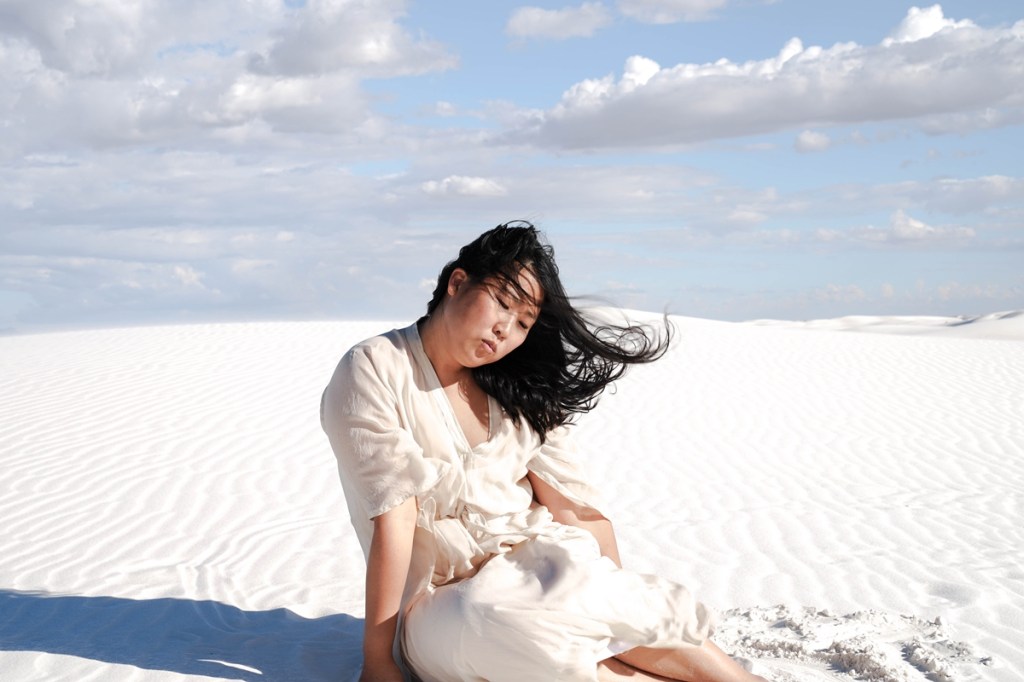
Susie Suh’s new video for the song “Blood Moon” follows the Fall 2021 release of her album Invisible Love. The production on the song centers her expressive voice giving expression to a yearning for resolution and meaning in a time and in a world where so many things seem in constant flux. The video shows Suh walking the the edges of a volcanic crater in Hawaii with mist arising from the steam emanating from the crater. Suh holds a wind chime which is used in sound therapy tuned to the four elements and in the imagery we see earth, water, air and an implied fire coming together at a point where change is a constant and inevitable and often irresistible. Suh invokes this concept in her song and the ways in which we can learn to live in harmony with natural forces as a lesson for how we might approach forces of change in the human world even though those seem just as beyond anyone’s immediate control though more so than we can influence when a volcano will erupt or the cycle of solar flares and other natural phenomena. And yet you hear in Suh’s resonant voice and the flow of synth tones around her the admission that she doesn’t know everything about the situations or how to address them and that in doing so opening up to possible paths through them and productive ways of engaging not dissimilar to the humility humans should have toward nature and not assume that our constructs of ego and identity can overcome all obstacles through sheer energetic willpower. But these conceptual considerations of the song aside it is a gorgeously soaring work of deeply atmospheric and emotionally refined experimental pop that is moving in its sense of wonder and ache for resolution. Watch the video for “Blood Moon” on YouTube and follow Susie Suh at the links below.
If not for the Alice Edwards’ melodious vocals and the upbeat and even bouncy jangle pop song in which they frolic one might get a very different impression of The People Versus song “Ocean Family” based on the music video. The band is awash in turquoise light and mostly looking like they’re in a trance performing music like an unlikely band that survived the sinking of a ship and cursed to perform lilting folk sophistipop for all eternity at the bottom of the ocean. Given prospects for the world now that may not be such a horrible fate. And the lyrics seem like a love song of a sort or certainly loving but it waxes sinister and reveals itself as a possessive love song as conceived from the perspective of a long-lived or immortal being whether a ghost haunting the aforementioned wreck or a goddess or a similarly appointed being. The music video along with the lyrics and music provide contrasting layers of meaning that you might expect from an A24 short film or a segment in an unlikely, supernatural musical greenlit by that production company. Perhaps it will be and maybe The People Versus will be brought on board. But whatever the potential of the whole concept of this song and video it’s a kind of ear worm that pushes the UK folk band past its presumed wheelhouse into the realm of art pop music and fans of Swing Out Sister and Rubblebucket will probably find the track to their liking. Watch the video on YouTube and follow The People Versus at the links provided.
The Polyphonic Spree is rightfully known for the orchestral spectacle of its shows featuring sometimes dozens of people on stage including locals when the band tours. What can get lost in that completely unique live show presentation is the impressive songwriting and heartfelt observations on life and the way it can yes hit you with heartbreak but also the ways you can seemingly find emotional and spiritual fortification and uplift in unexpected places and thoughts that strike you at exactly the right time. And that’s at the core of its single “Got Down To The Soul” in which singer and band director Tim DeLaughter describes a personal process of “breaking the spell, feeling the light inside” by connecting with your core instead of being weighed down and held back by focusing on the superfluous things that don’t serve us but which we are told to value. DeLaughter and what becomes a chorus of voices in the gentle flow of uplifting, bright melodies encourages us to find our future “by design” and “by the light” and that in trusting in some inner sense of authentic self the world around us tends to support our efforts. One hopes that nefarious types would have more doubt about the rightness of their actions but too often everyone else is filled with doubt and falls into a life more mundane and unfulfilling conforming to a standard of aspiration and living that doesn’t suit them and this song seems aimed at giving a boost to anyone down on life and going through the motions when they know deep down even modest mediocrity is a choice and its more inspirational to be at least somewhat on the path you’d prefer. Listen to “Got Down To The Soul” on YouTube and follow The Polyphonic Spree at the links provided.
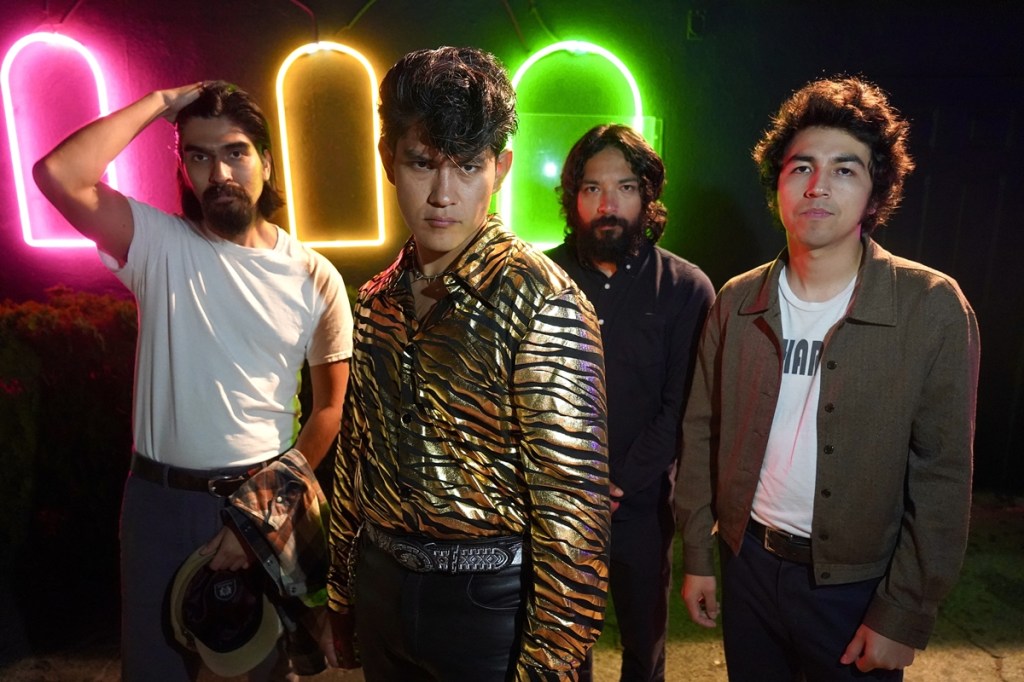
Dylan Dixon’s video treatment for The Tracks’ song “Your Bike” seems to tap into cultural touchstones like the Circle Jerks’ lounge scene in Repo Man and late 80s Love and Rockets comics with the foggy, dark basement noir menace of Green Room. The music an amalgam of bluesy post-punk with psychedelic saxophone in the latter half of the song adding to a sense of escalating disorder is difficult to compare to much else except for maybe The Dirtbombs and Ty Segall. It has that grit and a touch of the otherworldly. But The Tracks are more dusky and more atmospheric overall on this song and on the rest of its recently released full length Paredón Blanco (out July 29, 2022).In the video we see the band playing in a basement club where some conflict is about to go down and that tense energy permeates the scene and crackles in the vibe of the song as well. For a perhaps more contemporary comparison in terms of mood and aesthetic one might say there’s a touch of the lurid and decayed that one hears in more recent offerings from Iceage. Whatever the ingredients to the band’s music might be “Your Bike” stretches out and sways in its fluid progressions and tinged with a soulful darkness that is missing from too much modern music and a willingness to go to the edge of emotional breakdown and peer over before pulling back to give us some of that otherside spirit. Watch the video on YouTube and follow The Tracks, based out of Los Angeles, at the links below.








 Queen City Sounds and Art
You must be logged in to post a comment.