Pulsars is a band from Chicago that released one album, the 1997 self-titled LP, but which has a bit of a cult following. Though the band was around from 1994-2000 with a 2009 reunion and despite playing with some of the more well known alternative bands of its era Pulsars never entered the mainstream. But its embrace of New Wave synth sounds and power pop melodies was slightly ahead of the curve of a similar fusion of early synth pop and experimental electronic music with other popular music forms that informed the music of the likes of The Faint, !!! and later MGMT. chillwave and darkwave. But Pulsars’ music is a little grittier and in moments sounds like it has more sonically in common with The Jesus and Mary Chain and Dinosaur Jr at their most poppy and upbeat. In 2024 the group’s record was released for digital download, streaming, compact disc and vinyl.
Listen to our interview with Dave Trumfio of Pulsars on Bandcamp and follow Pulsars at the links below. Trumfio some may know for the band but many more may be familiar with his production work with Wilco, My Morning Jacket, Grandaddy and American Music Club among many others at his Kingsize Soundlabs also linked below.
Reindeer Flotilla’s new album Radio Silence LP will be out in early 2025 but for now you can see the video for “Today” and it’s vintage nature documentary visuals and lush guitar and synth interplay. Musically it’s reminiscent of mid-to-late 80s Talk Talk before that band went fully into pioneering post-rock. The processed guitar sound has that flare and edge favored inf that era and the vocals landing somewhere between soulful New Wave and a jazz fusion sensibility. The song has a cinematic quality that recalls the aesthetics of a previous decade when art rock bands were on mainstream radio and Michael Mann and Jonathan Demme films featured cutting edge left field rock. And yet there’s an immediacy to the energy of the songwriting and production that grounds it in the present befitting the title. Watch the video for “Today” on YouTube and follow Reindeer Flotilla at the links below.
Natalie Clark begins her song “Nothing Left To Lose” singing about having found an old notebook filled with ideas, plans, dreams, aspirations as well as memories of never having until now really followed through with those impulses. But the rest of the song builds on finally having set aside the personal blocks and hesitations in holding herself back from doing what feels important and not setting up artificial barriers like thinking you’re going to lose some part of your life or yourself or the “right” way to do things or the proper things to say. It’s a common issue most people have when you’re conditioned and encouraged to do what other people think you should do or what ascribed roles you should pursue according to culture and what is immediately and obviously available for you as a life path. Clark breaks free of these preconditions in the song and makes it seem like such an easy and natural path for anyone and one that feels better than simply going with the flow of a way of being and living that doesn’t suit you. Clark’s expressive phrases and breathy vocals are centered in the song but a spare bit of guitar work and strings lend the whole song an uplifting orchestral quality that makes its message hit as immediately accessible. Listen to “Nothing Left to Lose” on Spotify and follow Natalie Clark at the links below.
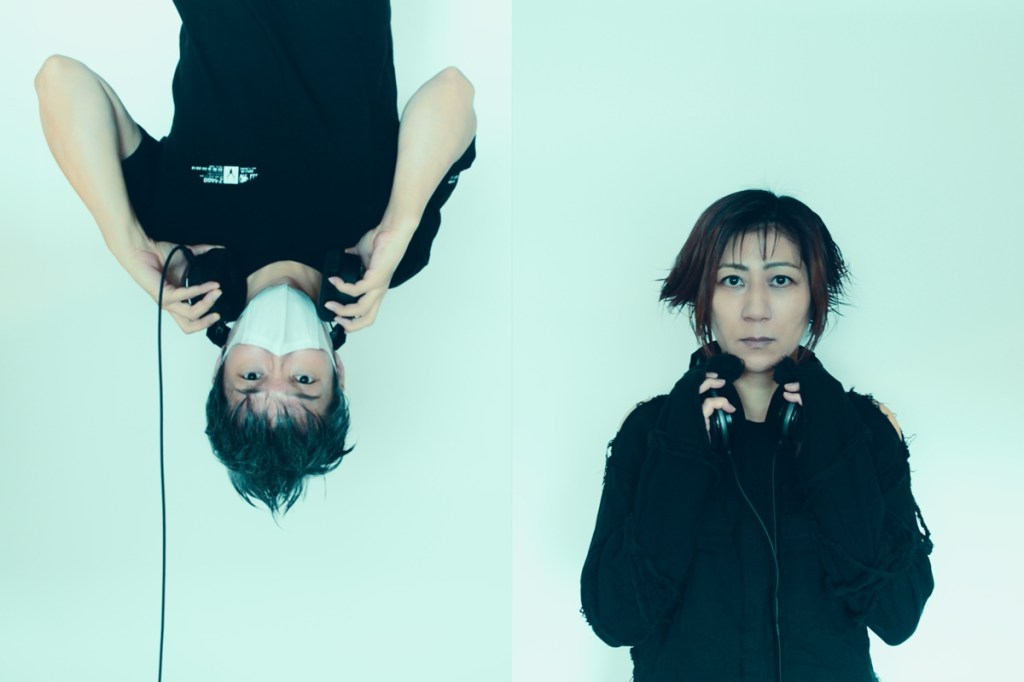
Since 1992 Tokyo’s Melt Banana has freely fused noise, hardcore, pop, grindcore and experimental electronic music in a uniquely frenetic and ever evolving mode of expression that has translated into furious live shows and a body of uniquely compelling recorded output. If you get to see the now duo of Yako and Agata live there is a raw, visceral power paired with an intense playfulness that creates a riveting energy that brings the audience along for a wild ride of sounds, ideas and rhythms. Year after year Melt Banana is consistently one of the most memorable live bands going from anywhere in the world. The band released its latest album 3+5 in 2024 marking it’s ninth in its long career and its first in eleven years. The new record finds Melt Banana offering what might be its most accessible songs to date but also some of its most exploratory material seeming to soundtrack and combination of video game and manga-based anime because of its gloriously frantic switches of pace, tonal richness and the musical equivalent of jagged jump cuts. We had the opportunity to pose some questions to Onuki and Agata via email. 3+5 is available now digitally, on CD and LP. Find links to connect with the band after the interview. Introduction and interview by Tom Murphy.
Tom Murphy: 3+5 is your first album in 11 years. Do you feel like you had to take some time off from Melt Banana to develop new ideas or methods of performing the music before making a new album?
Yako: We didn’t feel like it took 11 years. After we released “Fetch,” we kept doing our usual live shows and tours, then the COVID-19 pandemic happened, and we were busy with various things like starting our Patreon page and writing songs available only there. Time just flew by.
Agata: We never took a break from Melt-Banana during these 11 years. It’s not like we spent 11 years making “3+5,” but it feels like the album was made possible because of those 11 years. During that time, I started using new effect pedals like the Ricochet and the SY-300, which I used a lot on “3+5.”
TM: The title of the new album as well as songs titles like “Code,” “Puzzle,” “Case D,” “Stopgap” and “Hex” in particular point to mysteries or problems to solve or temporary solutions to complex challenges. Did you find yourselves faced with similar challenges to inspire songs like those?
Yako: For this album, I kept the song titles simple. Each of the nine tracks on the album feels like an independent piece, and using simple titles allows listeners more room to imagine their own interpretation of the songs.
Agata: Nowadays, everything is explained in detail and answers are easily found, so I think some ambiguity is needed.
TM: When adding 3+5 you get 8 which is a significant number in Chinese culture and numerology, a number of perfect balance and such. In splitting it into prime numbers was that maybe a commentary on the illusion of perfection and equilibrium through unconventional rhythms?
Agata: Yako came up with the album title. We had never used numbers or symbols before, and I thought it was a very good idea.
Yako: I don’t know much about Chinese culture and numerology, but in general, the number 3 is considered significant in this world. Since this is our 8th album, we needed to add 5 to make it 8.
TM: The album cover looks like a black and white collage art and ragged edged origami. Who designed the artwork and what is its significance for you and the album?
Agata: We always create our own album artwork. We make what we think looks good at the time, so we don’t usually decide on a specific theme beforehand.
Yako: As you pointed out, the initial idea was to create something by tearing and layering paper. When we create songs, sometimes they come together quickly, but often we go through many revisions, examining them carefully, cutting, pasting, and experimenting. The feeling of completion finally comes when we reach the end of that process. The artwork for this album wasn’t specifically designed with that image in mind, but it might represent that kind of process.
TM: What role did samples and field recordings play, if any, in the songwriting on the new album and how you are able to perform the music live?
Yako: For this album, we didn’t use field recordings or natural sounds. Instead, we used more digital samples.
Agata: We used synths more this time. On our previous album, “Fetch,” we incorporated field recordings, which resulted in an organic feel despite using computers. With this album, we focused on what can be achieved using computers, so we didn’t use field recordings. It’s more about how the synth sounds can coexist with Yako’s vocals and my guitar. When we play live, these sounds are handled similarly to how we treat drum sounds.
TM: Have you adapted any of your music to the pace of gaming? Are there games you find resonate well with your music?
Yako: We haven’t tried adapting our music into games. I can’t think of any specific examples, but I think fast-paced games would probably suit our music well.
Agata: We often hear that our music fits well with games like Splatoon, though I’ve never played Splatoon myself.
Yako: When I played Rez, the music synced very well with the game, and it was a lot of fun. I think music is a very important element in games.
TM: Are there Twitch streamers whose content you find especially engaging and why?
Yako: I don’t watch Twitch much, so I’m not familiar with it, but I occasionally watch game streams on YouTube. Since I use a Mac, I check out PC games that I’m interested in, as it’s very convenient for keeping up with new game releases.
Agata: I also watch more Japanese game streams on YouTube rather than Twitch. Sometimes, watching these streams makes me want to play certain games, but if I already plan to play a game from the start, I avoid watching those streams. However, recently, I haven’t had much time, so I haven’t been watching streams much.
TM: With services like Crunchyroll anime and gaming can be enjoyed by people around the world. Are there any anime series and films that have particularly captured your imagination of late?
Yako: Unfortunately, I haven’t come across any anime that has really captured my interest recently. Over the past few years, I found “Made in Abyss” and “Ousama Ranking” to be interesting. So, I’m looking forward to the next season of “Made in Abyss.”
Agata: I watch anime more randomly than Yako. I tend to watch whatever catches my eye or what Yako or friends recommend. So, I usually only watch something once, and I tend to forget the story quickly. Recently, I watched an anime called “Sing a Bit of Harmony”. Initially, I thought it probably wasn’t for me and even considered stopping halfway, but by the end, I found it really interesting.
TM: Are there any manga adaptations to anime you feel have been especially well executed like maybe Banana Fish, One Piece, Attack on Titan or Blue Lock? Others?
Agata: It’s an old example, but I think both the manga and the anime of AKIRA were great.
Yako: Manga adaptations to anime can turn out really well or be quite disappointing. It often depends on the production company and director. It’s sad to see interesting manga fail as anime. I think “Attack on Titan,” “Demon Slayer,” and more recently “Oblivion Battery” are examples of manga that have been successfully adapted into anime. When I first read these manga comics, the art was a bit hard to understand, and there were many aspects that didn’t come across well, but the anime made things clearer and was very well done. Sometimes anime adaptations include unique elements of their own, but recently, I think the anime adaptation of “Bocchi the Rock!” was done very well.
BATTS released her third and latest album Just My Luck on October 18, 2024 and the single “Vessel of Love” showcases the singer-songwriter’s warmly melodious vocals and ability to write a song that feels both intimate and epic. BATTS’ soaring vocals and expansive song dynamics embody the part of the song with the chorus that is the title and its suggesting of using the power of love to lift everyone to a higher place if we are able to choose that path rather than those more selfish. The song feels like its going places and inviting everyone hearing to go on that trip and to “Hold space for me” because if people can do that for each other there will be room for everyone in a kinder and gentler headspace for the human community. That said, the song feels like a personal entreaty and not one so abstract and that’s why the song resonates as strongly as it does. Listen to the gorgeously spacious “Vessel of Love” on Spotify and follow BATTS at the links provided.
Stephen Becker employs a minimal, melancholic keyboard figure to introduce “Range” fitting the impressionistic lyrics seemingly built out of the mundane details of life that separately seem insignificant but together develop a vivid emotional portrait especially when his vocals join together with those of Alena Spanger and they seem to be reassuring presences for each other. Ghostly tones and textural tones give the otherwise fairly abstract song a tactile quality and one that’s gentle yet slightly unsettled. The lyrics toward the end of the song, “I’m not lost, I’m just outside my range/I’m not lost, I’m just a little spaced,” point to the overall mood of the song in its embodying an uncomfortable acceptance of unfamiliar experiences and settings and a slight feeling of being unmoored emphasized by the realization that the song has no standard percussion yet the rhythms have their own organic sense of order even if it’s unconventional in the realm of pop music. Listen to “Range” on Spotify and follow Stephen Becker at the links below. Becker’s new album, the existential and sonically daring Middle Child Syndrome released on October 25, 2024.
The layered melodies in foreground and background throughout Mystic Toad’s synthpop single “Hyperreal” create a soothing dynamic as each is deeply rhythmic but gentle. In the music video the singer strolls about an incoming tide after sunset but looking and sounding like his is awash in a spirit of acceptance and letting any of the anxieties of life go out with the waves. There is a bitter sweet aspect of the song like that acceptance includes letting go of attachments and assumptions about the way things are and how they should be as building blocks of one’s identity because they’re getting in the way of living. Toward the end of the song the subtle bass line seems to become more accented and reveals itself to be the guiding force of the song’s drifty flow like it’s the lifeline that makes it possible to keep focused on the essentials without being tied to no longer useful notions of what those might be. Watch the video for “Hyperreal” on YouTube and follow Mystic Toad at the links below. The new Mystic Toad album World of Destruction dropped August 15, 2024.
Melissa Weikart’s expressive vocals ride the subtle wave of shifting piano work between major and minor chords throughout “Easy,” the title track to her latest EP. In the video we see the singer-songwriter in black and white alternating between white line drawings on black in moments and household items that anchor one’s memories. Weikart seems to be singing about how we make space for others and do little things for those we love or wish loved us so that we are not difficult to have in their lives. But in Weikart’s resonant vocals we hear melancholic overtones that leave the unspoken impression that such gestures of quiet affection are not always extended to us when we need them. Without spelling anything out in granular emotional detail Weikart nevertheless articulates a nuanced personal headspace that isn’t often the subject of pop songs. Watch the video for “Easy” on YouTube and follow the French-American artist at the links provided.
Like the song the video for Elori Saxl’s “Grows Along the River Fast” builds in tonal clarity with an impressionistic palette. Arpeggiated sequences in layered cycles establish a textural pattern that immerses the listener in a nearly hypnotic flow of sounds like rapidly falling yet gentle raindrops as a harmonic halo hangs in the background. The brisk pace of the song contrasts with its contemplative energy in a way that reinforces the tranquil aspect of the song akin to waking up early on a cross country train trip well rested and not having one’s brain clouded by the “content” to which we’re subjected upon the usual daily contact with human civilization. It is a mind-cleansing listen that is a welcome respite from the inundation of superficial data of modern life. Watch the video for “Grows Along the River Fast” on YouTube and follow Elori Saxl at the links below. The song is from Saxl’s score for the TV series Earth Focus due out on digital download and vinyl on November 15, 2024.
Ty Baron invokes cinematic monsters across decades in the new Vases song “Contact” to convey a sense of haunted self-alienation. Stylistically it’s darker and more somber than we’ve come to expect from the songwriter whose gift for artful psychedelic pop is well established with the project. But with this song and its more darkwave flavor Baron brings to bear his ear for crafting rich melodies and mastery of the use of space. The song takes us through dense and up close moments and those seemingly more adrift in a darkened space like the songwriter is wandering around in his own, surrealistic nightmare, the kind where there is no immediate threat, just a sense of unease and dread. Yet Baron leaves us with a sense of closure from those feelings by the end of the song even as its captivating mood lingers on. Listen to “Contact” on Spotify and follow Vases on Instagram.





You must be logged in to post a comment.