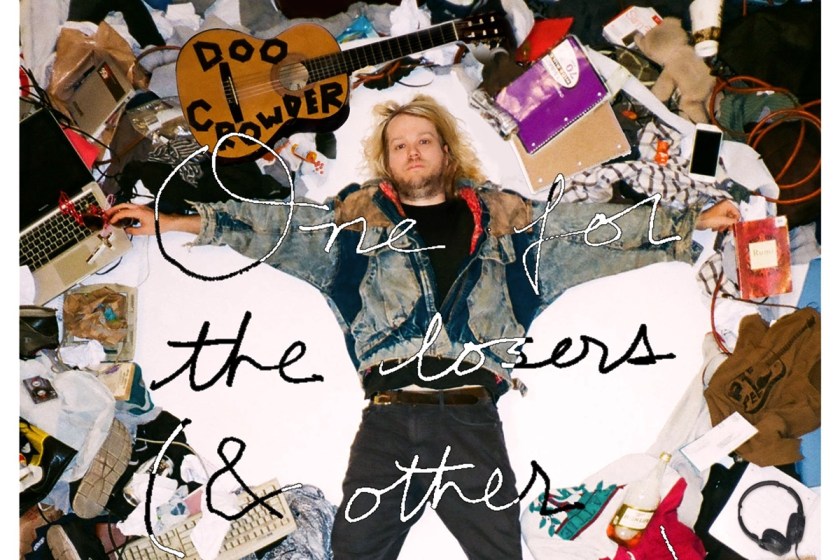
Doo Crowder Deep Dives Into the Heart of Human Creativity and the Aspirations on “Doo Crowder song”

one-for-the-losers-and_other_pilgrims_cover_crop
Doo Crowder One for the losers (& other pilgrims cover (cropped)

Door Crowder is probably largely unknown outside of Denver where he garnered a bit of an audience in punky indie band The Dinnermints and a bonafide cult following with his avant-folk pop group Pee Pee. As a solo artist, having long since left the Mile High City, he has explored a broad range of songwriting styles and sounds but with his latest album, One for the losers (& other pilgrims), having a full release in January 2020, Crowder is coming into his own as a composer of engrossing pop songs that plumb the depths of personal psychology in a way resonant with just about anyone. With the single “Doo Crowder song,” the songwriter uses a meta narrative about his journey as a creative person and his relationship with the motivations, temptations and supposed rewards of aspiring to be the kind of artist that can reach a wide audience by virtue of having something relatable and significant to say in a way that is also creatively rewarding. And to use that art as a vehicle to explore identity, the meaning of life, relationships and everything that helps to define and illuminate our lives. Crowder’s gently expressive voice flows through the song like a spirit and musically it taps into folk and psychedelia and employs some sly musical allusions to bring the mood of an era to various passages in the song as a tool to evoke the contextual emotional touchstones of ones memory. In a time of great confusion and disconnection in the world, here Crowder offers his own set of questions and yearnings without offering answers, but perhaps suggesting a method for all of us to untangle our own angst and get to a place of love, connection and tranquility. At the end of the song is a spoken part that connects the song to the rest of the album but the album entire is worth a solid listen as it offers more facets of this beautiful excursis into the human psyche in the modern era. Listen to “Doo Crowder song” on Spotify and follow Crowder at the links below.

distrokid.com/hyperfollow/doocrowder/one-for-the-losers–other-pilgrims
youtu.be/rUIFaASrLMs
instagram.com/doocrowder

“Chasing Crazy” by Rx27 is an Irreverent Diss Track For a World Where Love is Another Commodity

Rx27_ChasingCrazy1_Crop
Rx27, photo courtesy the artists

“Chasing Crazy” finds Rx27 sneering at this era in which love is too often shallow, insipid, casual and commodified in a way that leeches all the grit, blood and essential humanity out of it. Online dating and the odd catalog/menu quality of it as echoed in so many areas of our lives seems to have warped our sense of what is vital and life-affirming. Singers Joie X Blaney and Msmaxine Murrderr trade lines like 45 Grave doing a tag team diss track. Though nearly shouted as a chorus, the refrain of “fuck forever” casts that throwaway word forever in its most colloquial and conceptual usage as the subjective experience that feels like forever but also as a rejection of the values of temporal and tepid rather than passionate, meaningful and enduring. The subtext of the song one might assume as being wanting the kind of love that’s transformative and deeply significant over transient and merely titillating. The line “Cry me a river hoping I will down, I would rather be alone than on your merry-go-round” is key as it poetically states a principle of wanting something that matters rather than be part of someone’s game in which everyone involved is disposable. “Chasing Crazy” blurs the line between punk, glam and death rock with a bombastically irreverent attitude toward the norms of this drab age and yet, in its own way, is the kind of love song that eschews the clichés by chasing after something that might seem crazy to some and that is something that is more than appearances and with someone whose flaws we accept and who accepts ours as part of the deal of being in a relationship with another actual human being. Listen to “Chasing Crazy” on Spotify and follow Rx27 at the links below.

therx27.com
youtube.com/channel/UCFX258qE-EJzVgNZX4Dbbyw
twitter.com/therx27
facebook.com/therx27
instagram.com/rx27_official

The Fragile Elegance and Economy of Songwriting in Hannah Connolly’s “Meet You There” Lingers Long as a Vivid Portrait of Deep Affection

HannahConnolly_MeetYouThere1_crop
Hannah Connolly “Meet You There” cover (cropped)

In the spare acoustic guitar figure running through Hannah Connolly’s “Meet You There” we find a place to relax and take in the gentle affection with which the songwriter uses imagery to craft vibrant sense memories of the person she loves. At times her voice delivers the lines alone, at other times it’s doubled as though Connolly is harmonizing with herself. There is a sense of the early morning in the song and in fact Connolly sings “When the sun comes breaking through the dawn, I’ll meet you there/ When the waves come crashing on the shore I’ll meet you there” to express a longing without overwrought emotions. When she sings “I like driving through the canyons on the days I’m missing you, you said they look just like a green screen and I smile because it’s true,” Connolly gives a unique and rich sense of place that is immediately relatable and speaks much more about the place the person to whom these lyrics are directed has in her heart that the usual platitudes about love that drive so many songs don’t. It is in the fragile elegance and economy of Connolly’s songwriting where its power lies because it is that quality that lingers with you longer than bombastic declarations of devotion. Listen to “Meet You There” on Soundcloud and look for Connolly’s forthcoming full-length From Where You Are due out in 2020.

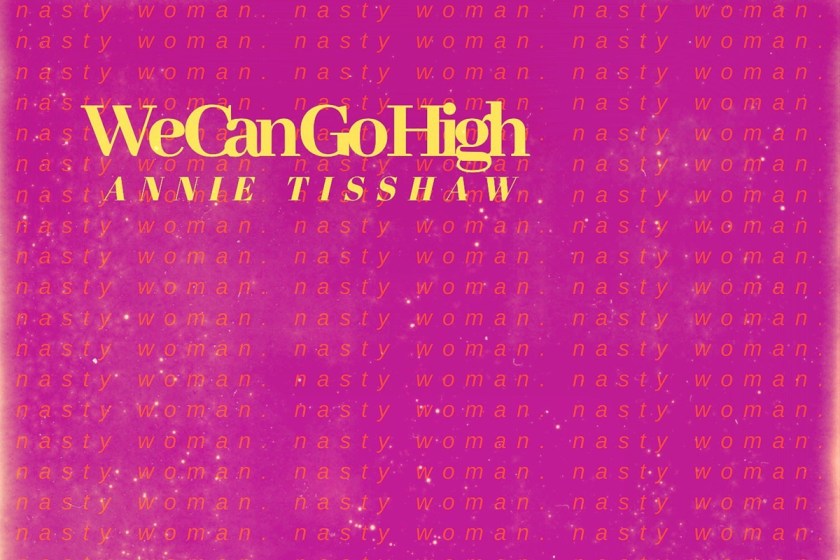
Annie Tisshaw Challenges the Destructive Side of Our Culture on the Soaringly Transcendent “We Can Go High”

AnnieTisshaw_WeCanGoHigh_cover1_crop
Annie Tisshaw “We Can Go High” cover (cropped)

In “We Can Go High” Annie Tisshaw weaves her own words on how we often feel disempowered to say what must be said but we can choose to speak up with parts of Nina Donovan’s poem “Nasty Woman” made famous at the Women’s March in 2017 including the line “I’m a nasty woman, I’m not as nasty as racism, or fraud, or homophobia, sexual assault, transphobia, white supremacy, white privilege, ignorance, or misogyny.” An echoing tonal wind flows in and flutters throughout the song as Tisshaw’s vocals travel through different sound environments while maintaining a consistency of message and conviction challenging patriarchal systems of value in various contexts. Her own line “We know one plus one but do they teach us to love” speaks much to the devaluing of emotional intelligence in a patriarchal culture to the detriment of all. The pulses of white noise later in the song are like an ascending breeze carrying the vocals and the uplifting message aloft, one that has only increased in relevance over the past few years rather than faded with time. Listen to “We Can Go High” on Spotify.

ZLEEP’s Pastoral “Endless Blues” is a Melancholic Ode to the Pain of a Love That Should Never Be

ZLEEP_EndlessBlues2_crop
ZLEEP, photo courtesy the artists

The impressionistic, pastoral “Endless Blues” by ZLEEP, crafted from a spare, piano tones, a gentle guitar figure and harmonized male and female vocals, is a resonant and poignant portrait of a broken yet conflicted heart. Though seemingly minimalistic, the song conveys an emotional complexity that is beyond even the sum of its parts. In the song we come to understand the narrator deeply misses the object of their love because that person made them happy with a deep romantic attraction even though that loved one also had the ability to make them sad like no one else. There is a sense of being lost to that song particularly the line about dreaming in “endless blue” of being lost in love, lost in the romance of it all and lost without it. That said there is a feeling of resignation that runs through “Endless Blues” from the beginning to the end as difficult as it is to accept and that is the loss of that love is in the end for the best despite the heartache and despite the feelings of strong connection because on some level you know that holding so tightly onto a relationship that brings such pain is foolish and self-destructive. The tape hiss as white noise in the background gives the song the quality of an old record, the kind maybe you take out to listen to remind you of an earlier part of your life and which haunts you when you do. Listen to “Endless Blues” on Soundcloud.

RAHM’s Touching “To Live Without Her” is a Powerful Commentary on Modern Social Isolation as We Get Older

RAHM_ToLiveWithoutHer1_crop
RAHM “To Live Without Her” cover (cropped)

RAHM gives us a real character sketch and story with “To Live Without Her.” It’s the story of an old man living in a rural area near a city in a house full of memories years after his wife has passed. With a elegant swells of atmosphere from keys and synth around a piano figure, we hear how the old man seems to have his own kind of living death without the woman who gave his life some meaning and structure, days going by, going through the motions for “twenty-one” years and sleeping through holidays and complaining about winter, looking forward to summer but with nothing much else going on and no one with whom to share his life and perhaps nudge him out of his routine. We can all fall into such habits in our lives and “live” but not truly live and come to rest in a kind of inauthentic state of personal dullness when we could choose to do something with our time other than count down the days until we die, whether we acknowledge that or not. The song casts no judgment but looks on such an existence with curiosity, compassion and recognition of how our relationships, our occupations and our friends shape us and guide us in ways that we don’t think much about, especially in the culturally and socially atomized present in which we’re increasingly isolated and encouraged toward a corrosive rugged individualism. RAHM’s song mourns that reality by casting this reality in the utterly relatable song about an old man already there as a way of seeing that possibility in ourselves as we get older. Listen to “To Live Without Her” on Soundcloud where you can also follow RAHM.

soundcloud.com/rahm-music

JustTizze’s Soulful and Soul-baring “City Lights” is an Uplifting Journey From the Depths of Despair to Living One’s Best Life

JustTizze_CityLights1_lg_crop
JustTizze “City Lights” cover (cropped)

“City Lights” by JustTizze sounds like picking yourself up from being beaten down by life but finding that final strand that lets you bask in in enough of compassion for self to sit up and consider what you need to feel like you can go on. The soulful, soaring vocals and the shift from torch song beginnings to triumphant rock and pop in the last half of the song parallels the sense of going from a flicker of life and hope to finding the will and motivation to discover the rungs of the ladder back to at least trying to live your full life again. The production style here and arc of song is reminiscent of solo George Michael from the late 80s and early 90s but it also perfectly suits the subject matter of the song. Listen to “City Lights” on Spotify and follow JustTizze at the links provided.

justtizze.com
soundcloud.com/justtizze
twitter.com/JustTizze
instagram.com/justtizze

JIGI’s Melancholic Yet Hopeful “Welcome” is an Anthem to the Yearning in Your Heart for the Presence of Loved Ones

JIGI_Welcome1_sm
JIGI, photo courtesy the artist

JIGI’s single “Welcome” from the 2020 album I’M OK sounds like it could be a love song but was written for the singer’s cousin who he misses dearly and who moved to Mexico to do art. The broadly dynamic song has some interesting breaks that have a cinematic quality like switching scenes in jump cut style but coming back to the main story line quickly. Processed piano and vocals get the song started on a melancholic tone until the chorus starts with “You’re always welcome, I miss you, come back home” and the kick drums resound to accent the vocal line. Guitar and the full drum kit start up and lend the track a full, lush sound while also elevating the tone from melancholic to hopeful. Maybe aforementioned cousin left because circumstances at home were not nurturing of hisdreams of working on creative pursuits but JIGI sounds like he both wants what’s best for his cousin and wishing they could be living closer together and hang out regularly like close friends do. Listen to “Welcome” on YouTube and follow JIGI at the links below.

soundcloud.com/user-41891380
facebook.com/getjigi
instagram.com/jigi_music

Deepest Bison’s “Rider” Is a Psychedelic Folk Journey Outside Conventional Time and Space

DeepestBison_Rider_cover_crop
Deepest Bison “Rider” cover (cropped)

The fact that there is a lo-fi aspect to the recording of “Rider” by Deepest Bison gives one a sense of this maybe having been recorded at any time in the past fifty years. Its mix of texture and waves of melody from acoustic guitar and electric guitar convey a kind of timelessness like you’re not sure if this song or artist is coming out of a particular era or which set of inspirations informed the songwriting. Maybe one would point to the Brian Jonestown Massacre, Foxygen, Whitney or even The Moody Blues and The Zombies but there is none of the Laurel Canyon sound and there is no obvious attempt at conventional nods to modern availability of higher fidelity recording on a computer. Could have been recorded by an old handheld cassette recorder placed hanging from the ceiling of the room but capturing the essential details and sounds. The title of the song is telling in that the song feels like songwriter Kyle Imes, a solo artist, is conveying a sense of riding this wave of inspiration and emotion to craft an experience that stands outside obvious connections to contemporary music. Listen to “Rider” on Bandcamp and follow Imes’ further exploits as Deepest Bison there as well.

deepestbison.bandcamp.com

“Regret” by In/Animate is Like Industrial Dance Pop for a Survival Research Laboratories Event

InAnimate_TheDream_cover2_crop
In/Animate The Dream cover (cropped)

This In/Animate from it’s 2019 The Dream EP is called “Regret” but it sounds like the kind of music that you would hope would be used in some future Olympic games type of event when the A.I.’s go off world to establish their own civilization away from crazy humans. Maybe take replicate the minds of people involved in Survival Research Laboratories as mentors to creative, competitive mayhem that artificial intelligences would find interesting and amusing and just unpredictable enough to inject some innovation into their culture. Musically it’s like a playful fusion of industrial and techno with none of the harsh noises. Imagine Author & Punisher making instrumental dance pop and you have some idea of the sound of this track. It is both playful and majestic, uplifting and challenging. Listen to “Regret” on Spotify, follow In/Animate at the links below and look for a full length from the project in 2020.

inanimatemusic.me
soundcloud.com/in_animate_music
facebook.com/TheInAnimate
instagram.com/in_animate_music