You can all but see the end credits of a moody action thriller scroll with overcast sky and gentle rainfall from the very beginning of SV’s single “How Did It Feel” especially once Ariana Celaeno’s breathy vocals drift into the song to linger such is immediate cinematic quality of the song. Celaeno’s voice is like a figure we see wandering off into the foggy distance, dropping lines like “tell me how did it feel/crushing my heart into pieces without any fear” and outlining the various hurts she’s endured from someone that supposedly loved her. Not in an accusatory way, nothing that aggressive, but almost matter of factly and in that way more affecting. Perhaps one could think of it as a summary of the movie that had just happened, though never was, and reflecting on the experience with a mixture of regret and resignation. A lonely piano figure seems to trace this path and synth drones carry an ambient melody in the background, all accented by precise, downtempo percussion lending it lush trip-hop flavor an enigmatic quality that tops off a song that ends on a more satisfying note than many movies these days. Listen to “How Did It Feel” on YouTube and follow SV at the links below.
Ryan Policky of A Shoreline Dream, photo by Tom Murphy
A Shoreline Dream is a band from Denver that has often been lumped in with merely shoegaze but in this case that includes the electronic soundscaping element in its aesthetic in a way one might associate with Slowdive, Chapterhouse and Seefeel. Founded in 2005 ASD has gone through a variety of lineup and stylistic changes as its membership absorbed ideas and influences but all through its existence the project has been helmed by vocalist and guitarist Ryan Policky whose background in visual art and graphic design has graced the music’s presentation beyond the captivating and enveloping music. Policky got into the local music scene initially through death metal but by the early-to-mid-90s Policky had developed a taste for dark atmospheric music and underground electronic dance music. For the rest of the decade he got involved in both the Denver Goth and rave scenes and as a member of Pure Drama started down a path toward more experimental guitar rock and shoegaze. After the latter split Policky spent a few years in the relatively short lived trip-hop style group Drop the Fear before reuniting with former Pure Drama guitarist Erik Jeffries to write music that brought together ethereal, tonally rich guitar melodies with IDM-esque electronic sequences with live drums that can be heard on A Shoreline Dream’s 2006 debut album Avoiding the Consequences. The music didn’t sound much like other Denver practitioners of the shoegaze arts but none of them sounded like each other either. Since then Policky has followed whatever muse seemed to give form to the next chapter of songwriting across four more albums and now with a sixth, Loveblind due out September 23, 2022 via Latenight Weeknight Records. The new record is largely a solo endeavor for Policky with contributions from Jeffries and others, a product of the pandemic era and the changing nature of the music industry that had already been transformed before any lockdowns. The resultant songs are reflective and leaning toward hopeful even as the subject matter is a direct discussion of the forces that make the world we live in more challenging. But the exquisite and transporting melodies and inspired dynamic drift make it yet another ASD album to dive into places of cathartic tranquility.
We had a chance to interview Policky and discuss his past in music, his working with pinball machines, other projects like Genessier and Brim Liski as well as his struggles with the ups and downs of industry and being a maker of music in the wake of all the challenges facing anyone putting out music today. Listen to the interview on Bandcamp, give a view to the music videos for “loveblind” and “alarms stop ringing” and to check out the full album and follow what Policky is doing with A Shoreline Dream and his other endeavors visit the Latenight Weeknight website.
“Without Reserve,” the latest single from Sex Park’s forthcoming full length album out on Dowd Records later in 2022, showcases the trio’s elegant songwriting in the realm of post-punk. The group’s debut LP Atrium (on Denver-based post-punk band Voight’s Vacant Decade imprint 2018) revealed an ability to craft ebullient darkwave tracks with urgent guitar hooks and early No Age-esque lo-fi aesthetics. The vocal accents and layered rhythms and melodies lend the song an emotional nuance worthy of its lyrics sketching vividly a headspace of someone doing what he can to cope with the anxieties and unresolved emotional traumas that can build like a persistent specter always on the edge of consciousness. Yet the soothing sounds and energy of the song which has a flavor reminiscent of Technique period New Order and wouldn’t sound out of place on a a Future Islands record minus the guitar. As for the latter, the delicate arpeggios hang perfectly off the synth lines tracing the paces like something you might hear if Depeche Mode had guitar on Speak & Spell in that it would never be the focus of the song, just another element to create a deep mood that itself is the goal of the song as a vehicle for expressing feelings and ideas that can be heady but delivers well with a mix of minimalist elements. At a time when many modern post-punk and darkwave bands have settled into stylistic predictability, Sex Park gives us a song that reconciles its influences with a modern sensibility apt for conveying a complexity of thinking and feeling in a way accessible without downplaying struggle. Listen to “Without Reserve” on Spotify and follow Sex Park from Portland, Oregon at the links provided.
The images of the band at play and frolicking in the sunshine and the upbeat hooks of Laveda in the music video for “Surprise” serve as a great contrast to deep spirit of melacholy of the lyrics. Even the imagery of the video shows a place where not all the grass is green, where the playground equipment looks well worn and the buildings show signs of the kind of urban decay that used to be a major feature of all American cities of size and is starting to again if you’re not too dazzled by the veneer of “development.” The song’s lyrics really do get to a social phenomenon that has been at play in the USA going back thirty years when generations of students and young people in general are told to manage their expectations in the richest nation on earth and to just accept that all the lies we’re told growing up about working hard and getting educated and that anyone can be anything they want but when you get there it’s more challenging than you’ve been led to believe. “Thought I’d give away my youth/To something better used/And I need it babe/It’s just part of the day” really articulates that feeling of being beat before you’ve had a chance. “I don’t know/never talked much/Sometimes feelings not enough/There’s a deeper pain/It’s empty” later in the song maybe isn’t about how if you keep up your spirits that you’ll get through the tough times but there’s nothing on the other end of those tough times but more of the same. And “Get up/I know we just made it home/I’m not surprised that I’m not sober/Being alive is just getting old/I’m not surprised that I’m not sober” has to be one of the more poignant lyrics that addresses the fatigue, the overwork, the sudden realization that hustling may not be a temporary situation for your generation and that self-medication is one of the only ways to cope when all other paths to changing things seem to be closed to you. And yet in the irresistible haze of Laveda’s guitar work and propulsive rhythm there is a sense of hope and perseverance against the tide of history because what else are you going to do but at least do some of the things you love and not give your heart and soul to a system that will crush everyone under to perpetuate its destructive funnel of all the goods of society to fewer and fewer hands. Watch the video for “Surprise” on YouTube and follow Albany, NY’s Laveda at the links below. The band is currently on tour with a stop at Denver at Lost Lake Lounge on September 25, 2022.
“Mist of the Teal Mara” begins with The Lunar Year sounding like a lost track by Cocteau Twins or Drab Majesty in the unconventional melodic progression but then eases quickly into more psychedelic territory as the song progresses to the halfway point. Languidly wailing guitar reminiscent of a gentler Bardo Pond get lost in the mist suggested by the title intertwine with the contemplative flecks of melodic drift that course through the song sits between vocal passages that seem to wander amid dream imagery and logic. The lyrics are a bit mysterious yet point to a yearning for focus and direction but only able to discern what that might be in symbolic language. Lines like “cat dream killed by sunshine” and at the end with “going to bed to find the thing I killed” appear to be clues to how dreams can offer answers to elusive aspects of our psychology and when interrupted we can feel cast adrift in our own minds and in perhaps returning we can rekindle that spark of psychic energy that reconciles the inner life with its disparate elements again. But even despite these attempts to make sense of the song’s resonant, impressionistic imagery it works as a condensed work of expansive, vital dream pop that feels like you’ve been on a real journey by the end of its all too brief one minute, fifty five seconds. Listen to “Mist of the Teal Mara” on Spotify and follow The Lunar Year on Soundcloud.
Kal Marks at Hi-Dive, October 24, 2021, photo by Tom Murphy
Kal Marks emerged a little over a decade ago as a solo project of singer/guitarist Carl Shane born of evolving experiments in songwriting and recording. But the full band developed around the house show and DIY scene in Boston around the turn of the 2000s into the 2010s and its sound would be difficult to pin down to an established style except that as its releases came out you could hear the fingerprints of punk, emo, noise rock, ambient music, collage pop and post-punk. Out of all of that was a band whose lyrics seemed informed by a frustration with the warped social and economic order and its impact on everyone’s everyday lives down to a very granular level. The intense vulnerability and inverted aggression of the live show is thrilling and disarming at once and its music is dense of creative musical ideas and an engaging energy that’s impossible to ignore. Over the last decade or so Kal Marks has released several albums and EPs that have given raw and poetic observations on working class existence and the looming challenges we all face and how difficult the weight of the likely possibilities of life in the near future can be to bear with bleak obvious prospects. And yet this music is both honest in those emotions and meets it with an inspirational ferocity. The new record My Name Is Hell (2022) came about when Shane had to assemble a new incarnation of the band when the earlier Kal Marks trio split in 2020. He was approached by friend and drummer Dylan Teggart of NYC noise punks A Deer A Horse and second guitarist Christina Puerto of also NYC based post-punk greats Bethlehem Steel and rounded up the lineup with bassist John Russell. The new album feels like a continuation of the ideas Shane had been developing all along as well as a rebirth with the benefit of two guitars in the mix allowing for an expanded atmospheric and dynamic range and seemingly allowing for Shane to stretch out a little more as a vocalist. It’s yet another remarkable offering in an already impressive catalog.
We had a chance to speak with Carl Shane by phone in the first leg of its 2022 USA tour and you can listen to that interview on Bandcamp. For all things Kal Marks please visit the group’s Instagram page where you can find a LinkTree in the bio to find out where to get a hold of its releases and keep track of its news and live events.
You can hear distant voices through the white noise and hazy melodic tones before the vocals come in like someone contemplating imponderables during those late night hours trying to follow a path from tiredness to the spiritual tranquility of dreams. The percussive bell tone loop sounds like the turning of the internal clock while the hours stretch on when you feel maybe too tired to sleep which sounds counterintuitive. But this collaboration happened between producer and multi-instrumentalist BlauDisS based in Washington DC and art pop/multimedia duo &Tilly based in Slovakia with the former experiencing perpetual sleep deficits due to being a new parent and the latter perhaps due to insomnia. And, honestly, anyone that suffers from health issues that make falling asleep difficult or a terrifying possibility before the body and the brain are in sync to make that happen and you end up being up later than you would like and during that time one’s brain and perceptions run in unusual ways, like an altered state of consciousness. This song with the ethereally melodic vocals and layered loops of rhythmic sound and drones not only parallels that unreality but serves as a musical soothing of the mind making an easing of the transition from extended consciousness into sleep seem possible rather than an ordeal as though the collaborators dipped deep into their experience with the phenomenon to craft the kind of music you’d want to hear to put your body and mind at rest at the same time. The music video (below in both forms) is like a hypnogogic fairy tale offering vivid images that are reminiscent of the kinds of situations and scenes you’d see in a dream like the faces of strangers but having an easy communion with them even in the most unusual of situations that would never likely happen in real life like wearing a diving mask to walk in the park. It’s difficult to compare this track to much else as a touch stone except for maybe the early work of High Places when the compositions were more intuitive and organic and seemingly sprung from the stuff of the subconscious mind, suffused with warm and gentle melodies and informal rhythms. Watch both videos for “3 AM Lullaby” on YouTube and connect with &Tilly at the links below.
Colin James is a Canadian blues and rock guitarist/vocalist who got his big break into a national and international music world when his band was tapped to open last minute for Stevie Ray Vaughan in 1984 when another opening act was no longer available. Since then James has expanded upon his electric and acoustic blues style and was an early adopter of swing in the early 90s when straight ahead blues wasn’t as much in favor for a number of years and his Colin James and the Little Big Band project enjoyed some success when the swing revival was under way throughout the 90s. But in the 2000s and 2010s it seemed as though blues enjoyed a bit of a renaissance including the popular Legendary Rhythm & Blues Cruise and numerous blues festivals that have come about since the turn of the century. James’ most recent album, 2021’s Open Road, is a collection of interpretation of blues classics and original material that showcases the musician’s masterful command of the musical idiom and ability to innovate within it.
Foyer Red’s ebullient pop single “Pickles” contains a richness of ideas and concepts both thematic and musical if you take the time to give its nearly four minutes a listen. It starts off with a spare but intricate twin guitar line and accented bass line before the vocals come in with lines seemingly sketching thoughts and observations on modern living and its attendant anxieties. But also imagery suggesting how in clinging to certain relationships and associations from those romantic, social, civic, artistic can hold us back from growth until we’re willing to let it go. When the two vocals trade off lines we are treated to a literary examination of these social phenomena as we feel them and not in some theoretical or ideological way but in how they impact us daily though at the time we can ignore how things are decaying and failing to serve our life or the function these things had for us or for anyone. The lines “torpid/standstill/what grew/shriveled/pillars of sand/are no match for tempered winds/facing the north side/you don’t get enough light” and then “huffing/slow burn/building/friction/save what/you can/watch the walls as they give” could really refer to anything but is so poignant in capturing what it’s like to be around when you’re the lifer in any situation (job, music scene, band, DIY space, school, relationship etc.) and maybe you should salvage what you care about and move on. You don’t need to carry the pressure of preserving some ideal that isn’t there anymore. It’s not a song about giving up or being cynical about what matters, it seems to be about self-care and with the aim of actually getting on with what’s important once again and maybe building something somewhere else with other people or at least not clinging past the time when all the juice and life is gone. Musically it has resonance with classic C86 bands but more contemporaneously with groups like Palm, LVL UP and Lithics with a bit of math rock and twee and the clear, yet unpretentious, artistic ambition of not just the lyrics but the dazzling array of sounds and song dynamics that are irresistible from beginning to end. Listen to “Pickles” on YouTube and follow Foyer Red at the links below.
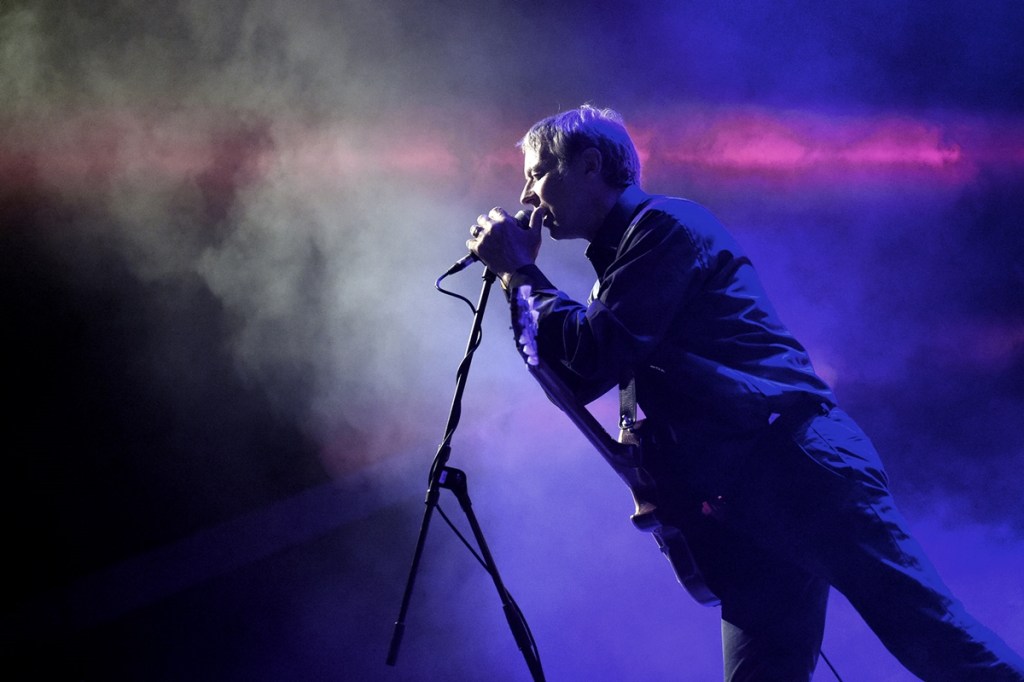
Mic Jogwer of Pink Turns Blue, photo by Daniela Vorndran
Pink Turns Blue is one of the foundational bands of modern darkwave. When the group formed in Berlin, Germany in 1985 its blend of then New Wave and dark, moodier post-punk was in line with the fusion of those elements one heard in The Cure, The Chameleons, Comsat Angels and The Sound. The group’s first two albums If Two Worlds Kiss (1987) and Meta (1988) had a spacious and dusky vibe with undertones of emotional urgency giving expression to the on the brink tensions of that decade when the world seemed in a tenuous and conflicted state. Pink Turns Blue split in 1995 for several years before coming back together in 2003 after the post-punk revival was well under way and ahead of the darkwave resurgence of the 2010s and in some ways benefited from both as a cult band that had influenced connoisseurs of adjacent styles of music. In 2019 respected experimental and more or less darkwave label Dais reissued If Two Worlds Kiss and Meta and introduced a new generation to one of the still extant legends of German post-punk. In 2021 Pink Turns Blue released its latest record TAINTED with its decidedly political content as a critique of a human civilization bringing to bear a completely and utterly inadequate response to anthropogenic climate change and the political and economic systems in place that ensure future destruction to the world we took for granted in a kind of feedback loop of escalating devastation. The future climate scientists have warned about for decades is now here. But it’s not all doom and gloom and the music of Pink Turns Blue isn’t a nihilistic analysis of world events, the new record, as with previous efforts, offers poignant personal portraits of love and loss and the life experiences and connections to others that give our existence its essential meaning beyond our utility in some economic context.
Pink Turns Blue performs at the Hi-Dive on Thursday, September 15, 2002 with Radio Scarlet and Redwing Blackbird (doors 8 p.m.) and ahead of that date we were able to pose some questions to founding vocalist/bassist/synth player Mic Jogwer via email about the band’s origins, background, the content of its music and the challenges of operation as a band from Europe in the USA.
Queen City Sounds: Before forming bands what kinds of things did you see or experience that prompted you to pursue making music? Was Rockpalast a part of your youth in getting exposed to some of the more adventurous music as well as more mainstream faire?
Mic Jogwer: I have to honest and say that my love for music began very early when I was 8 years old. And also that my first heroes were The Rubettes, Sweet, Abba and the likes.
I started with trumpet at 9 and changed to guitar at 12 (Genesis, Pink Floyd), then bass with 14 (Santana). And so on. Blues, Rock and then Punk. It wasn’t before I started Pink Turns Blue when we got compared to The Chameleons and The Sound and we got listen to those bands a lot. On Rockpalast you would not find up to date bands very often. Rather the classics. Still watched and liked it a lot.
QCS: When Pink Turns Blue was starting out in Köln you won an award from WDR. As a fledgling band in what ways do you feel that the German government and local arts groups supported music?
MJ: Definitely not. At that time, if you were a German band you had to sing and sound German. Ideally not too serious. The WDR in Cologne was a rare exemption. The was this one guy who was very much into new music and was excited to find bands that were daring enough to reach an international audience.
QCS: Early in your career you toured with Laibach. How did that come about? How did you smuggle Western studio equipment across the border?
MJ: We were lucky that our label FunFactory! released an Laibach album in Germany and also booked a tour for them. Also, we were lucky that we were the only band in its roster that Laibach were ready to take on tour with them. They didn’t like our name or our appearance but very much loved our music. Also, because were quite intrepid bigmouths they offered to produce our next 3 albums if we smuggled studio gear across the iron curtain. We nearly got caught but were lucky again and they were really impressed and started to like and support us.
QCS: I read Burning Down the Haus by Tim Mohr a few years ago and as you may know it’s an account of the punk and underground music scene in East Berlin. Did you have interactions with and/or were you familiar with artists from that scene in the early days of Pink Turns Blue? If so how did you facilitate perhaps bringing those bands over or play shows there if that was even possible before the fall of the Berlin Wall?
MJ: No, sorry. Until 1989 it was impossible to get in touch with any of this East Germany bands. The first contacts were made in the late 90s. Some of them became famous in different formations (Rammstein) others vanished. And yes, we know some of them but there never was a common scene.
QCS: People who weren’t there might assume you were part of a scene and friendly with the likes of Xmal Deutschland, Malaria! and Einstürzende Neubauten. Did you feel like you had a sense of community with other German bands? How did that look for you in terms of operating and touring and supporting one another? If not, why do you think not?
MJ: We had a strong bond with Einstürzende Neubauten, because they were daring and innovative. We also had a loose relationship to Nick Cave and the Bad Seeds (then living in Hamburg and Berlin) and Gun Club, The Sisters Of Mercy, again because they were based and working in Hamburg and Berlin were spent a lot of our time. The relationship was more like: we are the kids and they were the grown-ups.
QCS: Pink Turns Blue split in about 1995 and reunited in 2003 before the resurgence of a fairly widespread interest in post-punk and “darkwave.” Did the “post-punk revival” of around the turn of the century play a role in helping to relaunch the band?
MJ: The relaunch was more like a short romance with your ex-wife. The post-punk revival brought a lot of fresh and very talented musicians and many of them liked Pink Turns Blue very much. Then we became the “originals” (the old guys), and they were happy to have us around. So we got invited to many festivals and tours where we met quite a few of them and were both impressed and encouraged to write new songs that were our version of the post post-punk.
QCS: Dais Records reissued If Two Worlds Kiss and Meta. How did it come about that you connected with Dais and what ideas were presented to you to approve making those records available again for potential new fans?
MJ: Drab Majesty was supporting us in Barcelona and mentioned that their label surely would be interested in signing us. So we got in touch with Gibby [Miller] and proposed that they released our first two albums as vinyl to support our US tour in 2019. We also planned to co-release TAINTED but Covid and the vinyl production disaster made everything too difficult. Hopefully, when everything kind of has come back to normal we can follow up on this.
QCS: Some people may be surprised by some of the very direct political content of Tainted but that’s been part of your music since early on. But in those lyrics there is both a challenge and a personal touch. Why do you feel it is important to address issues of climate change, inequality, global conflict in terms that seem so immediate and grounded?
MJ: Well, I think that topics like climate change and equality have become a really important issue for everyone. The last 5 years and especially the Covid years have put most of us in a state of disarray. And if you write songs that describe the world as you see and feel it it is only natural that those topics find their way into your songs. I guess – at least for us – those times where you were singing about your first drug experiences and feeling like an outsider as a young white male university student are over. Well, hopefully.
QCS: German artists have had a tough time touring for a variety of reasons. What might be helpful in facilitating this in the future other than imponderables like the world coming to its collective senses and addressing the aforementioned with reason and compassion? Are there practical things that maybe people can do to ease your journey touring North America?
MJ: I guess I have no idea. I guess we Europeans have our own insanity to get on top of. Not a good position to give advice to others. What I find encouraging is that many Americans and Europeans are able to make jokes about themselves. Wish it would be more of them. Still hoping that we all can inspire each other to try harder.








You must be logged in to post a comment.