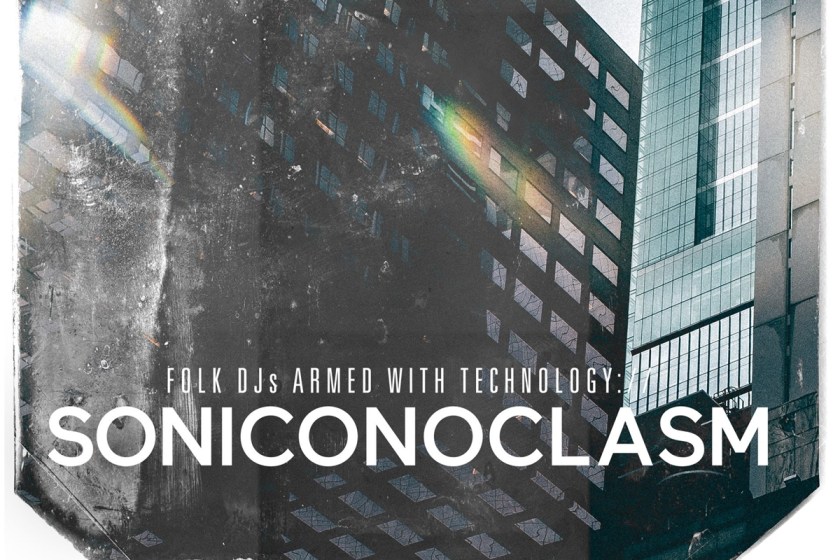
SONICONOCLASM starts off its new single “Dead Air Zone,” the third from its forthcoming album, with sentiments of disassociation and references to different aspects of oneself in the third person and of being a fainting memory, repeated , as though convincing oneself to stay emotionally paralyzed. The vocals at times almost synthesized as befitting the aforementioned but also expressively emotional like the voice resisting the feelings of depersonalization like the side of your brain that isn’t stuck but has empathy for the side that is. Musically its within the realm of downtempo with the beautiful low end tones, brooding pace and sense of echoing space and motion. But it’s sonic lines are a little too clear and stark to be trip-hop. Though moody and brimming with emotional murk there is a clarity of tempo and tonality and even though the song doesn’t come to clean cut conclusions there is a sense that a will to go somewhere out of the mental stasis suggested in the song is very much present and gives the piece its languid momentum. Listen to “Dead Air Zone,” an apt title for a song if ever there was one to suggest a sense of stasis and stark dissatisfaction, on Soundcloud and follow SONICONOCLASM at the links below.
On his new single “Saltwater” Salt Lake City based hip-hop artist Heather Grey recruited Rakaa Iriscience of Dilated peoples to rap and therein there are references to Bob Ross and Skin Walker Ranch in lyrics that sound like musings offered during a stroll through the neighborhood, reflecting on recent journeys to the coast with the concept of salt water as a trigger for memory and reflection, something tangible that can take you out of a moment or transport you to another. The song with its offhand delivery speaks to the things in our everyday lives that keep us inspired and nourish our imaginations. The shifting tones of Heather Grey’s production and Rakaa’s cadence are at times reminiscent of Cannibal Ox but the mood and vibe are hazier and dreamy perhaps hinting at the melding of styles with DJ Juggy throwing some scratching for texture on the edges. West Coast imagery alongside SLC references give the track a unique flavor that is chill but not lacking in a casual swagger. The music video features choice graffiti that seem to obliquely narrate the journey outlined in the song and enhances a sense of complimentary aesthetic between Rakaa’s Los Angeles roots and Heather Grey’s own from the middle of the country. Listen to the song and check out the video on YouTube and follow Heather Grey at the links provided.
“Lil’ Flicker,” the first single from Sinnet’s new EP Tennis Elbow Club is about those flashes in life where you are taken out of the current moment and forget that someone you knew is gone and they remain a presence in your conscious mind. The lyrics of the song describe this experience like a psychological ghost mixed with a yearning of reconnecting. The line “just a break in the nothingness” captures well this desire within us to transcend the strictures of everyday mundane experience and to embrace the kind of nostalgia born of your living memory of someone or something that reminds you that life is more than a mundane ho hum existence. The gorgeous synth melody repeating like a hypnotic metronome of memory trickling in like the gentle pulse and flow of the Aurora Borealis draws you in a rhythm of mind in which you’re able to hold onto those better memories for longer than the fleeting moments captured so well in the song. Listen to “Lil’ Flicker” on Soundcloud and follow Sinnet at the links provided.
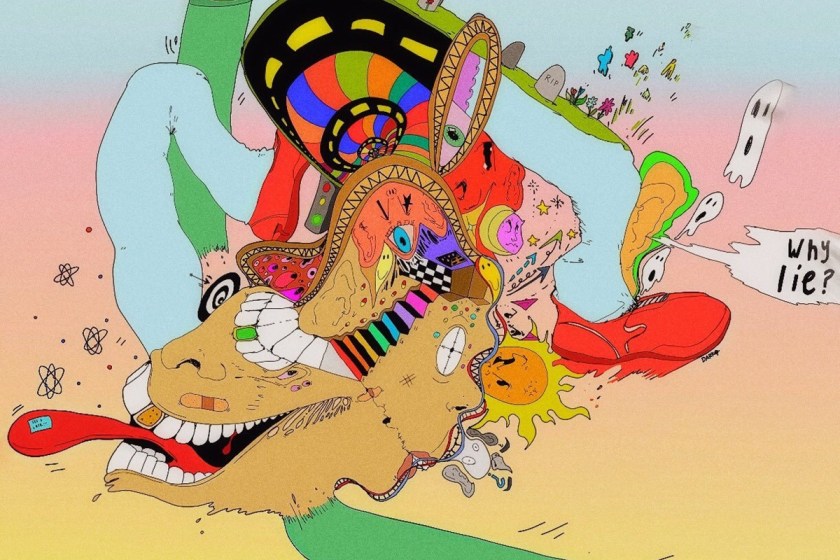
Jai Discord’s track “All4wan” (working with Xamax and produced by and with contributions from BlueBayou) sounds like both a cry for help, a personal exorcism and the utter breakdown of the psyche once you’ve run yourself down through the prison of your own mind after self-medication has long since failed to salve the psychic pain. The vocals strain against the drag of personal darkness in the lyrics and the synth and beats set out a cadence like one might imagine being awake during an alien medical examination wherein even those advanced scientists schooled in more than purely physical medical science hit a conundrum in treatment, the background sounds of their instruments monitoring vitals and brainwaves counting time in tones and texture. The descending bass line mid-song is menacing and in perfect sync with the desperation of the tortured vocals that precede the slow warping that serves as the surreal outro. Fans of Doseone, Busdriver and Clipping. will find much to appreciate about the relentless and creative flow of ideas and sound and the experimental spirit of this song. But the whole of Jai Discord’s new EP Why Lie? Is rife with unusual sounds and wonderfully left field musical ideas, soundscapes and imagery. It’s the kind of record that puts you through some tough headspaces but by evoking them so well and pairing them with imaginative beats that mirror those feelings well you get the sense that no matter how bad a place you’ve been in your mind that you’re definitely not alone in being there and that you too can get through this time with the help of creativity and patience with yourself. Listen to “All4wan” on YouTube and check out the rest of Why Lie? on Spotify.
Charcoal Burners described their new single “Time’s Informers” as “an unlikely marriage of Hüsker Dü and Pet Shop Boys.” Fair enough considering the mix of distorted pop hooks and acerbic wit is actually like a latter day, more slackery “Could You Be The One.” But at times it also oddly reminds one of “Living After Midnight” by Judas Priest in its changes and dynamics. All this combines to make for a song that touches upon familiar places in your brain. But overall its sweet synth sheen and back beat-driven rhythm and introspective yet pointed lyrics delivered in laid back, almost disengaged, fashion give the single fascinating contrasts that add another dynamic dimension to the song but one more emotional than purely sonic. For a band that has a single called “The Verlaines and Hüsker Dü” name-checking its most obvious influences, this song isn’t as crackling with inspired cheek but it is informed by a similarly wonderful sardonic humor. Listen to “Time’s Informers” on Bandcamp and follow New Zeland’s Charcoal Burners at the links provided.
Iñigo Montoya’s animated video for “MDTG” traces the band’s journey since releasing its debut EP in 2015. The triumphs signified by green and frustrations by red. Natural disasters both benefit and throw stumbling blocks. Nuclear waste and warplanes represent the active and passive conflict that plagues everyone’s lives making them more dramatic than need be but also enervating at times that aren’t always obvious. All the while the playful yet sometimes frantic melody and almost sing-song-y vocals give the surreal imagery their emotional context as an expression of perversity of our lives in the developed world as we are encouraged to indulge our whims even in the face of impending global disaster. Follow Iñigo Montoya at the links below.
Fatima Al Qadiri Atlantics soundtrack cover (cropped)
Senegal born, Kuwaiti raised composer Fatima Al Qadiri brings the gravity of her experience with war and post-colonial history to her darkly evocative soundtrack for the critically acclaimed 2019 movie Atlantics. The movie, marking the directorial debut of Mati Diop, is the story of a woman in a suburb of Dakar, Senegal who falls in love with one of the construction workers that have been building a futuristic-looking tower although she is betrothed to another man. The track “Boys in the Mirror” is imbued with that sense of melancholic longing, conflicted emotions and portents of tragic endings. The linger keyboard melody is reminiscent of Eduard Artemiev’s beautifully brooding and desolate work for Andrei Tarkovsky’s Solaris (1972) and Stalker (1979). The depth of tone, the suggestion of texture and an organic flow that courses through your mind, haunting it long after. Listen to “Boys in the Mirror” on YouTube, stream Atlantics on Netflix from November 29 onward and follow Al Qadiri at the links provided.
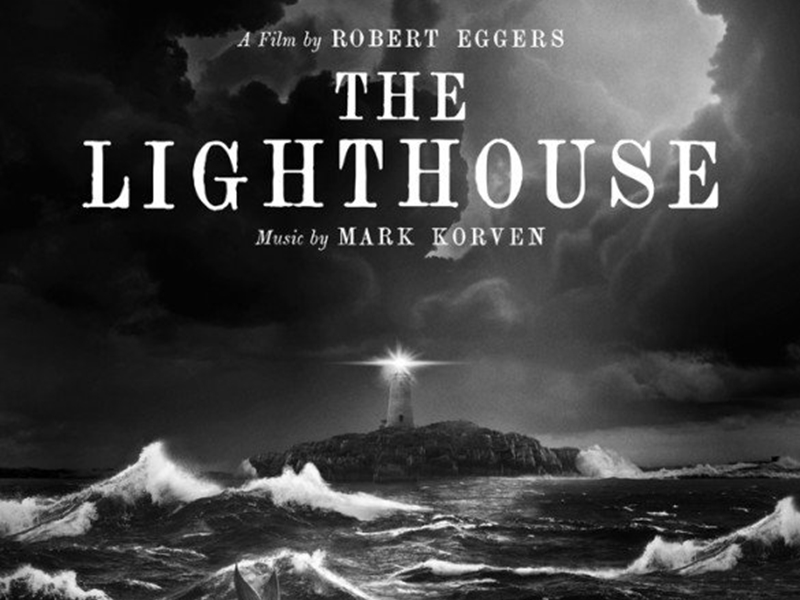
Mark Korven The Lighthouse soundtrack cover (cropped)
Mark Korven’s score for the 2019 supernatural horror film The Lighthouse is well represented by the track “Stranded.” The swell of menacing horns like a sudden stormy wind giving way to a tense calm only for the horns to weft their way into the sonic frame again with portents of cosmic horror on the horizon. Director Robert Eggers worked with Korven for his chilling and moody score for Eggers’ previous horror masterpiece, 2015’s The Witch, and brings a similar sensibility employing textures and interweaving, dynamic layers of brass instruments to give voice to the forces of darkness waiting outside normal space to drive humans mad and feed on their fear. Like his work for The Witch, Korven’s composition on “Stranded” gets under your skin with its deeply unsettling moods by masterful use of tone, texture and dynamics. Listen to “Stranded” on YouTube and follow Korven on Twitter.
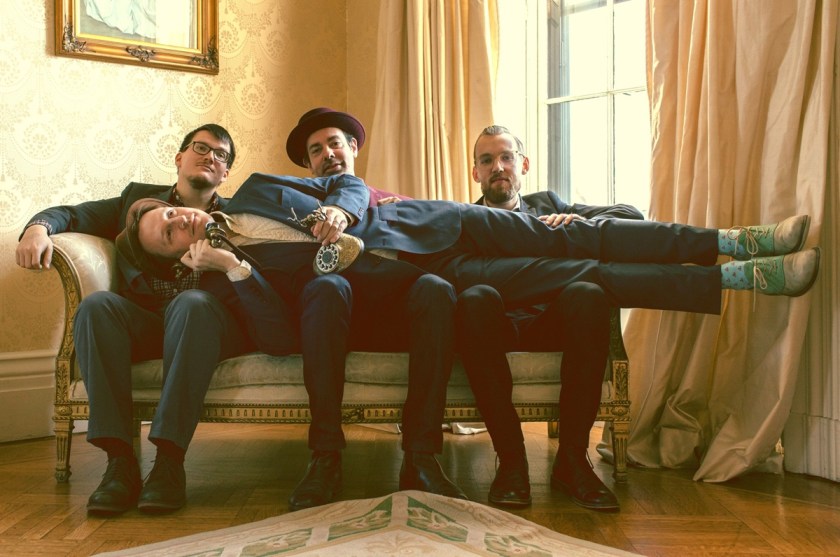
The music video for ARCHE’s single “Back to the Sun” suggests a certain disregard for conventional style and in subtle ways a willingness to look silly and absurd. Like when one of the members of the band looks into the camera nonchalantly as a shower rains down on him in the background. Musically it’s a bit like if Duran Duran had come up in the period after chillwave and summery post-punk like Beach Fossils happened. Glistening synth melodies and swirl around as you see the guys wearing terrible sandals, intentionally mis-matching outfits and a mix of personal styles that a conventional manager trying to guide a band to commercial success would advise against. But it works so well for the song and speaks to a wonderfully carefree spirit in the music itself. It is a level of self-awareness that embraces ones imperfections in a real attitude of not caring about superficial nonsense when its the transporting emotional quality of the music that matters. A lot of videos where bands are looking like they’re relaxing and having fun it looks like they’re also trying too hard. ARCHE is having none of that try harditude. The subtext of the video and the song is be yourself especially when no one is watching. Check out the video on YouTube and follow the band at the links below.
Kyle Emerson just released his second album as a solo artist, the introspective and thought-provoking Only Coming Down. The songwriter recently relocated back to Los Angeles in August 2019 after a stint back in Denver where he originally came to the attention of fans of psychedelic pop during his stint in the band Plum. For a couple of years, the latter was a bit of a buzz band before it realized that maybe Denver wasn’t the best place to base a band that seemed to have the opportunity expand its reach beyond the local scene, beyond being nominated for local awards and playing the same gauntlet of small clubs and occasionally playing bigger venues like the 550 capacity Bluebird Theater or graduate in draw and popularity to the Gothic Theatre at 1,100. Plum moved to Los Angeles in 2016 and within about a year Emerson had left the band and not long after Plum fizzled out. For some that would have been discouragement enough but not for Emerson who had already relocated once to pursue his dream of being a musician with a career.
Emerson was born in Northern Ohio not far south of Detroit where his father was a worship leader at a non-denominational church. While involved in a worship band Emerson learned some music theory from the group’s leader who also shared his love of Radiohead, indie rock and later era alternative music. Emerson also connected with and studied guitar under a music teacher of a local private school, Patrick Paringer, who had grown up in Seattle and known Elliott Smith. At that time Emerson the current bassist in his live band Dan Volmer who also played in the youth group band.
After high school a number of Emerson’s friends moved to Colorado and Brooklyn. Those that moved to the latter offered to let him join their band and sleep on their couch until he got on his feet. But life in NYC was daunting and Emerson didn’t feel like he was ready to live in the city on his own.
Colorado beckoned in 2014 and before moving to Denver Emerson was blithely unaware of happenings in the state and city. He did not know about the legalization of recreational cannabis or that the city was experiencing its largest and longest period of population growth in many years with many musicians moving to Denver seeking out the opportunity for perceived overnight success of acts like The Lumineers and The Fray or at least to be in a place where music was happening and the scene not yet oversaturated. Emerson’s friend Andrew Bair (now of dream pop phenoms Tyto Alba and other projects), son of the pastor of Emerson’s church in Ohio, had moved to Denver and he felt like with Bair and other friends around he could keep his footing in a less expensive city than New York. So he moved into a two bedroom apartment at Thirteenth Avenue and Marion St. near the former location of the Gypsy House Café and shared a room with Volmer for a few months before moving in with the guys from Plum in the Villa Park neighborhood of west central Denver.
The fledgling band had a lot going for it aside from musical and songwriting talent. Ty Baron was a music business major and did some talent buying at Larimer Lounge, a club where many up and coming acts perform weekly, and Jake Supple had been also playing in Abandin Pictures, a group with some cachet in the local psychedelic rock world (he now performs in Flaural). Both had navigated the local music world both as artists and on the less romantic business end of what it actually means to be in a band that might want to do more than play for a few dollars and free drinks.
But like a lot of bands Plum ran into that often unspoken barrier to a lot of bands from Denver and Colorado generally that prevents most from reaching beyond the local band status. Sure, there are anomalies like the aforementioned Lumineers, The Fray and Nathaniel Rateliff and the Night Sweats and on a smaller scale, Tennis. But outside of jam bands and the EDM world, not a lot of in between being bonafide famous and “local band” status regardless of one’s artistic merits. So even though the move and living in cramped quarters in what was essentially a practice space in L.A. lead to the band breaking up, the decision to relocate was understandable. When you have some hype at home it stands to reason you can build that elsewhere, especially when you’re young.
When Emerson left Plum in 2016 he moved back to Denver where he had some roots and connections and wrote and recorded his moving debut solo album, 2017’s Dorothy Alice. It combined Emerson’s insightful lyrics and storytelling with a folky psychedelia and almost textural atmospheric melodies. The sound has become a bit of the songwriter’s signature sound. Emerson had recently split with his then girlfriend and on top of the other experiences it’s no wonder there is more than a bit of a melancholic vibe to Dorothy Alice that is part of its deep appeal. But recorded with Jeff Cormack of pop band South of France and Justin Renaud of psychedelic rock outfit Sunboy the record reflects Emerson’s renewed hope for his music and his affection for the Mile High City.
“It felt very Denver, very Colorado and it felt great to be back,” says Emerson. “I was living back in that old house where Plum was living. It was like picking up where I had left off in a weird way.”
Emerson didn’t waste any time in writing for his sophomore record nor did he intend for it to come across like a journal entry of the last few years as he moved from Denver to Los Angeles, then repeating that same move and the experiences that framed those moves but it does. In writing the new material Emerson had no working title, which he feels might influence the sound of a record and songs chosen for better or worse, it just came to him one day. “You talk about the come down from anything, a natural high or drugs or alcohol or whatever,” says Emerson. “The more I conceptualize it I don’t know if it gets cooler or more lame but I just think there’s something about if you’re only ever coming down then there was no high on the other side of it.”
Emerson also suffered from a bit of Obsessive Compulsive Disorder as a kid and the acronym has the same letters as Only Coming Down. It reflects the fact that Emerson feels that music was the only thing that got him out of that head space of focusing so much on minutiae to the detriment of a productive life. Now in the process of writing his third record Emerson realized that he had to grow up.
“It’s not a conscious thing for a lot of people and you dabble in things you know you need to move on from,” explains Emerson. “The last two records are about the woes of growing into yourself. You’re always growing up your entire life. It’s not like you get to a certain place and you’ve arrived. There was something about putting a bookend on a lot of the themes I was writing about and the things I was feeling. The title summarized that feeling in so many ways with just three words.”
The heaviness that many listeners heard on Dorothy Alice is still there on Only Coming Down but the early feedback has remarked on it being upbeat. Whether it’s Emerson’s recent decision to use more electronics on the new record since discarding a purist’s disdain for technology or the more than a hint of hope in his songs that often contrast hope and despair, or the songwriter’s compassionate take on his role as a musician, the new album definitely tilts toward the positive.
“I don’t play party music, it’s not like that,” says Emerson. “But it’s like I stand in front of a room full of people who at the end of the day are just there to have a good time and as artistic as this can get and as some songwriters and musicians think they are I do believe in the power of positivity. I didn’t think about that so much when I was younger but now if you can say yeah this sucks but I’m here for you, it’s going to get better. I think that’s more worthwhile to say than it’s all shit and then we die. I think there’s power and reality in both of those, I just find it a little bit easier living in the first one a little easier.”
Catch Emerson live during his run of shows in Colorado with Houndmouth:





 Queen City Sounds and Art
You must be logged in to post a comment.